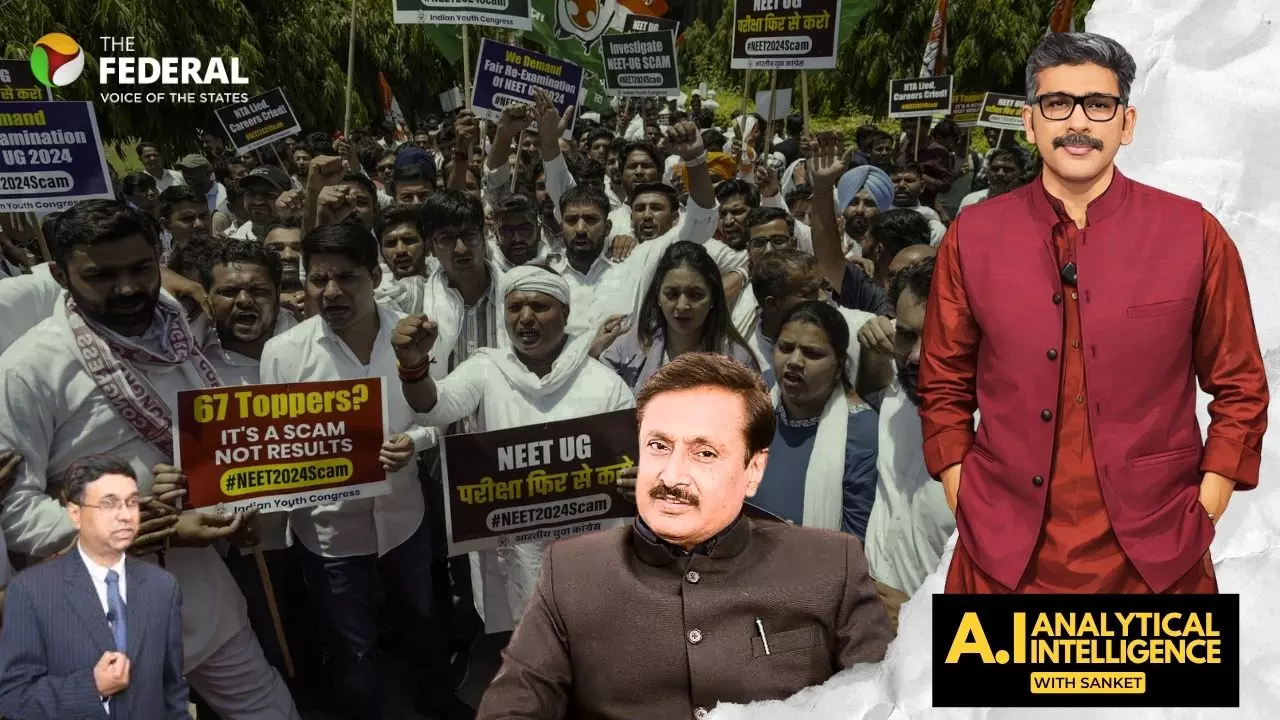
NEET exam: What experts think is the best solution to fix it | AI With Sanket
From a traumatised aspirant to seasoned educationists, a panel tells why NTA keeps failing India's 24 lakh medical hopefuls — and what must change

Days after the NEET UG 2026 exam was cancelled following a large-scale paper leak, Keshav Agarwal, vice president of the Coaching Federation of India warned, "The paper leak mafia has started networking again." For millions of aspirants, this was not a headline — it was a recurring nightmare.
The cancellation and the announcement of a re-examination on June 21 have done little to restore faith in the National Testing Agency (NTA), the body entrusted with conducting one of the country's most consequential tests. The Federal spoke to Keshav Agarwal, vice president, Coaching Federation of India; Prof. Chandra Bhushan Sharma, Vice Chancellor, Vinoba Bhave University, Hazaribag; and Shivam Tiwari, a NEET 2026 aspirant, to understand why this cycle persists — and what it will take to break it.
A student's trauma
Shivam Tiwari had barely exhaled after writing the exam on May 3 when the rumours began. "I thought, like 2024, people are just saying this as a meme. But then it came on the news — the paper had leaked on a very big scale," he said. What followed was, in his own words, "a sudden trauma." Two years of preparation appeared to have been rendered meaningless overnight.
Also read: NEET-UG 2026 exam to be re-conducted on June 21, says NTA
When the full cancellation was announced, Shivam found himself pulling his books out again, unable to process what had happened. "Two years of studying — now I have to start again. It took two or three days just to understand what to do next," he said.
His story is far from unique. Over 24 lakh students appeared for NEET UG 2026, each carrying years of preparation, financial sacrifice, and parental expectation into a single exam — an exam that has now been cancelled or compromised in 2021, 2024, 2025, and 2026.
'June 21 is a challenge, not a solution'
Keshav Agarwal was blunt about the re-examination scheduled for June 21, which coincides with International Yoga Day. "June 21 is a reaction to this leak. It is not a long-term solution," he said. "The students have been cheated. May 4th, the student said they woke up thinking the big day was finally over — just to wake up again and find that nothing had ended."
He pointed out that troubling signals had already begun to emerge even before the retest. "The messages have started again — 'paper chahiye' (want paper) — the paper leak mafia has started networking," he said. "Now there are more doubts than trust. People are calling NTA the 'National Thug Agency', the 'National Trauma Agency'."
Also read: NEET-UG 2026: How NTA, the agency built to fix exams, kept breaking them
Prof. Sharma, who previously served as Chairman of the National Institute of Open Schooling (NIOS) — the country's largest testing body — was equally unsparing. The re-examination, he argued, is a crisis management measure, not a structural fix. "You have not been serious about it," he said, noting that NEET has been compromised repeatedly across years. He revealed that evidence now suggests the 2025 paper was also leaked by the same network, meaning not one but multiple examination cycles have been tainted.
Root cause: wrong people in charge
Both Agarwal and Prof. Sharma converged on a central diagnosis — the NTA is led by the wrong people. "You appoint someone just one month before, with an AI background, and this exam has nothing to do with AI and technology," said Agarwal, referring to recent leadership changes at the agency.
Prof. Sharma was even more direct. "You have a Director General of NTA who is not an academic, who doesn't understand assessment. You make one IAS officer after another the head of NTA. It is not a bureaucratic job — it is a technical job," he said.
Drawing on his own experience conducting examinations nationally, he recalled how he had cancelled all examination centres in a problematic belt spanning parts of Rajasthan and Haryana when he headed NIOS, because the mafia there could not be controlled despite police protection. He asked pointedly: "Why is it that the NTA doesn't know which are the problematic areas of the nation?"
Also read: NEET UG 2026 cancellation: Of shattered dreams and burned-out lives of aspirants
He cited the example of the Prime Minister himself acknowledging in Parliament that generalist bureaucrats cannot be expected to manage specialised domains competently. "When he created the Ayush Ministry, he decided to have an Ayurveda expert as secretary. Look at the performance of the science and technology ministry, which has a non-IAS secretary. This body is not an academic body — it is a bureaucratic body," Prof. Sharma said.
The leak chain
Agarwal described, in precise terms, where the leak happens. "NTA runs on a contractual basis — the typist is from outside, the paper setter is from outside, the printer is from outside. So of course the paper will go from inside to outside when there are so many loopholes," he said.
He also pointed out an uncomfortable contrast: IIT-JEE and UPSC papers rarely leak. "Why can't the coaching mafia or paper mafia leak those? There is some problem here — why is it so easy to leak NEET?"
Prof. Sharma offered a partial answer, recalling a 2006 incident in Mumbai where a medical entrance paper leaked at the printing stage. He credited CBSE's then-Controller of Examinations Sanyam Bhardwaj with resolving the crisis within a week. "You have people, you have systems that can conduct exams. You are not serious about using them," he said.
Online exams: hope or hype?
The government has announced that NEET will shift to Computer-Based Testing (CBT) from 2027. Shivam welcomed the idea. "The chances of a paper leak would be reduced. And in a CBT, even if you mark an answer wrong, you can switch it — unlike OMR sheets where a mistake under time pressure costs you marks," he said.
Also read: NEET-UG 2026 paper leak: Will conducting exam online solve problem?
But Agarwal was cautious. "Our country still doesn't have the connectivity everywhere to make this glitch-free. Hackers outside can just hack your system. An invigilator may not even notice a student scrolling and having the paper taken by someone else," he warned. "24 lakh students cannot be conducted in one day online — you will need 15 to 20 days."
Prof. Sharma agreed that India must eventually go fully online, but argued the infrastructure is not yet ready. He cited his own experience with on-demand exams at NIOS, where papers were released one hour in advance at only 65 centres — and some still could not access them due to power and network failures.
Agarwal's 'Big Boss house' proposal
Agarwal offered what he called a "foolproof solution" to the leak problem. He proposed that paper setters be locked in a secure, fully monitored facility — with no contact with the outside world — for 15 days before the examination. The paper would be printed only at examination centres, on the day of the exam, one hour before students begin writing.
Also read: NEET scam: Bihar gang busted, expert calls for online exam | Interview
"The people making the paper are still inside. Nobody went out. The paper is made one to one-and-a-half hours before. Students are inside the exam hall. A leak, if it happens — where will it go? Who will use it?" he argued. "The leak happens at printing and transport. Here, you minimise both."
Increase seats, reduce pressure
The panellists also agreed on a structural solution that goes beyond exam mechanics: India must dramatically increase the number of government medical seats. "The root cause of this leak is 60,000 government seats and 24 lakh students," said Agarwal. "CLAT and other exams don't get leaked. The problem is here because the stakes are so high. In eight years, not a single seat was added."
Also read: How Rajasthan's Sikar became ground zero of the NEET 2026 scandal
Prof. Sharma proposed additional reforms — limiting the number of NEET attempts (as IIT-JEE does), introducing a two-stage test of screening followed by a main examination, and setting an upper age limit for candidates. "You would not want a 52-year-old to go to medical college. Why do you have no upper age limit? IAS has one. Why not medical?" he asked.
Shivam's hope
Asked for his final thoughts, Shivam was measured but hopeful. "If all the points said by both these personalities are considered by the NTA, then of course it will give confidence to the aspirants. At least I will know that the exam I am giving is 100 per cent honest, and the result everyone gets is from their own hard work — not from money spent to buy a paper."
As India watches June 21, the question is not just whether the exam will be held without a leak. The question is whether the institutions responsible for protecting the dreams of millions of young Indians will finally decide to be held accountable.The content above has been transcribed from video using a fine-tuned AI model. To ensure accuracy, quality, and editorial integrity, we employ a Human-In-The-Loop (HITL) process. While AI assists in creating the initial draft, our experienced editorial team carefully reviews, edits, and refines the content before publication. At The Federal, we combine the efficiency of AI with the expertise of human editors to deliver reliable and insightful journalism.