NEET scam: Bihar gang busted, expert calls for online exam | Interview
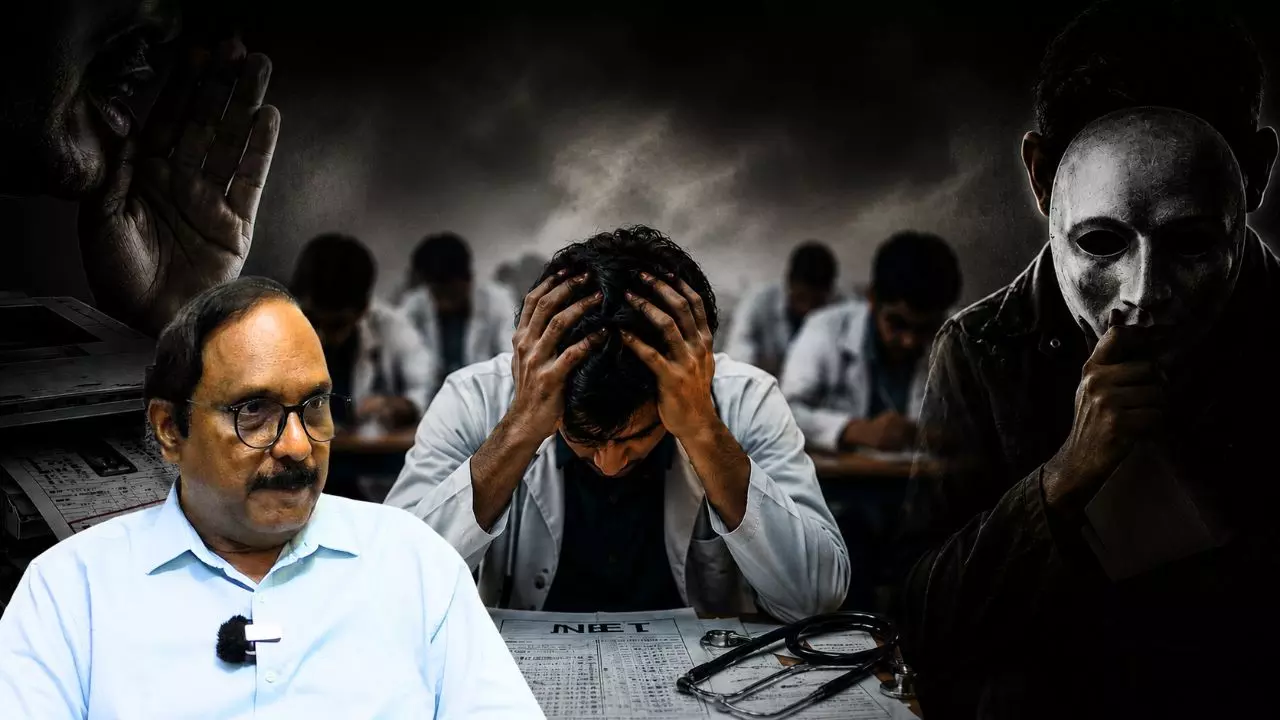
Dr. Ravindranath, who was a member of the AK Rajan Committee that studied the impact and discrepancies of NEET, calls for states to be allowed to ban NEET or get an exemption from it for state government-controlled seats

A major NEET-related scam has been busted in Bihar’s Nalanda district, where police uncovered an alleged 'NEET solvers' gang involved in proxy candidates, paper leaks, and forgery.
In this interview with The Federal, activist Dr. GR Ravindranath, general secretary of an organisation called Doctors' Association for Social Equity (DASE), speaks about recurring scams in competitive examinations across India, from NEET and TNPSC to even civil services exams.
Also read: NEET-UG 2026 paper leak: Will conducting exam online solve problem?
Dr. Ravindranath, who was a member of the A K Rajan Committee that studied the impact and discrepancies of NEET, stresses the need for strict punishment for culprits and suggests moving NEET-UG to a fully computer-based online examination system to prevent future malpractices.
The Bihar Police have exposed a NEET “solvers gang” involved in paper leaks and proxy candidates. How serious is this issue?
These types of scams are taking place in various examinations, not only NEET. In state-level TNPSC examinations also, it is taking place. In various states and various examinations, it is taking place. Even in civil services examinations, it has happened.
During the UPSC examination, IPS officers were also involved in scams. So we have to see it in that broader perspective. But the culprits should be punished severely. These problems should not recur in future. So we have to take remedial measures. That is very important.
The government can take a lot of remedial measures in NEET-UG. They are conducting the examination on pen and paper. We can change it to an online, computer-based examination. It will help solve the problem.
Also read: How Rajasthan's Sikar became ground zero of the NEET 2026 scandal
Why do discrepancies repeatedly surface in NEET-UG, while NEET-PG appears relatively more controlled?
In NEET-PG also, it has happened earlier. But now they have changed to online examinations. Even in online examinations, irregularities can happen, but they have been controlled and curtailed to an extent.
The Radhakrishnan Committee was formed to solve the problems in various national-level examinations and to rectify these issues. They have given many suggestions. Our association has also submitted recommendations to the Central government and the National Testing Agency (NTA). Those recommendations should be implemented. Through that, we can reduce the problems.
Wherever examinations are conducted across various streams, there are possibilities of scams. There have been many reports earlier too. Seats are limited and the number of competing students is very high. Naturally, scandals take place through different methods.
Also read: NEET UG 2026 cancellation: Of shattered dreams and burned-out lives of aspirants
How badly do such controversies affect students appearing for NEET?
Not only are their chances, but students are also physically and mentally fatigued. They travel long distances to examination centres — sometimes 100 km or 200 km, even within their own state.
They travel with parents, arrange accommodation, food, transport and book tickets. Some students attend examinations in other states also. They have to travel very long distances.
Now, if they have to write the examination again, they will face all those troubles again. It creates enormous mental pressure and physical strain. We have to keep all these problems in mind.
Do repeated controversies strengthen Tamil Nadu’s demand to ban NEET?
States should be allowed to ban NEET or get an exemption from it for state government-controlled seats. For that, the Central government should amend the National Medical Commission Act, 2019.
The Act can be amended to allow states willing to opt out of NEET to get an exemption. Other states seeking exemption should also be allowed to do so.
However, some form of national entrance examination should continue for AIIMS, JIPMER, All India Quota seats, Armed Forces Medical College seats and students living abroad, including NRI students.
We cannot admit students to AIIMS or JIPMER based only on Plus Two marks because every state follows different patterns of assessment. Maintaining a common merit list would become difficult.
So there must be one entrance examination at the national level for those seats, whether it is called NEET or by some other name. But that examination should be conducted properly.
What are your concerns about private medical colleges and counselling processes?
In the name of decentralisation, we cannot allow private medical colleges and deemed universities to conduct their own entrance examinations and admit students independently.
Through NEET admissions, students are admitted based on marks and ranks. Private medical colleges and deemed universities cannot admit students directly.
But during mop-up counselling and stray vacancy counselling, private institutions get opportunities to admit students by collecting large amounts of money through various methods.
We are demanding that mop-up counselling and stray counselling should not be allowed. All seats should be filled entirely through government authorities.
For Central government-controlled seats, the Central government should complete admissions till the last seat. Similarly, state authorities should fill all state-controlled seats till the final seat. That is how we can prevent malpractice.
You were part of the AK Rajan Committee. Were any of its recommendations implemented?
Not yet. The AK Rajan Committee recommendations have not been implemented because implementation depends on the Central government.
The main recommendation was that Tamil Nadu should be exempted from NEET for state government-controlled seats. For implementing that, the Central government should amend the National Medical Commission Act.
Otherwise, the President should give assent to the Bill passed by the Tamil Nadu Assembly seeking exemption from NEET for undergraduate admissions in state-controlled seats.
Has the Bihar exposé once again strengthened the anti-NEET voice in Tamil Nadu?
A comprehensive solution is needed because medical seats are inadequate while more students are coming forward to study medicine.
We must increase medical seats. At the same time, states’ rights should be protected. For state government-controlled seats, admissions should be handled only by state governments.
Whether admissions are based on state entrance examinations, Plus Two marks, or a combination of both should be decided by the states. The Central government should allow that.
For central government-controlled seats like AIIMS, JIPMER, All India Quota and Armed Forces Medical College, the Central government should conduct a national entrance examination and manage admissions through a central authority.
So the issue should be divided into state and central components. State governments should control admissions to their seats, while the Centre should manage central institutions.
Do you think NEET is pushing Indian students to pursue medical education abroad?
NEET is one issue, but it is not the only issue. Students can go abroad after merely qualifying NEET. The bigger question is why they are going abroad.
India does not have enough medical seats. Nearly half the seats are in private medical colleges. Middle-class and poor students cannot afford those institutions because of the fee structure.
That is why students go abroad. Even after paying for travel and living expenses in another country, the cost is often lower than studying in a private medical college in India.
The National Medical Commission allows fee regulation for only 50 per cent of seats in private colleges. The remaining 50 per cent can have fees fixed by private institutions themselves. Fees have increased significantly, and that creates major problems for students.
What is the solution to the shortage of affordable medical education?
The government should start more medical colleges in the government sector. But what is happening now is that many states are handing district headquarters hospitals to private operators and starting medical colleges through the PPP model.
These colleges charge high fees. Poor students cannot study in PPP model medical colleges. So they either go abroad, abandon medical education, or suffer mentally. Some even commit suicide.
The government should not start the PPP model medical colleges. It should not hand district headquarters hospitals to private players.
Instead, governments should establish medical colleges directly in government district headquarters hospitals. Then, poor students can also study medicine in India.
(The content above has been transcribed from video using a fine-tuned AI model. To ensure accuracy, quality, and editorial integrity, we employ a Human-In-The-Loop (HITL) process. While AI assists in creating the initial draft, our experienced editorial team carefully reviews, edits, and refines the content before publication. At The Federal, we combine the efficiency of AI with the expertise of human editors to deliver reliable and insightful journalism.)