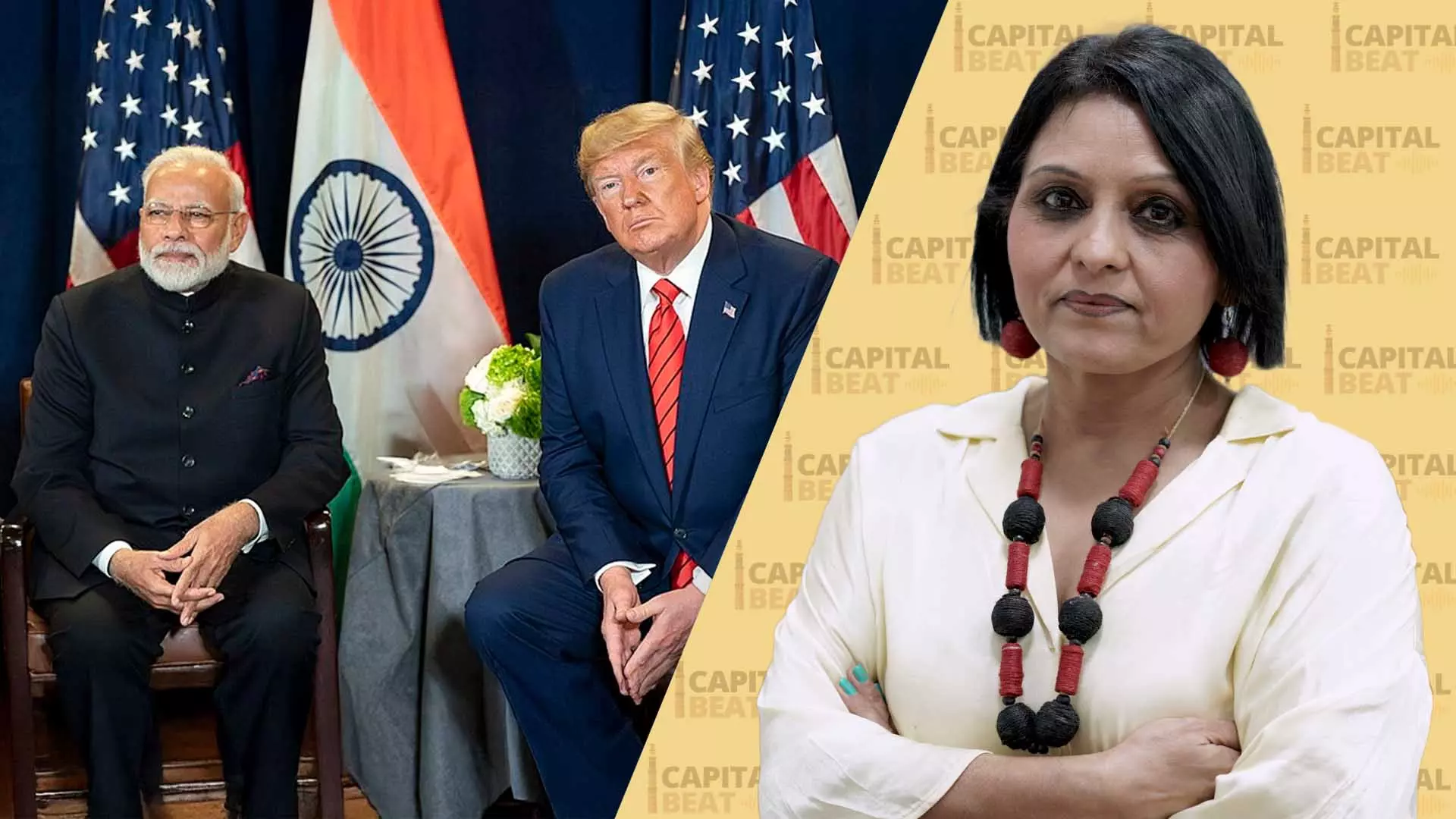
Modi-Trump call: Friendly talk or strategic alarm? | Capital Beat
Modi and Trump speak again as US tariffs bite Indian exports and a senior US trade official visits Delhi. It also comes just days after Russian President Vladimir Putin visited India. Is trade pressure merging with geopolitics?

The Capital Beat episode on Friday (December 12) examined Prime Minister Narendra Modi’s latest phone call with US President Donald Trump amid escalating trade tensions and strategic pressure on India.
Veteran journalist Sanjay Kapoor and international affairs expert Aftab Kamal Pasha discussed the implications of the call, the continued 50 per cent US tariffs on Indian exports, and the presence of US Deputy Trade Representative Rick Switzer in New Delhi.
The discussion focused on whether the outreach reflected routine diplomacy or mounting pressure on India over trade, defence ties, and energy imports from Russia. The panellists assessed statements issued by the Indian prime minister, the absence of a detailed US readout, and the broader geopolitical context shaping India-US relations.
Also read: PM Modi, US President Trump hold talks on trade, tech, defence
On Thursday, Prime Minister Modi stated on X that he had spoken with President Trump and that both leaders reviewed bilateral relations and discussed regional and international developments. Modi described the conversation as “warm and engaging”. This was the third phone call between the two leaders since the US raised tariffs on Indian imports to as high as 50 per cent.
No US statement
The phone call came as India sought relief from US tariffs affecting exports such as textiles, chemicals, and food items, including shrimp. Kapoor pointed to the lack of a detailed response from Washington as a significant detail.
“There’s been a phone call between the two leaders and the fact of the matter is that nobody is owning up except the prime minister from India,” Kapoor said. He noted that while agency reports indicated White House confirmation of the call, there was no formal statement outlining the discussion.
Also read: Trump warns Russia-Ukraine war could trigger World War III
Kapoor said this was unusual given the US president’s tendency to publicise conversations with foreign leaders. “There is normally far greater engagement from the White House whenever the president speaks with a head of state and this time around there has been nothing,” he said.
He questioned what issues were discussed under the rubric of bilateral relations and whether strategic concerns involving Pakistan, advanced technology transfers, and regional security were raised during the call.
Switzer’s Delhi visit and trade pressure
The episode also examined the visit of Switzer to New Delhi. The visit coincided with ongoing trade negotiations and tensions over India’s economic and strategic choices.
Also read: Modi-Putin photo sparks debate in US Congress as Democrats slam Trump
Kapoor referred to statements by India’s Commerce Minister Piyush Goyal indicating that the visit was a courtesy call rather than a negotiating session. “These people were here only for a courtesy visit. There were no negotiations, no discussions,” Kapoor said, citing official remarks.
He underlined that a gap remained between what India sought and what the US was willing to offer. “Surely there is a gap between what India wants and what the US is willing to give,” Kapoor said, linking this gap to stalled trade negotiations.
The discussion referenced commentary describing Switzer’s visit as a strategic signal rather than routine diplomacy, though panellists confined their remarks to what was visible through official actions and statements.
India, Russia, and strategic alignment
Kapoor rejected the suggestion that India was decisively drifting towards Russia, arguing that key defence and energy commitments had not materialised. “India hasn’t really bought Sukhoi, India hasn’t really bought much of the military hardware,” he said, listing systems and deals that had not moved forward.
Also read: What is 'Trump’s Gold Card visa' – the new US visa scheme for skilled migrants?
He added that despite assurances from Russia about uninterrupted oil supplies, no major long-term oil deal had been concluded. “There’s been no signing of the oil deal also,” Kapoor said.
Kapoor emphasised that India had shown openness to US offers on oil and defence equipment, while expressing concern about US military and financial support to Pakistan. He pointed to upgrades of F-16 aircraft, IMF assistance, and mineral exploration contracts as developments affecting regional balance.
“These are very disturbing signals,” Kapoor said, adding that India would raise such issues in any substantive bilateral engagement.
Reading the timing of the Modi–Trump call
Pasha focused on the timing of the phone call rather than its origin. He said relations between Modi and Trump had deteriorated over recent months, marked by the absence of bilateral meetings at major international forums.
“After February, there is no one-to-one meeting either at the G7 or the ASEAN or G20,” Pasha said. He referred to an invitation extended to Modi during the G7 period and explained why it was not taken up.
Pasha said US pressure on India had intensified following public commitments to expand bilateral trade. “There was no need to make such a bombastic statement,” he said, referring to targets to raise trade volumes from USD 170 billion to USD 500 billion.
He said the US demands focused on market access for agricultural and dairy products, weapons, oil, and gas. “America wants India to buy agricultural products, dairy products, GI products,” Pasha said, warning that such access could severely affect Indian farmers and the dairy sector.
Trade talks and arm-twisting allegations
Pasha said trade negotiations collapsed when India resisted opening its agricultural markets and declined to acknowledge claims of US mediation in India-Pakistan issues. He described the current phase as renewed pressure rather than genuine negotiation.
“This is nothing but arm-twisting,” Pasha said, referring to Switzer’s visit. He listed a series of pressures, including tariffs, visa restrictions, and actions affecting Indian business interests.
Pasha argued that the US administration believed India lacked viable alternatives. “They know that Modi has no immediate options other than to give in to American bullying on tariffs,” he said.
He also referred to US engagement with Pakistan, including military support and diplomatic backing, as part of a broader pressure strategy affecting India’s security environment.
Tariffs as a coercive tool
Returning to the discussion, Kapoor addressed whether tariffs were being used as leverage rather than a trade instrument. He cited public statements indicating that bureaucratic negotiations would not resolve differences without direct leadership engagement.
“The agreement will not take place because of tariffs or because of this,” Kapoor said, recalling remarks attributed to Commerce Minister Goyal. He said meaningful progress would require direct talks between the two leaders.
Kapoor compared the situation to stalled India-China border talks, stating that lower-level negotiations had produced little movement without top-level intervention.
He maintained that tariffs were a means to compel concessions rather than address trade imbalances. “Tariff is a way to arm-twist India into submitting,” Kapoor said.
Messaging and domestic perception
Kapoor also examined the tone of Prime Minister Modi’s public messaging after the call. He noted that describing the conversation as warm and engaging served multiple audiences.
“The tone and tenor of Prime Minister Modi’s message looked like a very happy message,” Kapoor said. He questioned whether this reflected actual cordiality or an attempt to project stability.
Kapoor suggested the messaging reassured domestic audiences and Indian constituencies in the US that relations remained on track, despite unresolved issues.
“Everything is on course, everything is happening fine and it will all be sorted out,” Kapoor said, summarising the implied message, while adding that outcomes remained uncertain.
Russia, BRICS, and global scrutiny
In the final segment, Pasha addressed how Russia and BRICS partners might view US outreach to India. He said global actors were closely observing India’s responses.
“Putin and the Chinese leaders, BRICS, all of them are watching very closely how Modi is going to react,” Pasha said. He noted that Russia had made several offers, including defence systems and energy supplies.
Pasha argued that India faced a complex balancing act between maintaining ties with the US and managing relationships with Russia, China, and BRICS partners. He warned that sustained pressure could continue if India did not accommodate US demands.
“The pressure, relentless pressure, will continue,” Pasha said, linking external pressure to broader regional developments.
(The content above has been transcribed from video using a fine-tuned AI model. To ensure accuracy, quality, and editorial integrity, we employ a Human-In-The-Loop (HITL) process. While AI assists in creating the initial draft, our experienced editorial team carefully reviews, edits, and refines the content before publication. At The Federal, we combine the efficiency of AI with the expertise of human editors to deliver reliable and insightful journalism.)