



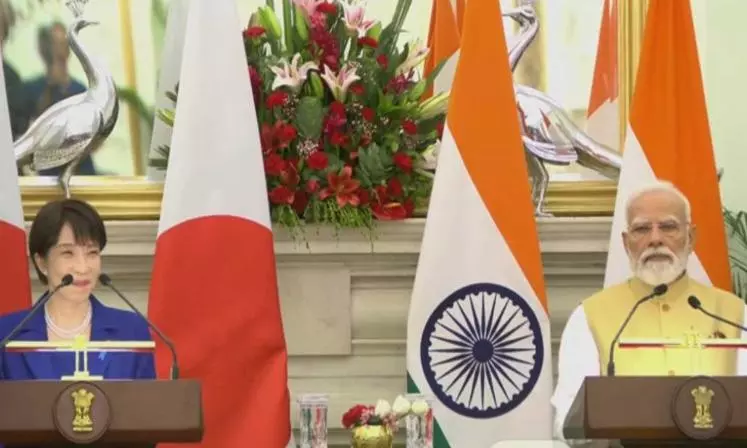
The development comes amid China’s increasingly assertive posture in the South China Sea. Screengrab: ANI
Modi, Japan PM reaffirm rules-based Indo-Pacific amid China concerns
The two leaders announced stronger defence ties, a new joint exercise and closer strategic cooperation as regional security challenges grow

The issue of a “rule-based Indo-Pacific” became a key point during the joint press briefing by Prime Minister Narendra Modi and his visiting Japanese counterpart, Sanae Takaichi, on Thursday (July 2). Both described the issue as the “shared priority” of the two countries. The development comes amid China’s increasingly assertive posture in the South China Sea.
Partnership in focus
Speaking after bilateral talks at Hyderabad House, PM Modi said India and Japan were entering a "new chapter" in their Special Strategic and Global Partnership as two of the world's five largest economies assumed greater responsibility for regional stability. He said the partnership had acquired added significance at a time of global uncertainty.
Also Read: PM Modi holds talks with Japan PM Takaichi on semiconductors, AI, economic security
"Just a few days ago, at the G7 Summit, I had said that in today's atmosphere of global upheaval, mutual trust is our greatest strategic asset. And I am proud that the India-Japan partnership stands fully tested on this touchstone," said PM Modi as quoted by ANI.
Shared Indo-Pacific vision
Highlighting the strategic convergence between New Delhi and Tokyo, he said Japan had been an important partner in India's development and that the relationship was now expanding beyond economic cooperation.
Also Read: Surprise, unease in Japan after Trump uses Pearl Harbor to defend Iran war
"Japan has played an important role in India's growth story. Today, through PMs visit, we are starting a new chapter in our global strategic partnership. Today both are the five largest economies in the world. Ruled-based Indo-Pacific is our shared priority. As the largest democratic region, we have taken several important initiatives. We will lead the way to peace and stability," he said.
Defence cooperation
Takaichi echoed the emphasis on preserving a rules-based regional order, saying both countries had agreed to deepen strategic coordination in the Indo-Pacific under Japan's updated Free and Open Indo-Pacific (FOIP) policy.
Also Read: Japan halts Indian mango imports over pest control flaws, blow for exporters
"Today, both India and Japan are among the world's largest economies. A free, prosperous, and rules-based Indo-Pacific is our shared priority. As the region's largest democratic and market economies, we have undertaken several significant initiatives today. Together, these will pave the way for peace, stability, and progress across the entire region," she said.
She said the two countries had agreed to expand defence and security cooperation, including a planned joint exercise involving Japanese forces and the Indian Navy, while confirming that the next India-Japan 2+2 ministerial dialogue would be held before the end of the year.
China factor
The focus on a rules-based Indo-Pacific comes amid continuing concern over China's activities in the South China Sea. Beijing continues to assert expansive claims over much of the disputed waterway through its "nine-dash line", despite a 2016 arbitral tribunal ruling under the UN Convention on the Law of the Sea that found there was no legal basis for China's claims to historic rights within the area covered by the line.
China has rejected the ruling. In recent years, Chinese coast guard vessels have repeatedly confronted Philippine resupply missions to the Second Thomas Shoal, including through the use of water cannons, while Beijing has reportedly expanded military infrastructure on artificial islands with runways, missile systems and surveillance facilities.