



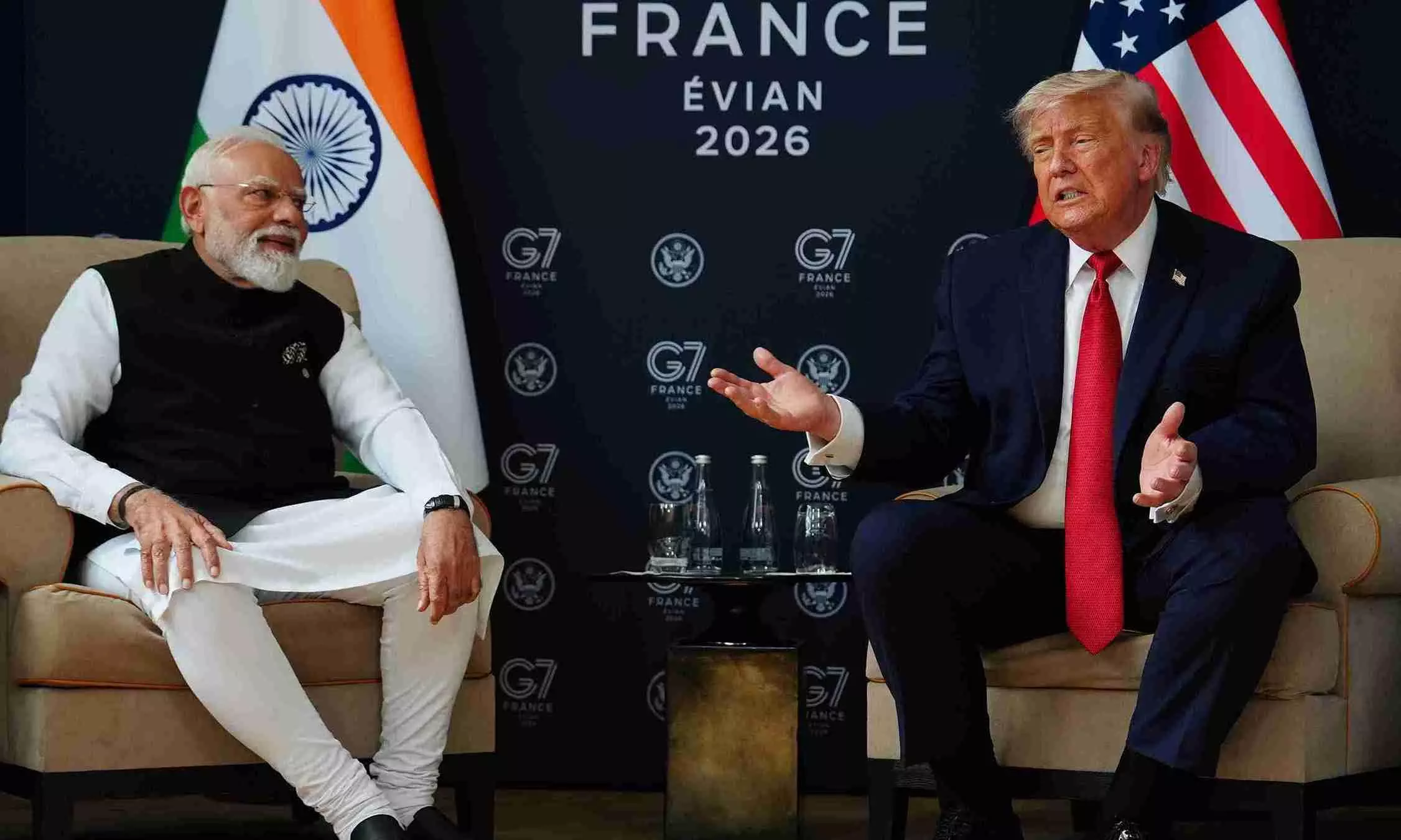
Modi at G7: PM takes up sailors’ safety with Trump, holds meet with Merz
At the summit, Trump says US will back India militarily in the event of an attack as long as Modi is at the helm

Prime Minister Narendra Modi and US President Donald Trump met on the sidelines of the G7 summit in France on Wednesday (June 17), signalling a significant step towards resetting India-US ties strained by tariffs and, most recently, the deaths of three Indian sailors in US-led attacks in the Gulf of Oman.
Modi commended Trump’s efforts to stabilise West Asia but also raised concerns over the safety of Indian seafarers, who account for nearly 10 per cent of the global maritime workforce. Stressing their importance, he urged that their security be prioritised in ongoing negotiations.
Trump also pledged unwavering support for India, but with a caveat. Trump praised the India-US defence relationship and made clear that Washington would back New Delhi militarily in the event of an attack, as long as Modi is at the helm.
"I think it is a great relationship. If they were attacked, we would be there to help them. We don't have a contract, but if they are attacked and Modi is the leader, we are going to be there to help. If anybody attacks that man, we are going to be there. If there is another leader, I don't know about that, but if they are attacked and he is the leader, we are going to help," Trump added.
‘Indian seafarers’ safety is paramount’
Meeting Trump after a 16‑month gap, Modi said: “It is a pleasure to meet you, Mr President. Since our last meeting in Washington, new momentum has entered our relationship. Our teams have set ambitious targets, and we are moving forward rapidly to achieve them.”
The Prime Minister praised Trump’s leadership in advancing peace efforts in West Asia, emphasising that keeping the Strait of Hormuz open was vital for global trade and that freedom of navigation must be safeguarded.
Also read: Melodi makes waves at G7: Meloni’s ‘most famous couple’ quip to Modi goes viral
He expressed hope that the US-Iran deal expected to be signed on Friday (June 19) would give due priority to seafarer safety. “Hundreds of thousands of Indian seafarers serve across global trade routes, including Hormuz, contributing significantly to world commerce. Their safety is paramount. I am confident this agreement will ensure it receives the highest priority,” Modi said.
If India is attacked, we’ll be there to help: Trump
On the killing of the Indian sailors, Trump remarked: “I heard about that, it’s a rough profession and we work together on it. This has been happening throughout time but we work together.”
Turning to defence ties, Trump emphasised America’s commitment to India’s security: “I think it is a great relationship. If they were attacked, we would be there to help them. If anybody attacks that man, we are going to be there. If they are attacked and he (PM Modi) is the leader, we are going to be there to help.”
He also highlighted the warmth of bilateral relations, declaring: “As long as I am President, they (India) have a great friend in the White House... Everyone here loves India and they have tremendous respect for this (PM Narendra Modi) man.”
Meeting with Merz
Besides holding the meeting with Trump, Prime Minister Modi on Wednesday also held talks with German Chancellor Friedrich Merz, focusing on shoring up bilateral cooperation in areas of trade, investments and defence.
The two leaders exchanged views on the situation in West Asia and the Russia-Ukraine conflict. Modi and Merz welcomed the understanding reached between the US and Iran to end the conflict in West Asia.
Also read: Modi, Trump reconnect at G7 summit in France; bilateral talks tomorrow
“The discussions with Federal Chancellor Merz were very fruitful. We discussed possibilities for how we can further strengthen bilateral cooperation through joint efforts in the areas of trade, investments, circular economy, defence, IT, and other fields,” Modi said on social media.
“We also talked about how we can strengthen the cultural relations between our countries,” he said.
What MEA said
While it was not immediately known what the discussions on defence entailed, shortly after the talks, the Ministry of External Affairs (MEA) said the two leaders reviewed the progress in bilateral engagements and expressed satisfaction at the renewed momentum in the India-Germany Strategic Partnership.
India is in the process of procuring six stealth submarines. German defence major ThyssenKrupp Marine Systems (TKMS) and Mazagon Dock Shipbuilders Ltd (MDL) have been holding price negotiations with the defence ministry for the Euro 5 billion deal to supply six stealth submarines to the Indian Navy.
They also noted the conclusion of the negotiations between India and the European Union for a free trade agreement.
“As India and Germany celebrate the 75th anniversary of diplomatic ties in 2026, the two leaders reaffirmed their commitment to further strengthen cooperation across diverse sectors, including trade and investment, defence and security, green and sustainable development, technology, innovation, education and mobility,” it said.
Also read: Modi flags deaths of Indian seafarers in US strike, calls for secure sea routes at G7
“They welcomed the signing of the Defence Industrial Cooperation Roadmap and the operationalisation of transit visa waiver for Indian nationals transiting through Germany,” it added.
Meeting with South Korean president
The prime minister also held a separate bilateral meeting with South Korean President Lee Jae-myung.
“I had a very meaningful conversation with Lee Jae-myung, President of the Republic of Korea, in Evian. Just two months ago, I welcomed President Lee in India,” Modi said in another social media post.
“The two countries are closely cooperating not only in trade and commerce but also in various future high-tech fields,” he said.
Modi’s proposal at outreach session
While speaking at an outreach session of the G7 summit, Prime Minister Modi proposed a framework to boost connectivity and trade by combining the strengths of the G7 nations, India and the Global South even as he flagged concerns over long-lasting consequences of the West Asia crisis on developing countries.
Floating the proposal for setting up the International Mobilisation Partnership for Accelerating Connectivity and Trade (IMPACT), Modi emphasised that modern economic growth cannot be measured solely by trade volume or GDP numbers and that the true value of progress lies in its direction, and who ultimately benefits from it.
New framework proposed
The impact of the West Asian crisis on fuel, fertiliser, and food supply chains will have long-lasting consequences for the Global South, Modi said, adding the most vulnerable countries should not bear the burden of geopolitical crises.
Also read: Modi in France: What’s on agenda? G7 Summit, meeting with Trump
“If we truly want to strengthen international solidarity, the most vulnerable countries should not bear the burden of these crises alone,” he said.
“Our international financial institutions must create support mechanisms that help developing countries absorb these shocks and maintain their economic resilience,” Modi said.
Inspiration from IMEC vision
The prime minister said the new framework to help the Global South can be modelled on the ambitious IMEC or India-Middle East-Europe Economic Corridor initiative.
“Drawing inspiration from the IMEC vision, we can work on connectivity projects with countries in Africa, Latin America, and the Pacific Islands,” he said.
Combining the capital of the G7, India’s talent, and the ownership of countries in the Global South, we could consider creating the International Mobilisation Partnership for Accelerating Connectivity and Trade, or IMPACT, he said.
“Its objective should be to create corridors that connect trade, technology, energy, and opportunity,” he said.
What is IMEC?
The IMEC initiative was firmed up on the sidelines of the G20 Summit in Delhi in 2023.
Billed as a pathbreaking initiative, it envisages vast road, railroad and shipping networks among Saudi Arabia, India, the United States and Europe with an aim to ensure integration among Asia, the Middle East and the West.
Also read: Modi in France: In era of disruption, PM bets on India as global technology provider
The project has not taken off yet in view of the crisis in West Asia.
“I am delighted that France’s G7 presidency places special emphasis on shared and sustainable growth. At a time when the world is facing many uncertainties, the message emanating from this forum is important for all humanity,” Modi said.
“Today, the question of growth isn’t just a matter of GDP or trade numbers. The real question is who is growth for, who is it with, and in what direction,” he added.
‘India’s growth story is a story of inclusion’
Modi said India's experience showed that shared development can be transformed from an aspiration into a reality.
“When India progresses, one-sixth of humanity progresses. Therefore, India’s growth story is a story of inclusion, scale, and democratic empowerment for all of humanity,” he said.
“Over the past 12 years, India has moved forward on the motto of ‘Sabka Saath, Sabka Vikas, Sabka Vishwas, Sabka Prayas’. This is also the guiding principle of our global engagement,” he said.
Strengths of Global South
The prime minister said the IMEC corridor connecting Asia, West Asia, and Europe will accelerate trade, strengthen supply chains, and create new opportunities for investment, employment, and innovation.
In his remarks, the prime minister also elaborated on the strengths of the Global South nations.
Also read: India says US Navy behind attack on MT Settebello, lodges protest
“Today, many societies are becoming ageing societies while India and other countries of the Global South have abundance of young talent, entrepreneurship and skills,” he said.
“To harness this natural complementarity, called for the creation of a Global Skills Partnership, where we can work together on skill mapping and promoting trusted skilled mobility,” he noted.
What India believes
Modi said India’s believes in shared global prosperity. “And it is not limited to words; it is also reflected in our actions. Over the past few years, India has concluded trade agreements with most of the countries present at this meeting. This demonstrates that India believes in integration, not fragmentation; partnership, not protectionism; and shared prosperity, not uncertainty,” he said.
“In the times to come, India will continue to work with all of you to strengthen shared economic resilience and build a more stable, reliable and prosperous global economy,” he added.
Modi travelled to France for the G7 summit as India was invited as a guest country to the gathering.
(With agency inputs)