Is LPG shortage a crisis of our own making, as Opposition claims? | Capital Beat
Is LPG panic real or political? Congress and TMC allege digital booking failures, black-marketing, and lack of energy buffer stocks. Watch as we debate LPG row

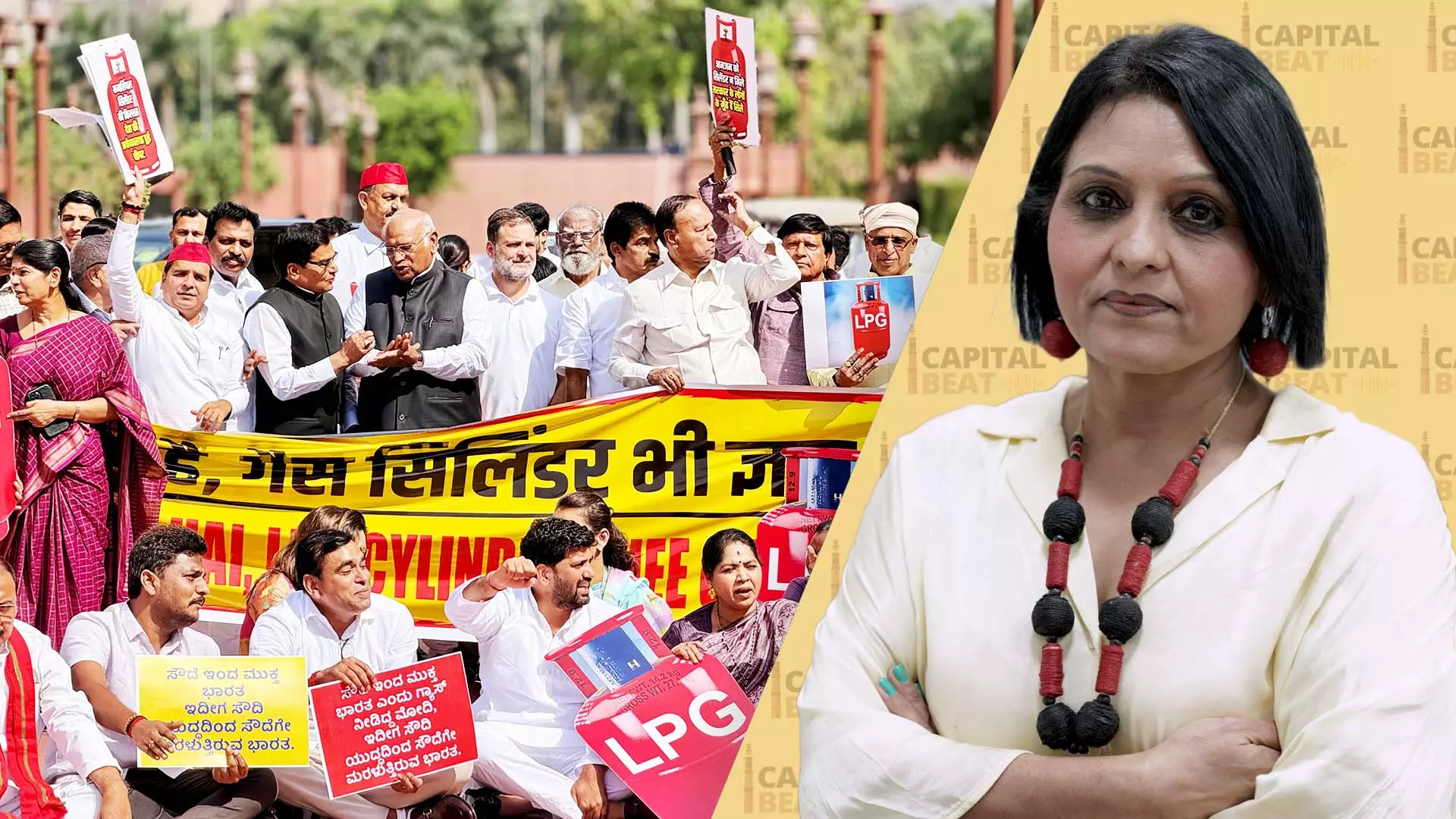
As protests rocked Parliament on Thursday (March 12) over the LPG shortage in the country, The Federal in this episode of Capital Beat spoke to Sujata Paul (Congress spokesperson), Shubhankar Bhattacharya (Trinamool Congress spokesperson), and Vivek Deshpande (senior journalist and political commentator) about the growing LPG controversy and its political and economic implications.
Parliament protests
The protests unfolded on Thursday amid mounting anxiety over the impact of the West Asia conflict on global energy supply chains. Prime Minister Narendra Modi told Parliament that disruptions caused by the conflict had created concerns but urged citizens not to panic, expressing confidence that India would overcome the challenge.
Also read: LPG delays and black-market claims: Are global supply tensions hitting distribution?
However, Opposition leaders countered that the government was downplaying the seriousness of the issue. Rahul Gandhi, Leader of the Opposition in the Lok Sabha, criticised the Prime Minister, saying that while he was asking people not to panic, he himself appeared to be “panicking for different reasons”.
Opposition MPs protested in Parliament premises, displaying props of LPG cylinders and staging symbolic demonstrations. Several women MPs, including Priyanka Gandhi, sat beside a mock brick cooking stove, or chulha, to highlight the hardships households could face if supplies worsen.
Shortage concerns
According to Sujata Paul, the shortage is already being felt across the country. She claimed that consumers are struggling to book LPG cylinders through official channels.
“Bookings are not taking place on the websites. The phone numbers are non-functional. People are trying to book cylinders at night because they are told that the window opens only then, but even that is not working,” Paul said during the discussion.
She argued that the crisis was linked to foreign policy missteps and deteriorating relations with key energy suppliers such as Iran. Paul also suggested that the escalating conflict in West Asia had exposed India’s vulnerability in energy security.
“If this war continues for weeks, what will the country do? Are people expected to cook with wood and coal again?” she asked, warning that tourism and hospitality sectors could also face disruptions.
Political blame
The debate also touched on whether political parties were using the crisis to attack the government. The host pointed out that similar protests had occurred during the UPA era, when Opposition leaders such as Smriti Irani staged demonstrations over rising LPG prices.
Also read: LPG shortage disrupts fresh meals on premium trains, snacks at railway stalls
Responding to the comparison, Paul said the situation today was fundamentally different. She argued that earlier protests focussed on rising prices, whereas the current concern relates to supply shortages.
She also said the government had previously used global conflicts such as the Russia-Ukraine war as explanations for rising fuel prices, but that such arguments would not hold if consumers begin facing real shortages.
“If people feel the brunt of it in their homes and kitchens, the government will have to face the consequences,” she said.
Ground reports
Meanwhile, Trinamool Congress spokesperson Shubhankar Bhattacharya said reports of black marketing and hoarding were emerging in some parts of the country. He cited anecdotal accounts suggesting that LPG cylinders were being sold at inflated prices in certain regions.
“In some places, people are saying cylinders are being sold in the black market for ₹1,600 or more,” he said, adding that the situation varied across states.
Bhattacharya claimed that while West Bengal had so far managed to maintain regulated prices for LPG cylinders, concerns about supply and availability remained. “The price may remain the same, but the question is whether you can get the cylinder,” he said, adding that state governments were trying to prevent hoarding and control distribution networks.
He also suggested that the crisis was affecting multiple sectors beyond household cooking gas, including transportation and small businesses dependent on fuel supplies.
Energy security
Senior journalist Vivek Deshpande said the debate over LPG shortages should be seen in the larger context of India’s energy security.
Drawing from personal experience, Deshpande said even households and small businesses were preparing for potential disruptions.
Also read: Panic buying, woodfire switch: How LPG crisis fear has hit the states
“The panic buttons have already been pressed,” he said. “People are buying alternative equipment such as hot plates because they fear that cylinder supplies might not continue as normal.” Deshpande questioned whether the government had anticipated the possibility of geopolitical tensions affecting energy supplies. He said a long-term contingency plan should have been in place.
“If a crisis was expected, the government should have created buffer stocks that could last three or four months,” he said.
He added that while India cannot achieve complete self-reliance in oil and gas due to limited domestic reserves, strong diplomatic relationships with energy suppliers remain crucial.
Political impact
Panellists also discussed whether the LPG issue could influence upcoming elections in several states. The host asked whether economic pressures, including shortages and rising prices, could become a major political issue.
Paul said that if the crisis deepens and households begin facing difficulties in accessing cooking gas, it could have significant political repercussions. “LPG is something that directly affects every household. If kitchens are affected, people will respond politically,” she said.
Bhattacharya, however, said the immediate focus should be on addressing the crisis rather than calculating electoral consequences. “This issue has entered people’s homes and kitchens. The priority should be ensuring supply and preventing hoarding,” he said.
War factor
The discussion repeatedly returned to the ongoing conflict in West Asia, which analysts say has disrupted global energy routes and increased uncertainty in fuel markets. Deshpande said the trajectory of the war could determine how long the crisis persists.
“If the conflict continues, the pressure on energy supplies will increase. But if there is a diplomatic resolution soon, the situation may stabilise,” he said.
He added that the priority should be to ensure that ordinary consumers are protected from the fallout of geopolitical tensions. “The most important thing is that people should not suffer because of international conflicts,” Deshpande said.
Ongoing debate
As protests continued outside Parliament, the LPG shortage debate highlights broader concerns about India’s energy security and crisis preparedness.
For now, the government maintains that there is no reason for panic. But Opposition parties argue that the situation requires urgent action to reassure citizens and stabilise supplies.
Whether the issue develops into a prolonged political controversy may depend on how quickly the supply concerns are resolved—and how the global energy situation evolves in the coming weeks.
(The content above has been transcribed from video using a fine-tuned AI model. To ensure accuracy, quality, and editorial integrity, we employ a Human-In-The-Loop (HITL) process. While AI assists in creating the initial draft, our experienced editorial team carefully reviews, edits, and refines the content before publication. At The Federal, we combine the efficiency of AI with the expertise of human editors to deliver reliable and insightful journalism.)