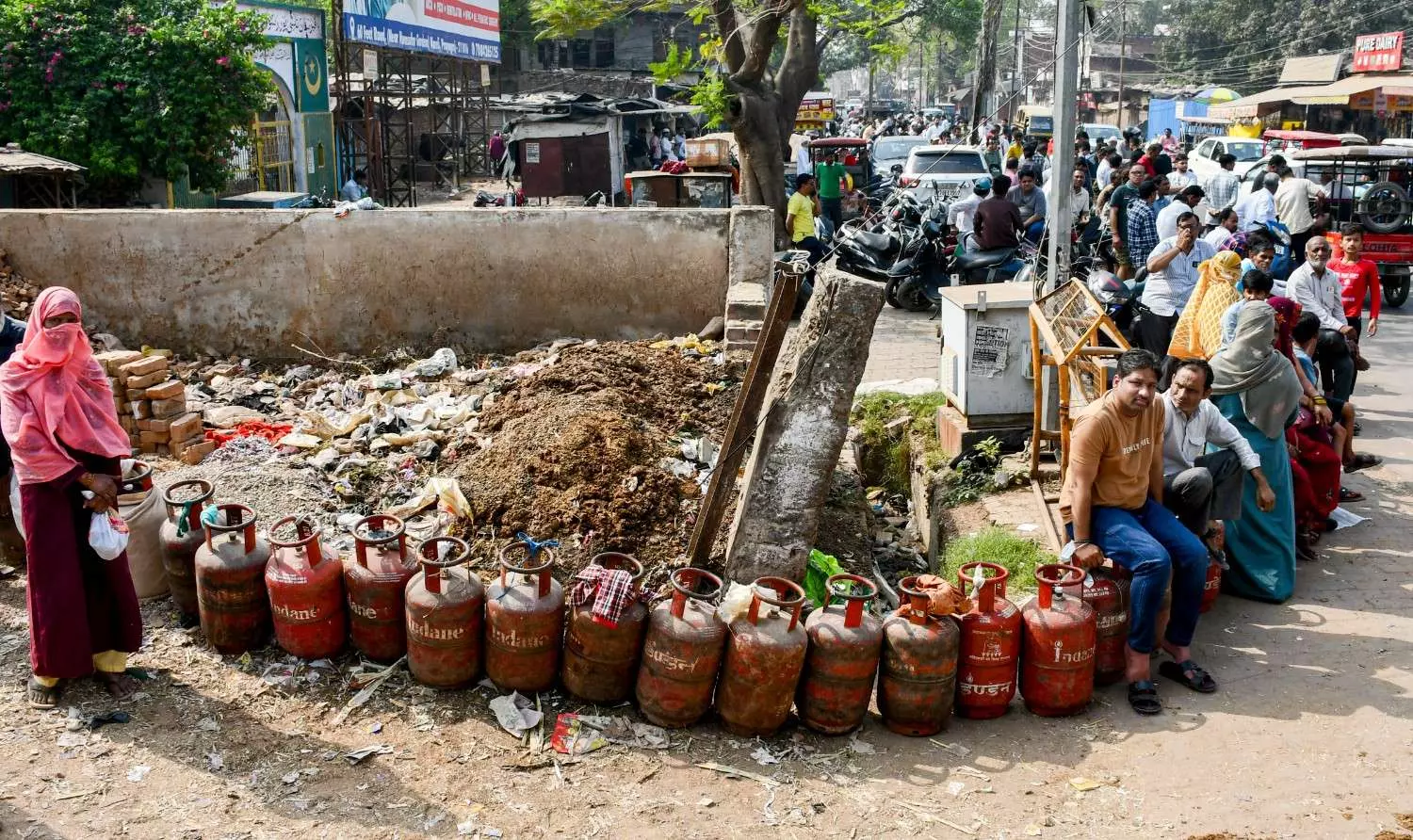
Consumers queue up with empty cylinders amid the disruption in LPG supply following the worsening Middle East conflict, near a gas agency in Prayagraj, on Monday, March 16. PTI
LPG crisis: Big changes in wedding menus; demand for kerosene stoves soar
The Iran war has not just taken away gas supplies; it has also created such fear that people are abandoning modern appliances and turning to older alternatives

The Iran war is now having a direct impact on Indian kitchens and businesses. Disruptions in petroleum product supplies have raised concerns about the availability of LPG in the country. To prevent the situation from worsening, the government has halted the supply of commercial LPG cylinders. The decision has triggered panic across the country. The food and hospitality sector, along with the wedding season, has been hit particularly hard. Several commercial activities are now on the verge of coming to a standstill.
The panic has become so intense that the government has imposed strict restrictions on the supply of commercial LPG cylinders to ensure there is no shortage of domestic gas. This is not just a government directive—it is a major blow for thousands of businesses whose kitchens run on the blue flame of commercial gas.
Also read: Congress, BJP lock horns in Rajya Sabha over LPG crisis amid West Asia tensions
The worst affected are banquet halls and caterers that already have a long list of wedding bookings. The moment the supply of commercial cylinders stopped, black marketing reared its head. Cylinders that were easily available until recently have either disappeared from the market or are being sold at prices comparable to luxury items. This undeclared restriction has slowed down commercial activity. In a country known for its love of food, ‘live counters’ at events are now lying deserted.
Smouldering questions and cold snacks
The concern felt across the industry is evident in the words of Kapil Nagpal, General Secretary of the Community Welfare Banquet Association. He says, “Most banquet kitchens run on PNG, but the soul of live stalls lies in commercial cylinders. Chaat, snacks, tandoori rotis and piping hot curries—no Indian wedding feels complete without them. Since cylinders are not available, running these stalls has become extremely difficult. As a result, every night we see heated arguments between event organisers and our teams.”
Old bookings and new troubles
Most wedding bookings were made six to eight months ago, when neither the possibility of war nor a gas crisis was even imagined. Pankaj Thakur, General Manager of SK Ceremony Banquets and the Manis Green Leaf restaurant chain, says, “Even if cylinders are available, their prices are beyond what we can afford. We cannot pass this additional burden on to customers because the agreements were signed months ago. As an alternative, we have bought expensive induction stoves, which has caused heavy financial losses. We are requesting people to include more cold dishes in the menu, but for them it is a matter of prestige and money—no one is ready to understand.”
Also read: Karnataka police guard LPG warehouses as shortage fuels theft, illegal sales
Anand, who manages operations at a banquet hall, describes the stress faced by field staff. He says, “We have to face complaints every day. When we tell customers that cylinders are not available, their response is—‘We have paid for the service; we don’t care about your problems’. Handling the anger of customers is becoming increasingly difficult.”
Price of induction stoves shoots up
The war has not just taken away gas supplies; it has also created such fear that people are abandoning modern appliances and turning to older alternatives. The uncertainty around LPG availability has turned parts of the market into a profiteering hub. Ramnish Garg, a stove trader in Delhi’s Sadar Bazaar, says the demand for induction stoves has surged so sharply over the past week that units priced at Rs 800-Rs 900 have crossed Rs 4,000. Good-quality products have already disappeared from the market, and only lower-grade stock is now available—at steep prices.
High demand for kerosene stoves
The fear is so widespread that those who cannot afford expensive induction stoves are rushing to buy old-fashioned kerosene stoves. Even on Sunday, March 15—a weekly holiday—people took Ramnish’s phone number from the shop signboard and called him to open the store. He says, “That day alone I sold 700 kerosene stoves. Not just that—diesel stoves that used to cost Rs 5,000 are now being sold for bids between Rs 30,000 and Rs 40,000.”
The shadow of the Iran war is affecting every product derived from petroleum. Rakesh Yadav, President of the Federation of Sadar Bazaar Traders Association, says disruptions in petroleum supply have also impacted cello tape and packaging tape. A carton that earlier cost Rs 2,000 has shot up to Rs 3,000 almost overnight. According to him, some players in the market are taking undue advantage in the name of rising manufacturing costs. In reality, the shortage in supply is not as severe as the atmosphere of profiteering being created in the market.
(This article was originally published in The Federal Desh)