‘Love jihad’ is not about luring women, it’s about controlling them: Sameena Dalwai
Law professor and author Sameena Dalwai says the 'love jihad' narrative is a tool of patriarchal surveillance that has brought Hindu women to the centre of Hindutva politics

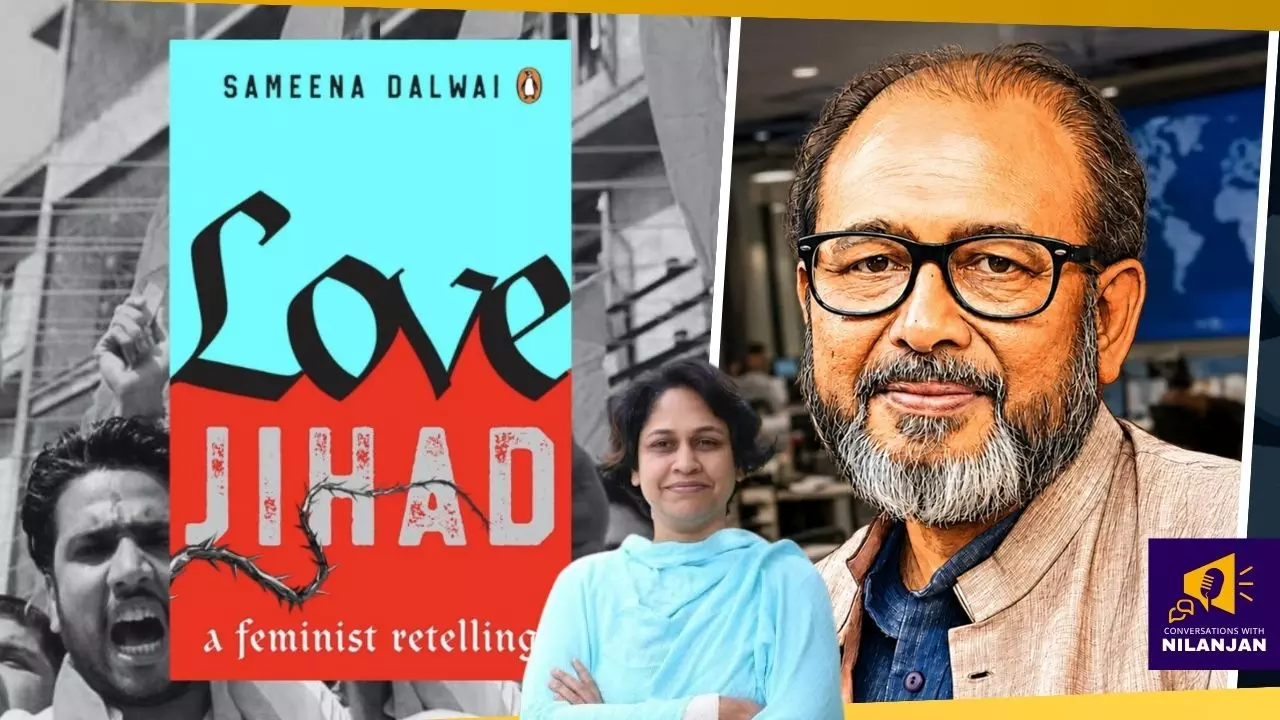
"Love jihad is an allegation, not a documented phenomenon," says Sameena Dalwai, author of Love Jihad: A Feminist Retelling (Penguin Random House, 2026). "When people decide to marry someone, they choose an individual, not a religion." As majoritarian politics continues to reshape India's social and legislative landscape, the concept of "love jihad"—the alleged strategy of Muslim men luring Hindu women into marriage for conversion—has moved from a fringe conspiracy theory to a central political narrative, backed by laws in at least 11 states. The Federal spoke to Dalwai, Professor of Law at OP Jindal Global University, about the politics, patriarchy, and the personal that lies behind the term.
Your book defines love jihad not as a social phenomenon but as a tool for social surveillance. Can you elaborate on that?
When the term first emerged from Kerala, about 15 years ago, it sounded quite ridiculous. We laughed in Bombay — abhi kuch naya nikla hai, new drama. We didn't think something like this would actually take hold. This was also a time of critical thinking, though 1992 had already happened, and Gujarat 2002 had already happened.
Also read | Maharashtra govt forms panel to draft law against ‘love jihad’
We still thought that in this modern democratic space of India, it would not take hold. And in the next 10 years, you saw that it did. And the most important thing it has done is pull Hindu women — upper-caste Hindu women — to the forefront of Hindutva politics.
When you speak of Ram Janmabhoomi, when you speak of rewriting history or diet politics, women are not the focus. The first time women become the focus of Hindutva politics is when love jihad actually becomes a serious allegation.
What exactly do you mean by "allegation"?
When people decide to marry somebody, they choose an individual. They don't necessarily choose a religion. If I want to marry a man, he's just a man I like to talk to, walk with, travel with. We have things in common — books, food, travel. These are at the forefront of our decision to live together. Our religions are in the backdrop.
Whether he is Hindu, Muslim, or Christian comes later. Whether he likes pani puri or sabudana vada — these are the personal things, the personal preferences that draw us to each other. Religion is there somewhere in the background. Maybe our food habits are shaped by religion, maybe our clothes are influenced by where we come from. But the personal actually trumps the religious and the political, to a large extent.
But when you look at any union that is not within the same religion, within the same caste, even within the same region, with suspicion — that is what makes it an allegation. You are already thinking that any interfaith relationship is circumspect, that it is not love but rather someone trying to lure someone away from their family and religion. As if the man falling in love with a woman is his commitment to his religion, and that religion is waging some kind of war that he is ready to sacrifice himself for.
The propaganda says that he is trying to sacrifice the woman. But I believe — a man who is actually marrying a woman, is he not ready to sacrifice himself?
My parents celebrated 52 years of their marriage. My father was an interfaith man; it was an interfaith marriage. Are we to say that for his religion, he sacrificed his whole life? That he lived with someone for 52 years because she was Hindu and Brahmin, and to take her away from her religion, he lived his whole life with her? That sounds ridiculous, doesn't it?
Unless they had something in common — which in their case was a fiery desire to change society. At that time, they were part of the Kranti Dal, and like many others in the 1970s, they were part of student revolutionary politics, socialist politics. They thought they were going to bring a new, casteless, genderless society to India. That dream sustained them and their marriage for those decades.
Otherwise, it's hard to live with someone for 50 years. You would get bored, you would get annoyed, you would get angry. Marriage is no easy game. We live within it because we find something everyday to enchant us about that person.
You write at the end of your book — "All love is a jihad." Are you turning the word around?
Yes. If jihad is the effort to work through and work out one's truth, one's calling, one's dharma — then in a way, a life well lived is a sincere love jihad.
But I must also note that within my family, the political and the personal are not different things. We have never recognised that distinction. Feminism teaches us that the personal is political.
When women were being beaten at home, they thought it was an individual matter — I must have done something to anger my husband. When they started talking to each other, they realised that other women were also being beaten, and it was not their individual fault. It was that men behave in a certain way to control women — their mobility, their freedoms, their thought, their domestic labour. That is when they realised: the personal is political.
For us, all the stuff that is happening around us, which is political, is very much a personal thing. When riots happen, they are not political alone — they are very personal. When something happens in Palestine, that is also not just political. When you watch children starving and their bodies strewn, it is not a political matter. It is a personal matter.
All of us live our politics through our personal lives. And those who don't are only doing faith politics — saying something and not living it. What kind of life is that?
Those who campaign around love jihad say there is a deliberate plot by Muslim men to lure Hindu women, beget Muslim children, and eventually outnumber Hindus. Are they too, in their own way, living their personal beliefs?
They are. But this book is not for those who are already in the Hindutva web. The book is for the thinking individual who may be confused and who needs some guidelines to look at this matter. It is for people who are in between — which is largely India's population.
Those who are trying very hard to stop love jihad — I don't have much to say to them. I just feel: Bhai, tu bhi mehnat karna. Just try to win a woman over yourself. Why do you have this concept only of arranged marriage, where a perfectly biddable girl is brought to your home and your bed by your parents, with dowry, with everything — scooter and car? You should be ashamed. Apart from being born a boy, what is it that you have done in life that a woman is brought to your home with all this entitlement?
Also read | SC allows inclusion of Himachal, MP in petition challenging 'love jihad' laws
So you also try. Don't arrange your marriage. Fall in love. Put in effort. Do all that lowering business that is necessary. Suffer. Pyar mein kuch mehnat karna. Then see what happens. Living with a woman you have chosen and won over is not easy. Getting a woman just as a gift, with your parents ready to give and take — and then using her as domestic labour — that is easy. That is all patriarchy is doing.
And the population argument? That is so ridiculous. When will this inversion happen? 200 years? 300 years? Currently, not even 3–5% of India marries outside their community by choice. And within that 3%, how many are actually Hindu-Muslim marriages? Most love marriages also happen within communities, within caste. Very few are actually Hindu-Muslim. So when will this demographic shift happen — 1000 years? You are worried about that?
Just worry about how many trees we are cutting right now. In just two or three generations, we will not be able to live because of simple environmental degradation. In my lifetime, Bangalore went from 22°C to 36°C; Bombay went from 27°C to 38°C. We should worry about the problems right now — that there will be no trees, no shade for our children. Forget the hate politics.
Your book has three chapters — one on Hindu women, one on the Muslim milieu, and a third bringing in the Dalit angle, which I found very innovative. Why this structure?
The book began several years ago when I wrote an article in The Indian Express called I Am the Unborn Baby. This was in response to the trolling of the Tanishq Ekatvam advertisement — where a young, expectant Hindu woman, wearing a bindi, was being celebrated with a godh bharai ceremony by her Muslim mother-in-law. And this ad was attacked and taken down. I thought — what is the point of giving political arguments to this? Let us tell personal stories.
So I said: I am actually that unborn baby. With a Hindu mother and a Muslim father. And all the things that happen around the birth of a baby — the stories of people going to the hospital, waiting, wanting to name me by the river in Konkan. Thank god they didn't. Otherwise I would have been called Vasishti Dalwai. So Samina is better — I told my father, thank you for that.
Then many people asked me to write more. And when I started thinking — should I write about my family alone? I said, why only about my family? This is a story of India. The India we are currently living in. But it is also the India I grew up in — that has changed from a political bubble of hope to the Ram Janmabhoomi India.
I realised that the love jihad trope has done two interesting things simultaneously. One, it has hyper-visualised two categories — Hindu women and Muslim men. Muslim men as conniving, luring these poor, innocent Hindu women away. These are the hyper-visible categories.
And then what is invisible in all this? The caste system. The elephant in the room — the Dalit-Bahujan majority. Their labour, their life struggle, their murders, their everyday marginalisation. Small to big, all of that, as if it doesn't exist.
Love jihad is, in many ways, old wine in a new bottle. There has always been a virulent opposition to upper-caste women choosing Dalit men as partners — often with fatal outcomes for the families involved. That means that Dalits have always been part of this scenario. Apart from all the other marginalisations they face, they have no right to love anyone from above their caste group. They will meet a painful death for that. This was already there.
But it becomes invisible in the Hindu-Muslim trope because you want to make people believe that Dalits are part of the Hindu fold — that they can be used against Muslims.
I wanted to make sure that all three angles — Indian patriarchy, Indian communalism, and the caste system — came together. It may seem innovative, but I always saw it as the most open-and-shut case. It is an open secret that they are trying to do the politics of communalism by overshadowing and superimposing it on the politics of caste.
You also mention the Manu statue outside the Rajasthan High Court in your book. How does that connect to your argument?
It is connected to Bhanwari Devi in my head. Bhanwari Devi was a government-employed grassroots worker who had to go to the Rajasthan High Court after being sexually assaulted by upper-caste men while doing her job. When she went there, they refused to believe her testimony. They said she was lying. They said no uncle and nephew would come together to rape a woman. Why would they rape a lower-caste woman? They should not even touch her.
This is the paradox — the caste system, on one hand, says you do not touch Dalit people, their shadow is polluting. But on the other hand, Dalit women's sexual labour is very much extracted and considered an entitlement. This is not even a misnomer. It is the same logic as American slavery — you would not marry a Black woman but you would keep her as a slave, she would work your fields, you would have children from her. This is not new.
And the judges not knowing this — or choosing not to know this — is interesting. When I read a judgement like that, I was aggrieved. But then I read: this High Court has Manu's statue outside it. And then I thought — ab isse jyada kya hoga? Because what is Manu known for? Manu essentially tries to establish and maintain a varna-based law — what we call Brahmanical patriarchy. Upper-caste men will rule, and everyone else will fall in line. Provide labour, goods, sex, et cetera.
In the Manusmriti, it is said that if Dalits or OBCs dare to listen to the Vedas, you should pour molten metal in their ears. If they speak, cut off their tongue. Mercilessly. This is what that statue outside a high court signals.
If that statue had been put in front of the RSS office in Nagpur, I would not have been aggrieved at all. Bhai, theek hai, tumhara hai, lagao, fine. But you put it in front of a high court? The High Court is supposed to uphold our law, our Constitution — which belongs to women, Dalits, OBCs, working people, farmers, thinking individuals. And you put that statue in front of it.
You say that reclaiming the legitimacy of interfaith and intercaste marriages is an essential act of democratic resistance. Why?
I say this not from the point of view of religious politics or communalism. I say it simply because every young person has a right to choose. That is all.
Democracy does not mean only a numbers game, only elections, only who rules at the centre. Democratic ethos means that an individual has a right to live her life according to her wishes. The individual is as important as the group.
Also read | 'Love Jihad' by certain communities poses a major threat to national unity: UP court
When individualism emerged in Europe after the French Revolution, the idea was that the individual has become an important aspect of social life — rather than just falling in line for group dynamics. And what is arranged marriage but exactly that — the individual has no say. Marriage is between two families, two clans. It is an economic relation — to beget children, to keep the patrilineal line going, to pass on land, dowry, gold, and political relations of patronage.
In this system, even if you decide within your own caste who to marry, the family may say: we will decide. You cannot decide even within caste. So it is not only about caste and religion — it is about whether you get to decide for yourself at all.
And feminist politics says: women will have their own chance to decide their small and big things in life. Who they marry. Whether they marry. Whether they have children. What kind of work they do. How they contribute to the economy. All of that must be left to themselves — and they should be enabled.
From childhood, I heard that women need protection and that they are being given protection. But throughout my book, you see that it is boys and men who get the protection — of their families, of society, of the state, of judges. Women do not get that. The same happens with all the marginalised versus the non-marginalised.
When people in power say Beti Bachao, Beti Padhao, they add — nahin to tumhare beton ko baad mein biwiyan nahin milengi. What? So a daughter's entire existence is only so she can become somebody's wife? Is that reason enough to convince parents to raise a daughter?
Tell me your daughter will have a safe life. That she can go to school without trouble. That she can travel in buses without being harassed. That she can roam around freely. If you tell me this — that she is safe, that she is treated as an individual, as a citizen — then I will say yes, I will have four daughters and raise them.
Men are enabled all the time to do all kinds of things. Women are not. And the same logic holds with caste and with communalism. Feminist politics includes everyone who is marginalised. Women. Dalits. OBCs. And it ultimately says: we will not carry the burden of this nation on our backs without being given the dignity to live as full human beings.
The content above has been transcribed from video using a fine-tuned AI model. To ensure accuracy, quality, and editorial integrity, we employ a Human-In-The-Loop (HITL) process. While AI assists in creating the initial draft, our experienced editorial team carefully reviews, edits, and refines the content before publication. At The Federal, we combine the efficiency of AI with the expertise of human editors to deliver reliable and insightful journalism.