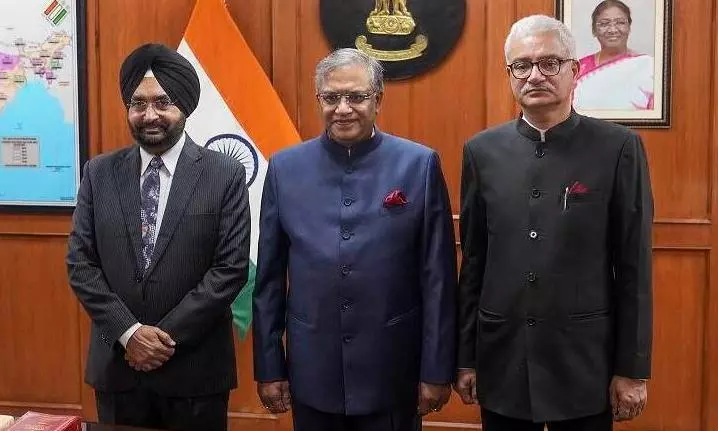
EC rift: How the government handled two commissioners’ complaint
RTI disclosures show the Cabinet Secretary went against the Commission's majority to appoint Maneesh Garg on an interim basis as Senior Deputy Election Commissioner

A file in the Cabinet Secretariat on August 3 suggested approaching Chief Election Commissioner (CEC) Gyanesh Kumar for his views. The file pertained to a complaint by two of Kumar's colleagues against a senior ECI officer. The same file, a day later, noted that taking any action on the complaint could be seen as intervening in a constitutional body. The Secretariat released 14 pages of the document under RTI on October 22.
The applicant, Commodore Lokesh K Batra (retd), a pro-transparency activist, submitted the RTI application on 24 September, a day after the Indian Express expose brought to light internal discord in the Commission. The bundle has a July 29 letter by Election Commissioners Sukhbir Singh Sandhu and Vivek Joshi enclosing two office orders. The bundle has two pages of file notings and replies from Cabinet Secretary TV Somanathan.
Two orders on the same day
A day earlier, two letters related to Senior Deputy Election Commissioner and 1996-batch IAS officer Maneesh Garg of Himachal Pradesh cadre, who has been working with the Commission since September 2, 2024. On July 28, Principal Secretary Rahul Sharma signed an order appointing him to do the work of Deputy Election Commissioner (DEC) Bhanu Prakash Yeturu, who heads the Administration Division and was on leave from July 27 to August 9. This order was termed as interim.
Also read: RTI reveals two Election Commissioners’ complaints against senior EC officer: Reports
Another order, issued the same day and signed by Secretary Ritesh Singh, reallocated work among the Commission's senior officers. It was "with immediate effect and until further orders" and made no mention of Yeturu's leave at all. Both Commissioners said Garg issued it within a few hours of him assuming charge, but without consulting the Commission or them. The Commissioners said this order was "by virtue of which he assigned work to himself and senior officers". Both said he had issued a similar order while he was in charge of the DEC (Administration). Although handwritten under "By Order", the order is nonetheless signed by Secretary Singh.
The table for this order deserves some parsing, starting with the link officers, who take over a colleague's files when she is on leave. Both letters indicate that DEC Sanjay Kumar was Yeturu's link officer. The new table designates Garg as link officer for both Yeturu and Sanjay Kumar, the division head of the Electoral Roll division, and assigns him planning and election materials, including EVMs, and the zones covering Bihar, Jharkhand, Chhattisgarh, and Uttar Pradesh.
The same table shows Director General (IT) Seema Khanna under information technology and public grievances, without any details of anyone she files through to the Commission. For a Director below her, the same table specifically directs issues requiring the Commission's clearance to go through a Senior DEC.
Both letters allege only a procedural issue: a Senior DEC trying to reallocate work by an officer without the Commission's explicit authorisation. Sandhu said it was contrary to his "repeated and explicit oral and written instructions." Neither letter mentions ECINet, the IT division, nor the special intensive revision (SIR) of electoral rolls. Joshi stated that the Administration Division did not deliver the file he requested.
The Commission said on September 26 that the two letters were about the "working of an officer on deputation." Their grievance stems from the order they appended to the Electoral Roll table and the IT division.
Also read: EC claims all SIR decisions unanimous; 'no explicit denial of charges,' says Congress
Both Commissioners referred to the move as a straightforward breach of Section 18(1) and 18(2) of the legislation governing the members of the 2023 Commission. 18(1) empowers the Commission to set its own procedures and apportion business among its members by agreement. 18(2) mandates unanimity if feasible, and decision by majority if not.
From "opinion" to "information"
The first noting, August 3, accurately reflected the complaint and asked the head of the Secretariat for a draft letter to obtain the CEC's view. A senior official referred the file "for further directions" on August 3. On August 4, the noting remarked that "the issue is the conduct of an officer appointed in the Commission by the ACC." The ACC is the Appointments Committee of the Cabinet, headed by the Prime Minister. After quoting Section 18, the noting said: "the CEC and ECs are equals." The noting concluded that "the decision is to be taken either unanimously or by the majority".
However, it went on to decide that the Commissioners wrote the letters in their "own personal capacity". They were to be given "the respect which is due" but could not form "a formal communication from the Commission as a whole". In the absence of this formal communication, it found that any steps taken "may be ill-advised" and could be seen as interference with a constitutional institution.
This reasoning is not persuasive; when tested against its own premise, the note quoted shows that only two of three members formed the required majority. The file itself opened on "D.O. Letter received from Election Commission of India".
Also read: Appointment dispute and internal dissent: EC faces a checks-and-balances question
An advocate of the noting might argue that the Commission records its resolution by majority. So, on that basis, two letters to an external third party would not constitute one. That argument is persuasive, and the Commission adopted that stand when, on September 26, it announced that it would publish agendas and minutes of its meetings ahead of time. It also avowed that the directions from Commissioners to officers would be "meticulously complied with".
Both pieces of correspondence dated 5 August, signed by Somanathan, are each one sentence long, acknowledging the order. Copies were also sent to the Secretary, Department of Personnel and Training (DoPT), its Establishment Officer, and to the CEC's Principal Private Secretary. The CEC, as the file's proposed seeking of opinion had urged on 3 August, received a copy "for information" two days afterwards; the RTI reply refers to these acknowledgements as the authorities' actions taken on the complaint.
A copy for the officer's record
"The noting submitted to DoPT described the copies as "an All-India Service officer as also ACC appointee". Keeping the matter on record, it said, "It will be taken into consideration while taking a final decision on the officer in future.” The executive therefore did not take action on the complaint of two Commissioners and left it for future decisions.
The file reveals a hierarchy at work within the Commission secretariat. Its staff can override an officer's command, as happened with both Commissioners. But the officer's placement and future now depend on the government that seconded him to the Commission. The noting tied his action to the Commission's regulations and his future to the DoPT.
The question Seshan left open
The defenders of the CEC may refer to the July 14, 1995 judgment of the Supreme Court in TN Seshan v Union of India. Seshan, CEC in 1993, challenged the legislation introducing majority rule, which a five-judge Bench had upheld. The Bench's reasoning, placing the commission staff "under the direction and guidance of the CEC", is why Article 324(3) makes him Chairman.
Also read: ECI’s internal dissent: What does the law say, and what happens next? | Capital Beat
However, the same judgment drew a boundary that the July 28 order now seems to challenge. It ruled that the Commission itself had to "decide on certain administrative matters of importance as distinguished from routine matters of administration" and that if the CEC's word were final, it would make the Election Commissioners "non-functional or ornamental". The earlier interim order of November 1993 in which only the CEC could direct the Commission's staff was set aside by the final judgment.
That question has returned to haunt the Court, which in a 5 October order issued notice on two petitions questioning the Commission's action. The Bench, headed by Chief Justice of India Surya Kant and Justices Joymalya Bagchi and V Mohana, issued the notice in one petition demanding quashing of Garg's 28 July order and, in the table attached to that petition, drew a link between three of the 14 objections of the two Commissioners to his action.
The other petition has the Cabinet Secretary as respondent, and the August 4 order previewed the response that he may give.
In 1995, the Seshan Bench observed that the Constitution's creators expected Commission members "to settle their differences in a dignified manner". Five years later, in 2026, two members of the Commission took a difference to the Cabinet Secretary, who flagged it to the CEC and followed it up with the DoPT. History and the Court may have to decide whether the Commission settled its differences as the Court envisaged in the Seshan case.