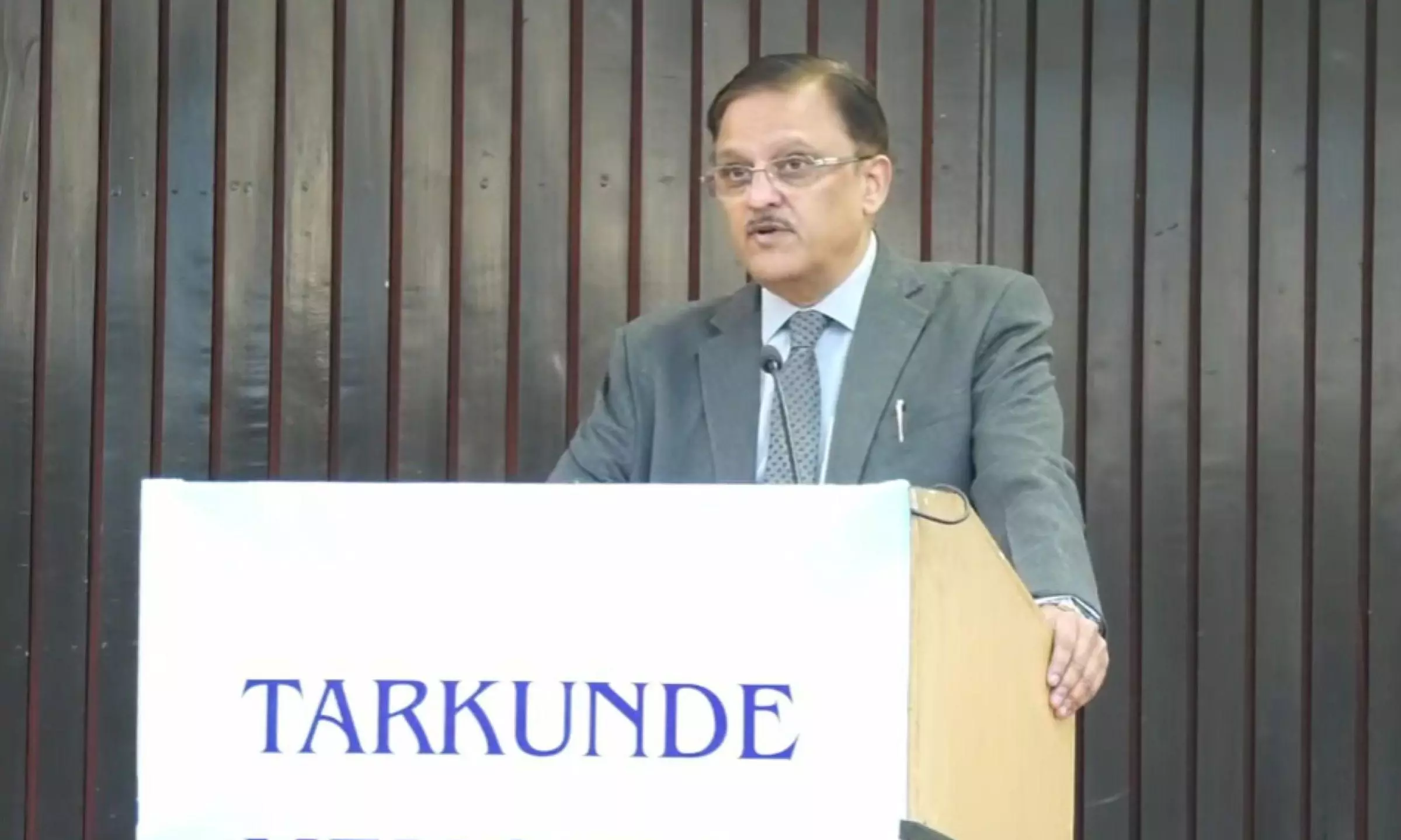
Justice Abhay Oka delivering the 16th VM Tarkunde Memorial Lecture at the India International Centre, Delhi, organised by the Tarkunde Memorial Foundation. Photo: The Federal
‘Superstition thrives, reformers attacked’: Justice Oka flags Kumbh-like events
Delivering the Tarkunde Memorial Lecture, Justice Abhay Oka stressed the need for scientific temper, and urged reforms in education and governance

Former Supreme Court Justice Abhay S Oka on Friday (December 5) delivered a sharp warning that India has failed to nurture a scientific temper even after decades of constitutional promise, and said that reformers who question superstition were attacked.
Delivering a sharp critique of India’s social and political climate, Oka said that change should begin with the school curriculum, and he also hit out at religious ceremonies such as the Kumbh Mela for polluting rivers and damaging the ecology. He reiterated why a country like India should develop a scientific temper and reforms.
Development of scientific temper
Speaking at the Tarkunde Memorial Lecture, Justice Oka said, “Though our constitution has existed for almost 76 years now, our society has generally not supported great people who have consistently promoted the development of a scientific temper and reforms. Unfortunately, in our society, anyone who proposes reforms in religious practices based on science or with the help of science gets targetted by people belonging to religious groups. This applies squarely to all religions."
Also Read: The 2D material revolution: Can India catch up with global leaders?
“In a country like India, we desperately need a scientific temper, as in our society, superstitions prevail. We do not understand the difference between faith and superstition. The moment social reformers speak against superstitions, it is projected as if they are interfering with rights conferred by Article 25 of the Constitution,” Oka added.
Tarkunde Memorial Lecture
Justice Oka was delivering the 16th VM Tarkunde Memorial Lecture at the India International Centre, Delhi, organised by the Tarkunde Memorial Foundation. The lecture is organised every year in memory of Tarkunde, a lawyer, rationalist, and radical humanist.
He said Article 51A(h) – the duty to develop scientific temper, humanism, and the spirit of inquiry – is indispensable.
Also Read: Delhi conducts first cloud seeding test to tackle air pollution
“I believe that we can lead a meaningful life only if we develop a scientific temper,” he said, adding that fundamental duties need to be seen in support of fundamental rights, and not in opposition to them.
Citing Supreme Court jurisprudence, he reiterated that “every citizen of India is fundamentally obligated to develop a scientific temper and humanism", and that this becomes a collective duty of the state.
'Our rivers are being polluted'
Justice Oka also stressed that Constitutional protection for religious freedom does not extend to acts that damage the environment or public interest.
“While performing so-called religious ceremonies, we damage our rivers, seas, and lakes. We pollute water. Article 25 protects the right to worship or the right to perform essential religious ceremonies. Since it is made subject to the other rights in part 3, the act of damaging the environment in the name of religion is not protected. We can avoid this only if we have a scientific temper,” he said.
Also Read: Why Oct 4-10 is celebrated as World Space Week; how India celebrates it
“Recently, we had Kumbh Mela. Can anyone claim that it did not damage or pollute our rivers? Can we say that our rivers will remain holy with all the pollution that we have caused to the rivers? Not only one river, but several rivers. But very few think on these lines,” Justice Oka added.
'Govts appeasing religious groups'
He argued that governments have largely avoided promoting scientific thinking due to fear of offending religious groups.
“The political class, irrespective of parties...believe in appeasing religions and therefore this class is completely unwilling to promote reforms,” he said.
Also Read: Potatoes are not bad boys; what matters is how you cook them: Research
Justice Oka paid tribute to rationalist Narendra Dabholkar, who was murdered.
“Throughout his life, he fought against superstitions in all religions. He led a very constructive and peaceful movement against superstitions… Many of us know how Dr Dabholkar's life ended. And why does this happen? Because he performed his fundamental duty under the Constitution of imploring citizens to develop a scientific temper and spirit of reform…” he said.
Key factor for real progress
Justice Oka also distinguished between scientific temper and technology.
“Only because we use technology does not mean that we have a scientific temper. Scientific temper is completely different. A person who doesn't know anything about science or technology, can acquire a scientific temper if he starts thinking rationally,” he said, adding that “developing scientific temper and spirit of reforms” was “key to real progress”.
“I am deliberately not using the word development. I am using the word progress because progress is something that is contemplated by our Constitution. Not the present idea of development. The moment you talk about the current idea of development, you infringe on fundamental rights. You talk about damaging the environment,” he said.
Also Read: Quantum physics 100 years on: Experts meet in Germany, where it all began
According to him, this process should begin at the level of school education.
“We need reforms in our education system. We need reforms not only to incorporate the fundamental duties, but we must teach the students the values, ethos, and concepts of our Constitution,” said Justice Oka.