



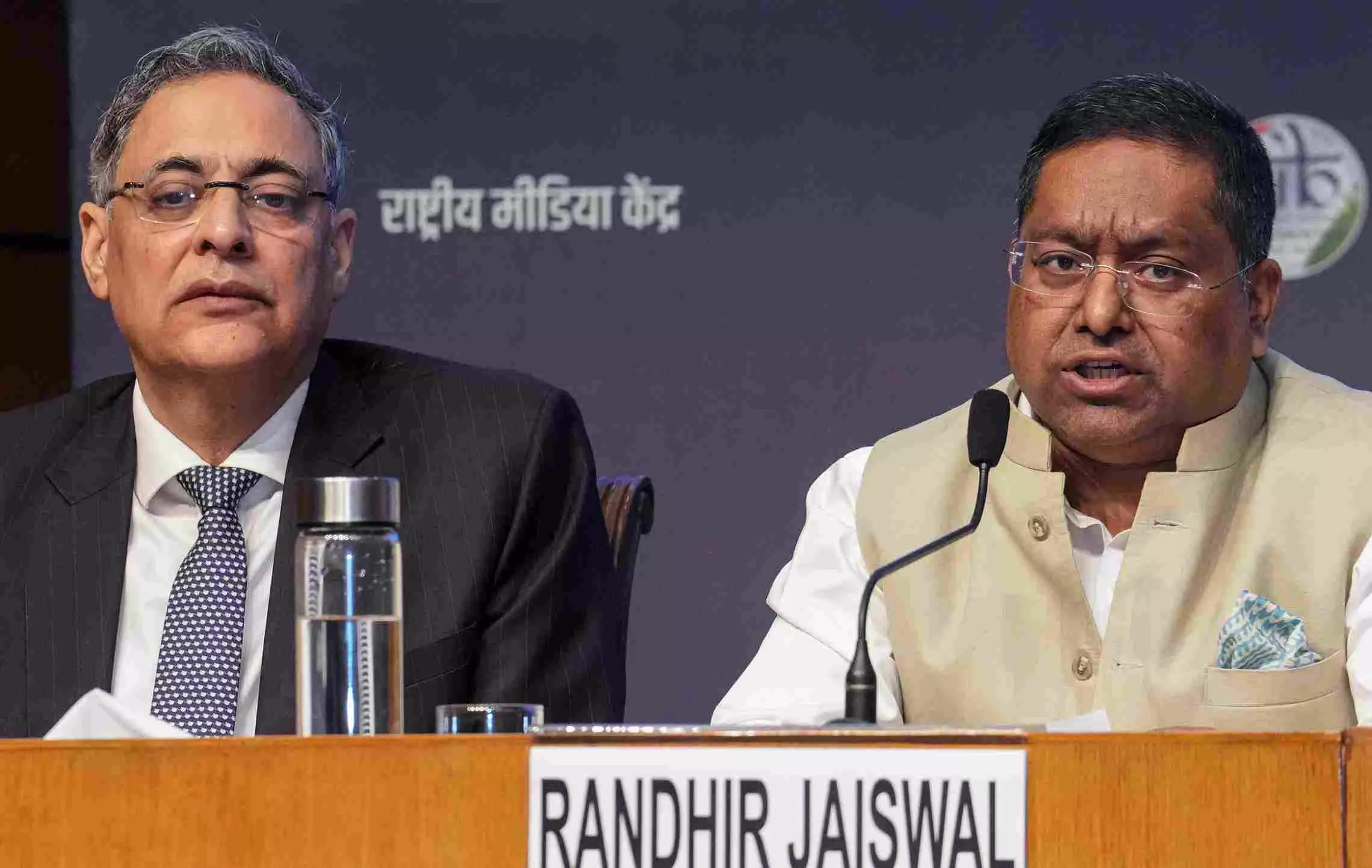
Randhir Jaiswal, spokesperson of the Ministry of External Affairs (right) with Joint Secretary (Gulf) Aseem Mahajan. File photo
India helping citizens return via Armenia; PM Modi supports dialogue: MEA
PM Modi calls for an end to civilian casualties in Iran war, as S Jaishankar holds talks with Tehran to secure India's energy interests in the Strait of Hormuz

Prime Minister Narendra Modi has spoken to several leaders in the Gulf after the Iran-Israel-US war started and has stressed the need for dialogue and diplomacy, said MEA spokesperson Randhir Jaiswal on Thursday (March 12).
“In these conversations with Gulf leaders, PM Modi has stressed the need for dialogue and diplomacy so that early peace can return. He also underlined the need to avoid civilian casualties and he focused on the protection of civilians. We have a large Indian community in the GCC countries and their security and welfare are of utmost importance. This was highlighted. We also, in several cases, condemned the violation of the sovereignty and territorial integrity of states...", Jaiswal added.
Further, responding to questions on India’s silence on the prevailing Middle East crisis, Jaiswal said that the foreign secretary Vikram Misri had signed the book of condolence for Iran's late Supreme Leader Ayatollah Khamenei on the very first day.
He also added that the external affairs minister, S Jaishankar, also spoke about the war in Parliament and is in touch with his Iranian counterpart Seyed Araghchi.
Maritime security
The government is in continuous touch with Teheran, the MEA spokesperson pointed out. The external affairs minister S Jaishankar spoke to Iran’s foreign minister Abbas Aragchchi in recent days thrice, including discussions on maritime security and India’s energy interests.
Also read: Iran allows Indian ships safe passage through Strait of Hormuz after diplomatic talks
The remark comes as the ongoing war involving Iran, the United States and Israel has disrupted maritime traffic in the region, particularly around the strategically vital Strait of Hormuz, a key route for global oil supplies.
Getting Indians back
Moreover, the government on Thursday said it is assisting Indian nationals in Iran who wish to leave the country amid the ongoing conflict in the region, facilitating their travel through neighbouring Azerbaijan and Armenia.
Indian missions are helping citizens with visas and land border crossings so that they can travel onwards on commercial flights back to India, said Jaiswal.
The government has been helping Indian nationals who are stuck in the Middle East to come back. He further added that a large number of people have already come back.
He added that around 9,000 Indian nationals were in Iran, including students, seafarers, businesspeople, professionals and pilgrims. Several of them—mostly students—have already returned home. “We are also assisting Indian nationals who wish to travel to Azerbaijan and Armenia and from there to take commercial flights to return home. We are assisting them with visas and with land border crossings,” Jaiswal said.
Indian students in Iran
The government said the Indian Embassy in Tehran is in constant touch with Indian students in Iran and is extending all possible assistance to ensure their safety amid the ongoing conflict in the region.
Also read: Live: Iran sets conditions to end war; US intel says regime at no risk of collapse
The mission in Tehran is closely monitoring the situation and coordinating with students and the Indian community on the ground, Jaiswal said.
Rejects Pakistan's claims
Meanwhile, India also rejected Pakistan's "baseless allegations" of India aggravating skirmishes with Afghanistan, accusing Pakistan of blaming others for its own misdeeds. Pakistan's history of state-sponsored terrorism undermines its credibility, said Jaiswal.
On the statement made by Pakistan, Jaiswal said, "I like to say that we reject such baseless allegations. It has become second nature for Pakistan to blame India for its misdeeds. As a state sponsor of terrorism for decades, Pakistan has zero credibility when it comes to cross-border terrorism; no amount of story-telling is going to alter this reality, nor is anyone fooled by Pakistan's assumed victimhood."
Pakistan and Aghanistan have exchanged airstrikes and claims of casualties along the Durand Line in February. Pakistan launched airstrikes on Afghanistan's capital, Kabul, and other cities, as clashes escalate along the two countries' shared border.