







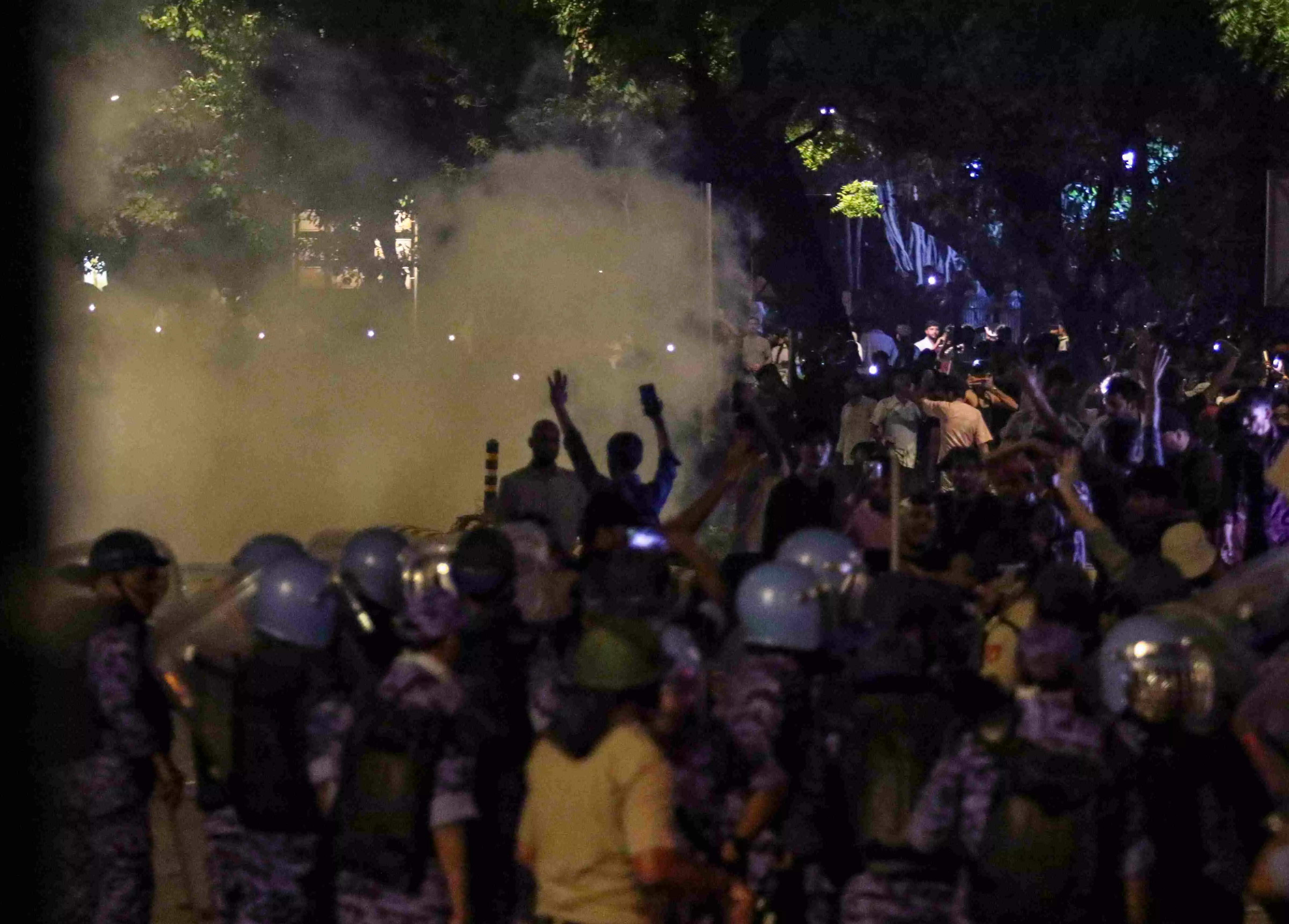
Social media has become an informal handbook for the Gen Z flooded by tips and hacks. Photo: PTI
Internet off, goggles on: Gen Z's protest survival guide goes viral
Gen Z protesters at Jantar Mantar are sharing offline communication tools, safety tips and preparedness advice as NEET demonstrations continue amid police action

What began as a protest over the NEET controversy has also become an exercise in survival and innovation by Gen Z agitators. At Jantar Mantar, where demonstrators linked to the Cockroach Janata Party (CJP) continue their sit-in despite repeated police crackdown, a parallel information network has emerged online.
Instead of debating slogans alone, young protesters are swapping practical advice on coping with internet blackouts, tear gas and baton charges.
Survival guide emerges
Social media has become an informal handbook for the Gen Z flooded by tips and hacks. One user, frustrated after repeatedly losing connectivity during the demonstrations, urged others to prepare before arriving by downloading offline maps.
Also Read: Why CJI’s dismissal of CJP protest crackdown plea exposes gaps in suo motu rules
He also recommended Bluetooth-based messaging apps that work without mobile data, locally run large language models that function without cloud access, LoRa communication devices, and saving the contact details of nearby residents in case of emergencies.
Offline hacks spread
Health tips are circulating just as quickly. A woman shared a remedy she said a friend found effective after a protest, suggesting a mixture of equal parts water and an antacid such as Maalox or Digene to ease the sting of tear gas. Others advised carrying painter's masks, dust masks and protective goggles to limit exposure to smoke and irritants.
Also Read: From slaps, social media ridicule to threats: Police brutality under fire amid CJP protests
Some suggestions are more improvised. One protester described slipping thermocol sheets inside his jeans to soften the impact of lathi blows. He also packed a spare shirt, an extra kurta for any woman whose clothes might be torn, and two helmets so one could be lent to someone without protection.
Improvising protection
The crowds have changed, too. Many of those arriving after Monday's clashes were first-time protesters. Videos of tear gas shells and police action at Parliament Street, Patel Chowk and Rail Bhawan convinced many to come equipped with swimming goggles, N95 masks, damp towels and helmets.
Also Read: Has CJP protest revealed a chink in BJP’s armour? | Talking Sense With Srini
Hardik, 22, returned wearing the same gear. "The tear gas was much stronger than I expected. Even after we moved away, we could still feel it. Yesterday taught us that the goggles and mask have to fit tightly. Even a small gap lets the gas in. These goggles really helped me, so I brought them again today. I bought them yesterday from Zepto," he said.
Despite the violence, he remained resolute. "I came yesterday, I came back today and I'll keep coming back. If students are raising questions about education, I want to stand with them. It is our fundamental right," he added.
Lessons from the frontline
Harishma, who travelled from Bengaluru, admitted, "I never imagined I would carry swimming goggles to a protest." Yet after witnessing people struggle through clouds of tear gas, she packed them again the next morning.
Also Read: Who Is Rhiya Ahir? Woman who blocked police van during Mumbai students' protest goes viral
Another teenager from Uttar Pradesh echoed the changing mood. "I ordered everything before sleeping as I saw videos online of yesterday. The goggles arrived in less than half an hour. I had never owned a pair before, but after watching yesterday's videos, I didn't want to come unprepared," he said.
For one student from Rajasthan, the experience left a lasting mark. "Yesterday showed us what to expect. I wasn't going to leave home without them again," he said, before adding, "Protesting is our fundamental right. We have the right to ask questions. I saw so many people get injured yesterday. I cried myself to sleep because I felt so helpless."
Across the protest site, the placards voiced political demands, while the goggles, masks and helmets reflected a generation learning, in real time, how to endure a crackdown.
(With agency inputs)