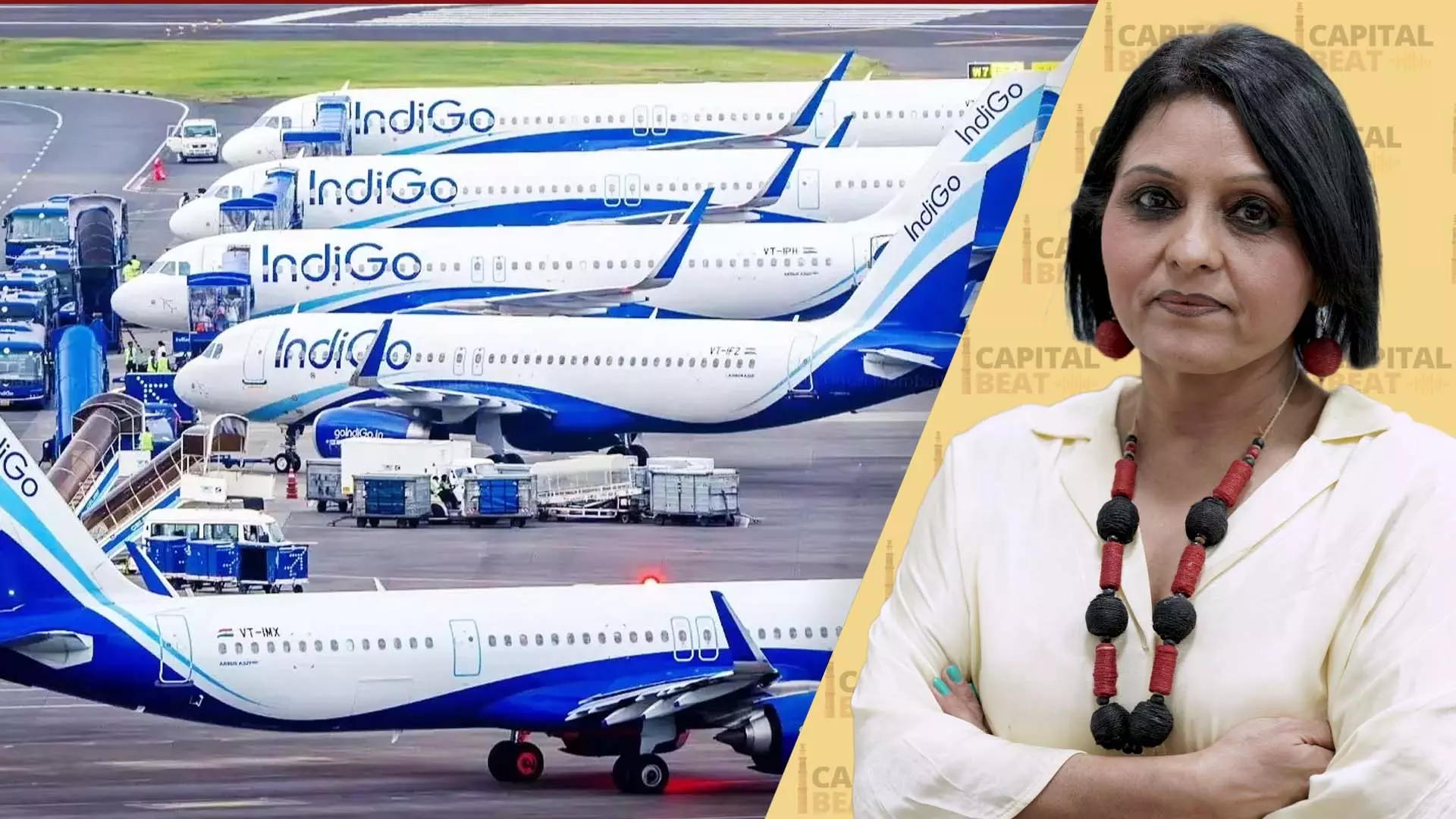
IndiGo mass cancellations: Where does the buck stop? | Capital Beat
India’s airports face chaos as IndiGo’s mass disruptions expose deeper concerns over passenger safety, staffing, and aviation oversight

India’s aviation sector is facing a severe credibility test after days of large-scale flight disruptions linked to IndiGo’s operations and a controversial U-turn by the Directorate General of Civil Aviation (DGCA) on new pilot duty rules.
In this episode of Capital Beat, Air Marshal M Matheswaran (Retd) and Capt. Amit Singh examine how one airline’s dominance, regulatory weakness and policy rollbacks have created what many passengers experienced as an aviation collapse.
Nationwide disruption and passenger distress
Over the past four days, IndiGo grounded more than 1,000 flights after failing to adequately plan for revised pilot flight and duty time limitations. The disruption led to long delays, cancellations and stranded passengers at airports across the country.
Also read: IndiGo crisis: Govt caps airfares, not to exceed Rs 18,000
Other airlines added capacity and the Railways stepped in to offer some relief, but travellers continued to report chaos and uncertainty. A government probe has been announced, with calls growing for accountability from both the airline and regulators.
Matheswaran, speaking from Nalanda University after his own flight from Patna to Chennai was cancelled, stated that he was “one of the affected parties” and highlighted the extent of disruption caused by IndiGo’s actions.
Monopoly concerns and IndiGo’s business model
The episode focuses attention on IndiGo’s dominant position in the domestic market. The airline holds around two-thirds of India’s domestic share, creating what the panel described as a de facto monopoly.
Matheswaran argued that this dominance has allowed the airline to push its resources to the limit: “IndiGo certainly is a very greedy and unethical airline.” He said the carrier’s approach “fundamentally hits at even the issues of safety of passengers” in a drive for profit maximisation.
Also read: IndiGo chaos continues; 400 flights cancelled
He added that the Competition Commission of India (CCI), the Ministry of Civil Aviation (MoCA) and DGCA had “failed to prevent this kind of a monopolistic situation”, enabling IndiGo to “extract the maximum out of their resources” without sufficient checks.
Regulator under fire
The DGCA, India’s aviation regulator, is facing strong criticism for its handling of the crisis. The new pilot fatigue rules were introduced in January 2024 and repeatedly deferred, largely at the request of airlines, including IndiGo.
Matheswaran said the regulator suffered from “lack of professionalism, conflict of interest” and even “corruption”, and argued that it had not enforced regulations with the seriousness required of an independent watchdog. He noted reports that “one of the vice presidents of IndiGo is also part of the DGCA system”, describing this as “a serious conflict of interest”.
The panel also questioned DGCA’s sudden withdrawal of its own circular, calling it a sign of regulatory capture. Matheswaran pointed to the wider impact on consumers, citing the example of an Air India ticket from Patna to Chennai that rose “from Rs 8,000 to Rs 75,000”, calling such dynamic pricing “sheer madness”.
DGCA ‘meow’ and IndiGo ‘roar’
Singh, an aviation safety expert, described the power imbalance between the regulator and the airline in sharp terms: “In the last four days, we have seen DGCA meow and IndiGo roar.”
He traced the timeline of the new flight and duty time limitation rules, noting that they had been under judicial scrutiny since 2019. The DGCA notified changes with four major reforms, but airlines pushed back, warning of a 25 per cent increase in crew requirements.
Initially, he said, the DGCA chief took a tough stand and “categorically said that nothing doing. First June is implementation date and it will not change”, which made the aviation fraternity hopeful that reform would go through. However, the decision was later diluted, suggesting pressure from “some higher power beyond his reach and capability and power”.
Fatigue rules and regulatory shortcuts
Singh detailed how the implementation was split into phases, with the first phase in July. Then, in September, DGCA issued a draft circular exclusively to airlines on bringing in a fatigue risk management system (FRMS), a data-driven mechanism to manage pilot fatigue.
He pointed out that FRMS requires extensive training and regulatory preparedness, which had not been done, despite earlier committee recommendations after the Mangaluru crash. “Right now, there is nobody who has been trained,” he said, adding that regulations cannot be replaced by circulars.
Under existing law, he explained, rules must be drafted, put out for 30 days of public comment, and finalised after due process. By attempting to implement FRMS by December through a shortcut, Singh argued, DGCA “wanted to implement the FRMS by December through this shortcut”, bypassing the mandated regulatory route.
Safety perception and public voice
The discussion also touched on broader safety culture and public risk tolerance. Singh noted that safety is often perceived rather than objectively assessed, comparing Indian road-crossing behaviour to foreign visitors’ unease.
He argued that the Indian flying public, the largest stakeholder, lacks collective representation: “The public does not have a say… There is nobody representing the public, so how will they push back?”
As a result, he said, “individually everybody knows which is a good airline, which is not a good airline”, but there is no organised pressure for system-wide reform.
He added that many in the industry are aware of how aircraft are maintained and ground operations conducted, and that “our risk appetite is higher” because of constant exposure to risk.
Calls to break up IndiGo
Looking ahead, Matheswaran argued that structural action may be necessary to protect passengers and the sector. He suggested that if such a crisis had occurred in Singapore, “the legal culture would have come down like a ton of bricks” on the airline.
He proposed that the government “break up IndiGo into three separate entities”, stating that “this monopoly will never benefit the country and will never benefit the passengers”. Referring to InterGlobe Enterprises’ wider presence in ground handling and maintenance, he described IndiGo’s dominance on both ground and air as “unethical” in a market that allows “an entity in terms of monopoly”.
He also compared the situation to international precedents where large corporations such as IBM were broken up in the past to protect competition.
Adani, training and systemic gaps
The panel briefly examined reports of Adani Defence Systems and Technologies Limited moving to acquire a majority stake in Flight Simulation Technique Centre, an independent simulator-based pilot training provider.
Matheswaran warned that this could create another concentration of power, as the Adani Group already has a major presence in ports and airports. He argued that such consolidation risks prioritising “business and monopoly control rather than meeting the safety and professional requirements” in training and simulation.
Singh, however, noted that pilot training is a profitable and growing business in its own right, given mandatory periodic training and projected fleet expansion. He pointed out that India outsources around 60 per cent of such training to foreign centres, resulting in a significant foreign exchange outflow, and said the sector requires a “big revamp” in both infrastructure and instructor standards.
Rules without enforcement
Singh concluded by highlighting a chronic problem: regulations exist on paper but are not enforced. He cited a rule requiring airlines with more than 10 aircraft to create training infrastructure in India, which has been deferred annually for six to seven years.
“Why make a rule when you have to give exemption?” he asked, arguing that exemptions have “become a norm” and undermine the entire regulatory architecture.
He described the system as structurally fragile: “Whenever you put pressure on the system, it breaks… because the foundation is so weak.”
(The content above has been transcribed from video using a fine-tuned AI model. To ensure accuracy, quality, and editorial integrity, we employ a Human-In-The-Loop (HITL) process. While AI assists in creating the initial draft, our experienced editorial team carefully reviews, edits, and refines the content before publication. At The Federal, we combine the efficiency of AI with the expertise of human editors to deliver reliable and insightful journalism.)