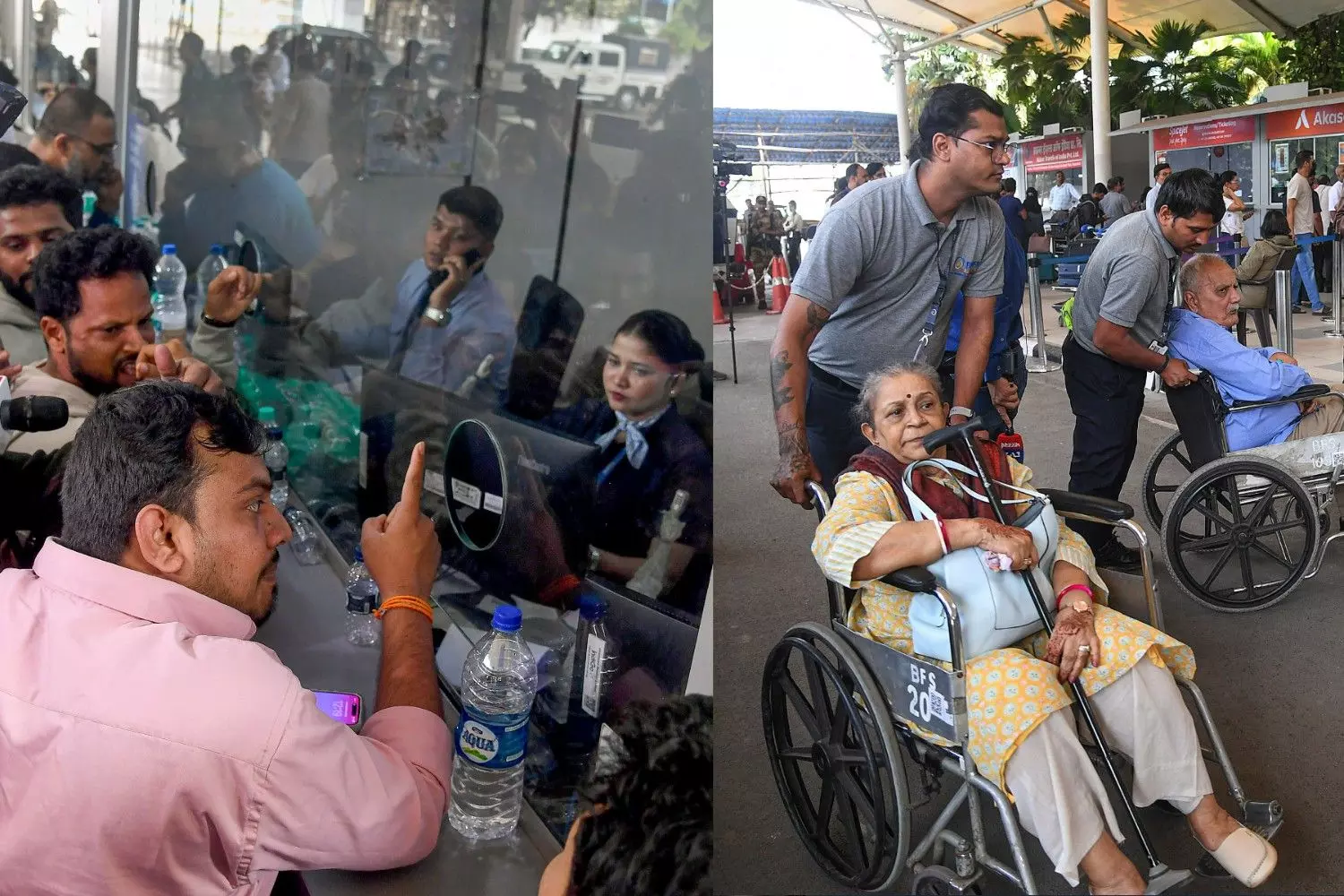
Stranded passengers at Chhatrapati Shivaji Maharaj International Airport amid IndiGo flight disruptions, in Mumbai, Saturday, December 6. PTI
IndiGo crisis: Govt caps airfares, not to exceed Rs 18,000
Air India and Air India Express, which have been adding capacity to absorb displaced passengers, said they have already been proactively capping economy-class fares on all non-stop domestic flights since December 4

India’s aviation sector has been thrown into turbulence over the past week, with IndiGo at the centre of an unprecedented disruption. Hundreds of cancellations and delays have left runways crowded with frustrated travellers and packed airport lounges.
In response, the Ministry of Civil Aviation (MoCA) has stepped in with an extraordinary measure: temporary caps on domestic airfares. The move is aimed at protecting passengers from what the ministry calls an “unreasonable surge” in ticket prices during a sudden capacity crunch.
Also read: IndiGo flight chaos: Airline offers free cancellation, rescheduling till Dec 15
Air India and Air India Express, which have been adding capacity to absorb displaced passengers, said they have already been proactively capping economy-class fares on all non-stop domestic flights since December 4.
“It is not technically possible to cap all permutations such as one-stop or two-stop itineraries or mixed-cabin combinations sold by third-party platforms, but we are engaging such platforms to exercise oversight,” an Air India spokesperson said, adding that both airlines were working to “help travellers and their baggage reach their destinations as quickly as possible.”
What is new four-slab fare structure?
At the heart of the government’s intervention is Order No. 01/2025 of the Ministry of Civil Aviation. The order, dated December 6, 2025, notes that disruptions in the operations of “one of the scheduled airlines” have led to cancellations and severe capacity constraints on several routes. It states that this has triggered “unreasonable” increases in fares across many sectors, prompting the Centre to act “in the public interest” by limiting what airlines can charge on domestic flights.
Also read: Domestic airfare shoots up; Kolkata-Mumbai at Rs 90,000
The order lays out a simple four-slab structure for economy-class one-way fares on specified domestic sectors. For flights up to 500 kilometres, the maximum fare that airlines can charge is set at Rs 7,500, excluding taxes and charges such as the User Development Fee (UDF) and Passenger Service Fee (PSF). For sectors in the 500-1,000 km range, the cap is Rs 12,000. Routes between 1,000 and 1,500 km have been capped at Rs 15,000, while flights over 1,500 km cannot be priced above Rs 18,000. These limits apply only to economy tickets and specifically exclude business class and RCS-UDAN flights, which follow separate rules.
Govt tightens oversight across all booking channels
Airlines have been told that these limits will apply to all forms of bookings, whether made through an airline’s website, mobile app, call centre, airport counters, or third-party online travel agents.
The government wants to close any loopholes that might allow carriers to bypass the caps by pushing high-fare inventory through particular channels. The order also reminds airlines that fares must be available “across all buckets”, effectively restraining them from blocking lower fare classes and offering only the highest permitted prices.
Also read: IndiGo chaos continues; 400 flights cancelled
The order instructs airlines to “avoid steep or unusual upward fare revisions” on sectors hit by cancellations and to consider capacity enhancement wherever possible. It nudges carriers to operate additional flights, rather than simply using scarcity to drive up fares. The ministry further asks airlines to extend “maximum possible support” to passengers affected by the disruption, including by offering alternate flights where feasible.
For passengers, this intervention brings a measure of predictability at a time of confusion and anger. Just days ago, travellers on some trunk routes were reporting shock fares running into several tens of thousands of rupees for last-minute bookings. The new caps do not necessarily mean cheap tickets, but they do set a transparent upper boundary for what a last-minute seat can cost while the crisis plays out. For a family of four travelling, for instance, the difference between an uncapped and a capped fare on a long-haul domestic route could mean savings of tens of thousands of rupees.
IndiGo’s roster meltdown and FDTL flashpoint
The immediate context for the fare caps is the meltdown at IndiGo, which has struggled to maintain its schedule after a severe roster crunch and ongoing disputes about pilot fatigue rules. Over recent days, domestic operations have seen mass cancellations, long queues and widespread delays as the airline scrambled to adjust. The disruption coincided with the implementation of revised Flight Duty Time Limitations (FDTL) rules, designed to give pilots more rest and reduce fatigue-related risks. IndiGo pushed back, arguing that the new norms were too restrictive and would force cuts in its winter schedule.
In an attempt to ease the pressure, the aviation regulator granted IndiGo selective relaxations from parts of the new FDTL regime. That decision, however, triggered a sharp backlash from the Airline Pilots’ Association of India (ALPA India). In a strongly worded letter to the Director General of Civil Aviation (DGCA), ALPA India described the dispensations as “selective and unsafe” and accused the regulator of destroying “regulatory parity” by tailoring safety norms for a single operator.
As the disruption widened, aviation regulators also came under scrutiny for how they handled the cascading operational failures and their impact on passengers. Alongside fatigue-rule dispensations and fare caps, a new dimension entered the debate on Friday (December 5) after aviation safety expert Capt. Amit Singh (Varah) argued that IndiGo’s actions may fall under abuse of dominant position as defined in Section 4 of the Competition Act, 2002.
In a detailed post, Capt. Singh said, "Indigo engaged in unfair and discriminatory conditions” — alleging that IndiGo “sold tickets knowing they didn’t have enough pilots to operate flights and cancelled flights without adequate mitigation." He spoke about the airline’s limited supply — arguing that the airline “deliberately restricted flights when fatigue rules kicked in and continued selling seats despite knowing operational capacity would fall short."