



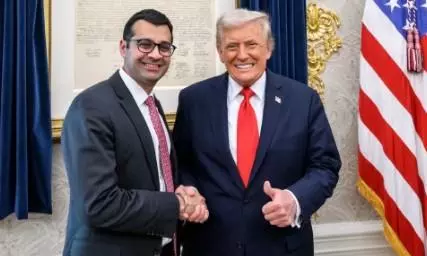
Who is Ricky Gill, Indian-origin Trump adviser awarded for ‘Indo-Pak ceasefire’?
Secretary of State Marco Rubio honours Indian-origin advisor despite New Delhi rejecting claims of US mediation following Operation Sindoor in May

In a move seen as reinforcing US President Donald Trump’s repeated claims of brokering peace between India and Pakistan, Ricky Gill, an Indian-origin adviser in the Trump administration, has been awarded for his alleged role in ceasefire negotiations between the two nuclear-armed neighbours.
Also Read: Trump reiterates claim of ending India-Pakistan conflict
Ranjit ‘Ricky’ Singh Gill, the senior director for South and Central Asia at the National Security Council (NSC), was recently conferred the NSC’s Distinguished Action Award by Secretary of State Marco Rubio. While the award citation is said to reference his role in ceasefire talks between India and Pakistan, the Trump administration has not disclosed details of Gill’s exact involvement.
Who is Ricky Gill?
Born into a Punjabi Sikh family to physicians Jasbir and Param Gill in Lodi, New Jersey, the 37-year-old Gill also serves as a special secretary to Trump. He is among only three Indian-Americans who are part of the president’s key advisory council in his second term.
A lawyer and expert in international affairs, Gill earlier served during Trump’s first term as director for Russia and European Energy Security at the NSC and has also worked as a senior adviser in the US State Department’s Bureau of Overseas Buildings Operations, including during the 2018 relocation of the US Embassy in Israel to Jerusalem.
Gill turned heads when he entered public service at 17 as the sole student member of the California State Board of Education under then-Governor Arnold Schwarzenegger, which made him a talent to watch for.
He holds a bachelor’s degree from Princeton University’s Woodrow Wilson School of Public and International Affairs and a law degree from the University of California, Berkeley.
Ricky Gill sparks diplomatic debate
The award, however, has drawn criticism in India, with several experts questioning the narrative of US mediation. Former Indian Foreign Secretary Kanwal Sibal took to X to express his concerns, suggesting the move contradicts India’s consistent denial of third-party involvement in the ceasefire.
“Puzzling. Apparently, the State Dept hasn’t announced this so far. Is this taking away credit from Trump, who has now said over 50 times that he coerced a ceasefire with trade threats? Now, it is a middle-level officer in the NSC who could knock together the Indian and Pakistani heads. Can’t see any purpose being served except to irritate India in propagating such a fictitious claim when India has denied any US role in the ceasefire even at Trump’s level (sic),” Sibal wrote.
Trump at it again
Meanwhile, Trump has once again claimed credit for ending hostilities between India and Pakistan, reiterating the assertion during his recent bilateral meeting with visiting Israeli Prime Minister Benjamin Netanyahu.
Trump claimed he had ended eight wars globally but had not received due recognition. He also said he resolved the Armenia-Azerbaijan conflict through tariff threats.
Also Read: Rajnath Singh refutes Trump's mediation claims on Operation Sindoor
“Settled eight wars, but we don't know the countries. Azerbaijan... It's good when you can say it... And (Russian President Vladimir) Putin actually said to me, ‘I cannot believe you settled that war because I've been trying for 10 years’. And I literally settled it in one day,” Trump said.
“Trade. They do trade. I said, ‘We're going to cut you off from trade. No more trade. To both of them... Then I put 200 per cent tariffs... the next day they called.… 35 years of fighting, and they stopped. Do I get credit for it? No. I did eight of them. India. How about India and Pakistan... So I did eight of them,” Trump told Netanyahu ahead of their meeting.
Also Read: Armed forces showed 'restraint' during Operation Sindoor, says Rajnath Singh
Since May 10, when Trump announced on social media that India and Pakistan had agreed to a “full and immediate” ceasefire after a “long night” of talks mediated by Washington, he has repeated the claim over 70 times that he ended the conflict.
India denies third-party involvement
He has reiterated this assertion during meetings with world leaders and on multiple foreign visits. India, however, has consistently denied any third-party mediation.
India had launched Operation Sindoor on May 7, targeting terror infrastructure in Pakistan and Pakistan-occupied Kashmir in retaliation for the April 22 Pahalgam terror attack that killed 26 civilians. After four days of intense cross-border drone and missile strikes, India and Pakistan reached an understanding on May 10 to end the conflict.