



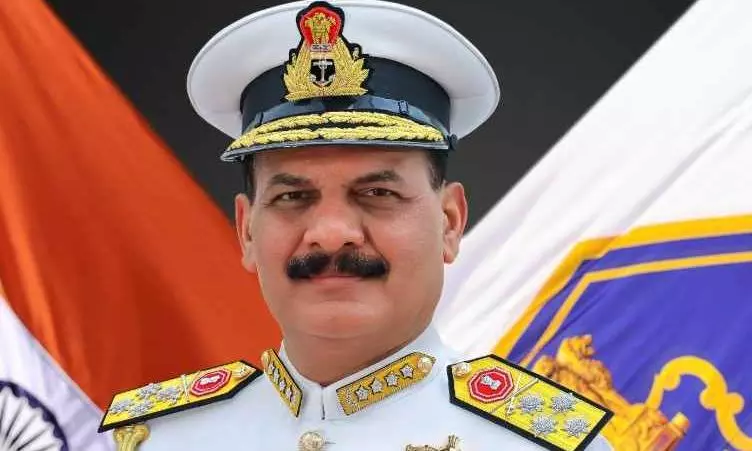
Chief of the Naval Staff Admiral Dinesh K Tripathi announced ambitious plans for Indian Navy. Photo: https://indiannavy.gov.in/
Indian Navy eyes 200-ship force by 2035, all new ships to be 'Made in India'
Chief of Naval Staff Admiral Dinesh K Tripathi outlines India's maritime ambitions after commissioning INS Anjadip at Chennai Port, targeting full Aatmanirbharta by 2047

The Indian Navy is on course to become a 200-plus ship maritime force by 2035 and plans to induct 15 additional vessels through 2026, Chief of the Naval Staff Admiral Dinesh K Tripathi announced on February 26. Speaking at the commissioning of INS Anjadip at the Chennai Port, the Admiral outlined an accelerating induction programme that he described as the highest rate in the Navy's history.
Tripathi said the Navy's long-term vision goes beyond fleet expansion: it aims to achieve complete self-reliance in shipbuilding down to the component level, evolving into a fully Aatmanirbhar force by 2047.
"The operational footprint of the Navy extends across the Indian Ocean Region and beyond, with naval units persistently forward-deployed on surveillance, anti-piracy and coordinated patrols, reflecting sustained reach and credible operational depth," he said.
Also Read: India unveils its first counter-terrorism policy, Prahaar
Describing the shift in India's defence manufacturing philosophy, Tripathi said the concept of Aatmanirbharat has progressed from 'Make in India' to 'Trust in India'. "We have embraced Aatmanirbharat not only as a strategic imperative but also as an investment towards future assurance," he added.
All 50 ships built in Indian shipyards
Highlighting the ongoing shipbuilding efforts, Admiral Tripathi said all 50 ships presently on order are being built in Indian shipyards. "As we look to become a 200-plus ship navy by 2035, our aim is to take Aatmanirbharat to the component level and build a fully Aatmanirbhar force by 2047," he said.
The maritime force is adopting a clear approach towards building credible capability across the spectrum of operations, addressing evolving threat perceptions on both the Western and Eastern seaboards, he said.
"Within this broader design, during the year 2025, the Indian Navy commissioned 12 warships and one submarine. This momentum continues with plans to induct about 15 more ships in 2026, setting an unprecedented benchmark and marking the highest rate of induction in our history," he said.
Anti-submarine warfare in sharp focus
Emphasising operational readiness, Tripathi said the Navy remains focused on sharpening critical warfighting capabilities, particularly in anti-submarine and undersea warfare.
On the commissioning of INS Anjadip, he said it is the fourth of the 16 Shallow Water Anti-Submarine Warfare vessels and strengthens the country's undersea warfare capability, particularly in the coastal and littoral waters of the Eastern region.
Also Read: India-built Bailey bridge in Sri Lanka under strain; Tamils seek permanent structure
Anjadip is equipped with state-of-the-art shallow water sonars, lightweight torpedoes, anti-submarine rockets and a combat management system, he said.
A ship that brings the nation together
Quoting Defence Minister Rajnath Singh, who has said that indigenisation in defence production strengthens national security, Tripathi said, "In that spirit, our pursuit of Aatmanirbharat has ensured that this ship enters service with robust capability and operational effectiveness."
He noted that INS Anjadip was built at Larsen and Toubro's Kattuppalli shipyard in the South by a team from Kolkata-based Garden Reach Shipbuilders and Engineers in the East, equipped with a combat management system designed in Ghaziabad in the North, and named after Anjadip Island in the Western region.
"It is indeed a true coming together of a maritime nation that is our India," he said.
(With agency inputs)