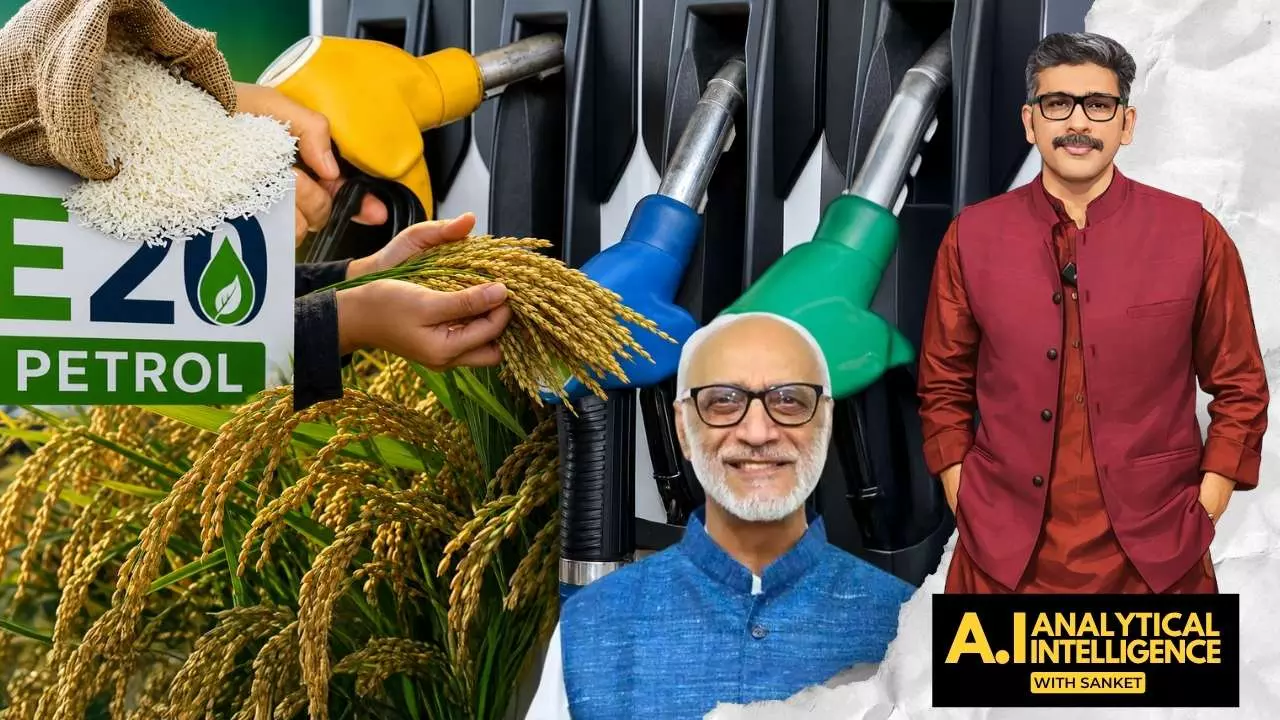
India must have strategic thinking on ethanol production: Ashok Gulati | Interview
Expert slams the use of water-guzzling irrigated crops for fuel; urges a revamp of distorted farm incentives, and a shift toward regions that are naturally suitable

As India expands ethanol blending to reduce dependence on fossil fuels, a move which has fuelled controversies over claims of vehicle damage and diminished fuel efficiency, questions are also being raised over sustainable agriculture policies.
In this episode of AI With Sanket, The Federal spoke with Professor Ashok Gulati, an agricultural economist from the Indian Council for Research on International Economic Relations (ICRIER), New Delhi, who feels the country is trying to solve the wrong problem by diverting surplus rice to ethanol, instead of fixing the policies that created the surplus in the first place.
Also read: Are automakers misleading E20 consumers? | AI With Sanket
According to him, distorted incentives, excessive procurement and unsustainable cultivation practices are placing enormous pressure on groundwater, public finances and the environment. In this discussion, we tried to understand from the expert why India needs to rationalise its rice policy, rethink procurement and redesign incentives for farmers.
Here are some excerpts from the interview
Why do you say India needs to rationalise its rice policy? What exactly needs to change?
Rice is our primary crop for human consumption. Today, we produce around 154 million tonnes of rice from about 53 million hectares, making India both the world's largest producer and exporter of rice.
We distribute 5 kilograms of free rice every month to nearly 800 million people. Now, because rice stocks have accumulated so heavily, we have also begun diverting rice towards ethanol production.
Also read: E20 fuel row: Experts question transparency in ethanol rollout | AI With Sanket
As of April 1, 2026, the Food Corporation of India (FCI) was holding nearly five times the buffer stock it actually requires for the public distribution system (PDS). Maintaining these excess stocks costs about Rs 5,900 per tonne annually, adding up to thousands of crores.
The government, therefore, decided to liquidate these stocks, initially using broken or damaged rice. My concern, however, is twofold.
First, why are we producing so much rice in the first place? States such as Punjab and Haryana provide almost free electricity, encouraging farmers to pump groundwater continuously. As a result, groundwater levels are falling by more than 1.5 feet every year.
Secondly, several states also offer bonuses over the minimum support price (MSP). Chhattisgarh is a striking example. In some years, government procurement of paddy has been almost equal to the state's total production. Clearly, something is not right.
If India wants to continue producing ethanol from sugarcane, we should return to where sugarcane was traditionally grown a hundred years ago—eastern Uttar Pradesh and north Bihar. They do not require the level of irrigation seen in Maharashtra. Sugarcane cultivation in Maharashtra is already creating a serious problem.
All of this comes under the food subsidy bill, which is meant to support the most vulnerable sections of society. Yet, the economic cost of rice to the FCI is around Rs 44 per kg, while broken rice is supplied to ethanol plants at roughly Rs 23 per kg.
The obvious question is: who exactly is being subsidised? Are taxpayers subsidising vulnerable citizens, or are they effectively subsidising vehicle owners through ethanol production?
There is also a major environmental concern. Rice cultivation damages groundwater; degrades soils and emits significant quantities of methane and nitrous oxide. We first damage the environment through production and then try to correct that damage by producing ethanol. We need rigorous scientific assessment of whether the overall energy balance is actually positive or negative.
Let me make one thing clear—I am not opposed to ethanol as a policy.
Globally, the United States is the largest producer of ethanol, accounting for more than half of global production, largely from corn. Less than 20 per cent of American corn is irrigated; it is mostly rain-fed.
Brazil, the second-largest producer, relies mainly on sugarcane, which is also largely rain-fed.
India, however, is increasingly using irrigated crops. Sugarcane in Maharashtra is highly water-intensive, while rice grown in Punjab and Haryana is even more damaging from a natural resource perspective.
That is why I argued that we must examine the balance between energy production and natural resource depletion. More rigorous testing is needed before we assume this is the right path.
My concern is entirely from an agricultural perspective, not about the impact of E20 fuel on vehicles.
Is India first creating a problem through subsidies and then trying to solve it by converting surplus rice into ethanol?
That is precisely the point.
We are not addressing the root causes of these enormous surpluses. These surpluses are not simply the result of efficient production; they are largely the consequence of massive subsidies on electricity and fertilisers.
One of our studies at ICRIER looked at 2023–24 data for Punjab and Haryana. We estimated that subsidies for rice cultivation amounted to roughly Rs 39,000 per hectare. Given the increase in fertiliser prices and subsidy levels since then, that figure today could easily be around Rs 50,000 per hectare.
Farmers also use nearly 250 kgs of fertiliser per hectare, most of it heavily subsidised.
The environmental costs are equally serious. Flooded paddy fields emit substantial methane, while plants absorb only around 35 to 40 per cent of the nitrogen supplied through urea. The remainder escapes into the atmosphere as nitrous oxide, which is about 273 times more potent than carbon dioxide as a greenhouse gas.
Also read: From mileage loss to rising repair bills: What a survey on E20 fuel found
So, first we pollute the environment and then claim we are reducing emissions by promoting ethanol. That simply is not a rational policy.
The real solution is to reform procurement and MSP policies.
There should be clear limits on how much paddy the government procures. Chhattisgarh, for example, procures almost everything it produces. Are people there consuming nothing themselves? They are incentivised to sell everything because they receive an additional Rs 1,000 bonus over MSP.
These are irrational policy choices. They damage both the environment and public finances.
Instead of looking for temporary ways to dispose of surplus rice, we must fix the policies that generate those surpluses.
If rice and sugarcane are problematic, won't shifting ethanol production to corn simply create new problems for food security?
That is the classic food-versus-fuel debate.
At the same time, we must also recognise that farmers need markets for whatever surplus they produce.
Instead of encouraging excess rice, policymakers should create stronger incentives for crops that India actually imports in large quantities—pulses and edible oilseeds.
Unfortunately, today's incentive structure is heavily skewed towards water-intensive and fertiliser-intensive crops such as rice, sugarcane and wheat.
Rice in Punjab and Haryana typically requires between 20 and 25 irrigations. Sugarcane in Maharashtra may require 25 to 30 irrigations.
Corn, by comparison, generally needs only three to five irrigations.
The reason farmers continue growing these water-intensive crops is simple: electricity for pumping groundwater is free or heavily subsidised in many states, while urea is subsidised by nearly 85 to 90 per cent.
As a result, we face shortages of pulses and oilseeds—crops that actually enrich the soil by fixing nitrogen and require much less water.
If we truly care about the long-term sustainability of Indian agriculture and want to protect our water resources, we must redesign incentives in favour of pulses and oilseeds.
If rice and sugarcane are not ideal feedstocks, won't ethanol production become too dependent on corn?
That is where the food-versus-fuel debate comes in.
Let us first look at the two biggest examples globally—the US and Brazil.
The former has a corn productivity of around 11 tonnes per hectare. In India, our productivity is only about 3 to 3.5 tonnes per hectare. The difference is not because they use more water or fertilisers. It is because they have adopted better technology, including genetically modified (GM) technology. India has rejected GM technology in crops such as corn and soybean.
Their productivity is almost three times ours, and under those conditions, using corn for ethanol does not create the kind of imbalance we are seeing here.
Brazil offers another example. As said earlier, sugarcane is largely rain-fed.
If India wants to continue producing ethanol from sugarcane, we should return to where sugarcane was traditionally grown a hundred years ago—eastern Uttar Pradesh and north Bihar.
Those regions naturally receive abundant water from the Himalayas. They do not require the level of irrigation seen in Maharashtra.
Sugarcane cultivation in Maharashtra is already creating a serious problem. It requires between 25 and 30 irrigations and is almost entirely dependent on irrigation. As a result, crops such as jowar, cotton and others lose access to water.
The late economist V M Dandekar, had pointed this out nearly 50 years ago. He described sugarcane cultivation in Maharashtra as almost criminal because it deprived food crops of scarce water resources.
If India wants an ethanol policy—and I am not against ethanol—we should identify regions where groundwater is abundant, such as north Bihar and eastern Uttar Pradesh. Those areas are naturally suited for sustainable sugarcane cultivation.
Also read: Centre never called E20 fuel programme an ‘experiment’ in SC: Attorney General's office
As for rice, I would not recommend using it for ethanol at all because rice is an enormous water guzzler.
Corn is a better alternative, but only if we improve productivity through better technology. Corn requires only about four irrigations. If we can increase yields from 3.5 tonnes per hectare to around 9 or 10 tonnes, there will be enough production for both ethanol and the poultry industry.
At present, people are consuming less corn because wheat and rice are distributed free under government schemes. Very few people regularly consume maize.
What is currently India's primary source of ethanol? Is rice becoming a major contributor?
No. Sugarcane continues to be the principal source of ethanol.
Last year, around five million tonnes of rice were diverted towards ethanol. Whether that becomes a permanent policy remains to be seen.
The government is currently pushing the industry to use broken rice because it wants to reduce the enormous stocks lying with the FCI.
Industry representatives have told me they are being asked to ensure that nearly 40 per cent of ethanol production uses broken rice supplied by the FCI.
That creates another concern.
The economic cost of rice for the FCI—including procurement, storage and distribution—is now about Rs 44 per kg. Yet this rice is being supplied to ethanol producers at around Rs 23 per kilogram.
The government argues that this is broken rice. But fair average quality rice already allows around 25 per cent broken grains.
Whether the rice contains 25 per cent broken grains or slightly more makes little difference to the PDS.
The real issue is the fiscal burden.
If the government carries excess stocks, it incurs heavy storage costs. If it liquidates them, it sells them at much lower prices. Either way, taxpayers bear the cost.
That is why every taxpayer should ask why India is producing such large quantities of rice year after year.
The incentive structure itself needs to change.
Do you have any specific policy recommendations to reduce India's dependence on rice while ensuring farmers accept these changes?
Yes.
The first reform should be to shift from crop-specific price support to direct income support.
Many states currently provide bonuses over the Minimum Support Price for paddy. Instead of rewarding a particular crop, they should provide farmers with direct income support.
If farmers receive the same level of support regardless of whether they grow paddy or pulses, they will be free to choose crops based on market demand rather than government incentives.
The second reform concerns procurement.
States that procure excessively large quantities of paddy should not be allowed to continue doing so indefinitely.
I mentioned Chhattisgarh earlier, where government procurement has reached almost 100 per cent of total production.
The Food Corporation of India should simply tell such states that any procurement beyond a reasonable limit is their responsibility, not the Centre's.
If you combine positive incentives with some policy discipline, farmers will gradually shift towards more sustainable cropping patterns.
That is where reforms to the Minimum Support Price system should begin.
If ethanol is here to stay, what should India's long-term strategy be?
Ethanol is certainly here to stay, and if we eventually move towards higher blends such as E100, demand will increase even further.
That is precisely why India needs a long-term strategy instead of temporary fixes.
For ethanol, we should focus on regions where groundwater is abundant and conditions are naturally suitable. That includes eastern Uttar Pradesh, north Bihar, parts of West Bengal and even Assam.
I would practically declare this entire region a sugarcane belt because sugarcane is the most suitable crop for ethanol when it is grown under natural conditions rather than intensive irrigation.
These regions receive abundant water flowing down from the Himalayas. Nature has already endowed them with this resource.
If policymakers think strategically, they can convert this natural advantage into rural prosperity.
If the chief minister of Bihar adopts such a strategy, north Bihar could become a major sugarcane-producing region for ethanol as well as sugar exports.
Instead of allowing this water to flow away every year through repeated floods, we should convert that water into economic value.
That is how farmers' incomes can increase while simultaneously meeting India's growing ethanol demand.
If India eventually moves towards E100, demand for ethanol will be even higher.
But the answer is not to keep expanding rice cultivation in water-stressed regions.
The answer is to produce the right crop in the right place using the right incentives.
That is the strategic thinking India needs.