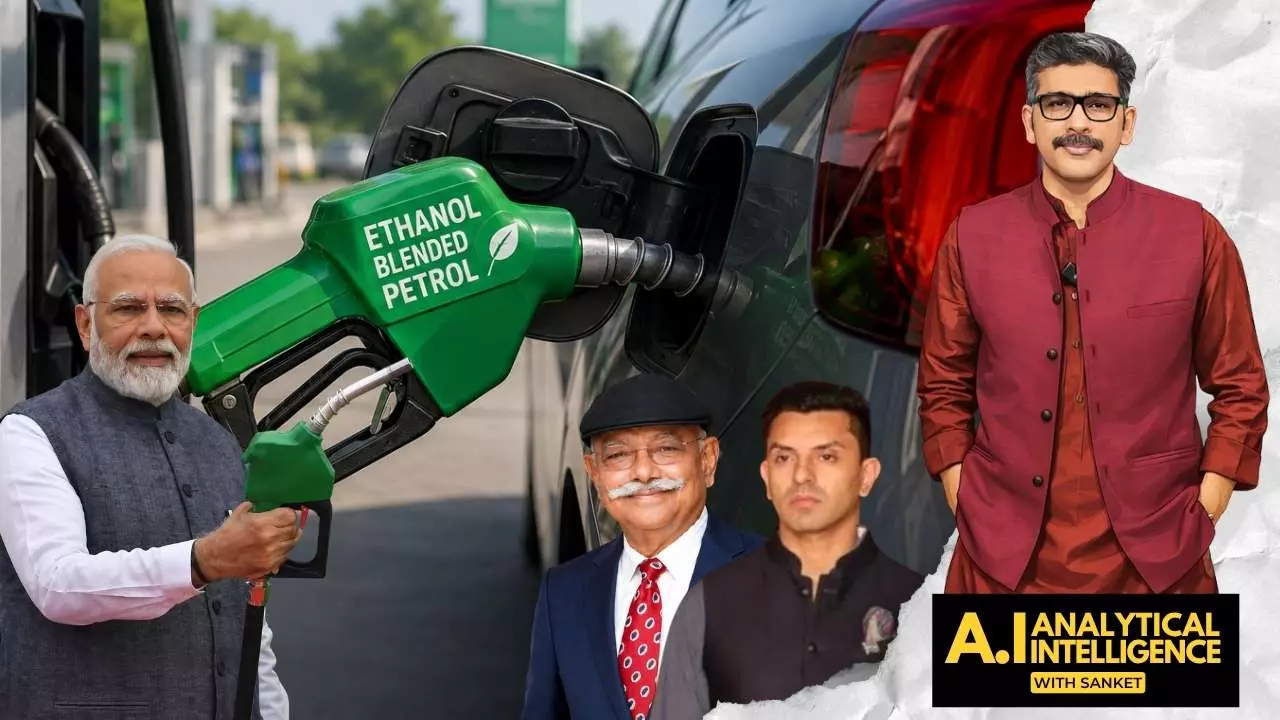
E20 fuel row: Experts question transparency in ethanol rollout | AI With Sanket
Auto expert Tutu Dhawan and political analyst Tehseen Poonawalla debate India's E20 fuel policy, transparency, consumer choice and vehicle safety

The controversy over India's E20 ethanol-blended petrol policy has intensified after the government reportedly described ethanol blending as an "experiment" before the Supreme Court, only to later deny using that term. The resulting confusion has raised questions about transparency, public consultation and the pace of implementation.
In this context, The Federal spoke to Tehseen Poonawalla, political analyst, and Tutu Dhawan, veteran automobile expert, on whether the rollout has been rushed and whether consumers have been given adequate information before being required to use ethanol-blended fuel.
Government's clarification questioned
Opening the discussion, Poonawalla said the government cannot deny statements made during Supreme Court proceedings when video recordings are available.
He claimed the Attorney General had described E20 implementation as an "experiment" and said the results would become clear after one year. According to him, the subsequent clarification denying the use of the word "experiment" has only deepened public distrust.
Poonawalla argued that citizens deserve complete transparency and access to all studies relating to ethanol blending rather than being asked to accept government assurances without supporting evidence.
Also read: Centre never called E20 fuel programme an ‘experiment’ in SC: Attorney General's office
He also criticised remarks made by Union Road Transport and Highways Minister Nitin Gadkari, saying critics of the policy were being branded anti-national instead of being engaged through evidence-based discussions.
Missing studies
Automobile expert Tutu Dhawan agreed that public awareness and transparency should have preceded implementation.
He pointed out that earlier attempts to popularise biodiesel through Jatropha plantations had failed despite extensive promotion, suggesting policymakers should have learnt lessons before introducing another alternative fuel programme.
According to Dhawan, consumers should have been informed about both the benefits and drawbacks of ethanol blending through publicly available testing before making it the default fuel.
He questioned why consumers were not given the option of continuing to buy regular petrol alongside ethanol-blended fuel.
Brazil comparison
Responding to comparisons with Brazil, Poonawalla argued that India's implementation differs significantly.
Also read: E20 petrol rollout is still an experiment; results expected by next year: Govt to SC
He said Brazil developed its ethanol ecosystem over several decades while offering consumers multiple fuel options ranging from E0 to E100 depending on vehicle compatibility.
In contrast, he argued, pure petrol has become difficult and expensive to obtain in India, effectively forcing consumers to use ethanol blends.
Poonawalla also questioned why India's original target of implementing E20 by 2030 was advanced to 2025 despite a large number of vehicles still not being fully compatible with the fuel.
Older vehicles
Dhawan warned that older vehicles face greater risks from prolonged exposure to ethanol-blended fuel.
He said vehicles built before BS4 standards, particularly vintage cars that remain parked for long periods, could suffer engine seizure because ethanol absorbs moisture from the atmosphere.
According to him, prolonged storage with ethanol-blended petrol could damage fuel tanks, fuel lines, injectors, rubber components and engine internals.
Owners of expensive luxury cars are already being advised to purchase fuel additives to minimise potential damage, he added.
Need for choice
Dhawan maintained that consumers should have been allowed to choose between conventional petrol and ethanol-blended fuel.
Also read: India to roll out 100 ethanol fuel stations, target 5,000 by 2027
He argued that those opting for ethanol should have received incentives, while those preferring regular petrol should have continued to enjoy unrestricted access to it.
He also acknowledged that comprehensive Indian test reports remain unavailable, leaving even experts dependent on anecdotal evidence rather than independently verified scientific studies.
Economic questions
Poonawalla challenged the government's claim that ethanol blending substantially reduces India's foreign exchange burden through lower crude oil imports.
While acknowledging that savings may exist, he argued that the government has not publicly accounted for other economic costs.
These include increased imports of corn by-products, diversion of food crops such as rice and maize towards ethanol production, pressure on livestock feed supplies and environmental concerns surrounding ethanol manufacturing.
He questioned whether any comprehensive cost-benefit analysis had been placed in the public domain before accelerating implementation.
July 5 protest
Poonawalla announced that he would participate in a protest at Jantar Mantar on July 5 against mandatory E20 implementation.
He clarified that the protest is not against ethanol itself but against compulsory E20 blending without consumer choice.
Also read: Will ethanol-blended fuel ruin your engine? India's ethanol push explained
Among the demands are publication of all government studies, restoration of fuel choices including pure petrol, implementation according to the original 2030 timeline, and complete transparency regarding testing and policy decisions.
He argued that vehicle owners whose manuals do not recommend E20 should not be compelled to use it.
Vehicle advice
Asked what owners of older vehicles should do, Dhawan offered practical maintenance suggestions.
He said owners of vehicles older than BS4 should exercise additional care while storing their vehicles.
According to Dhawan, adding approximately 0.05 per cent two-stroke (2T) oil to petrol may help improve lubrication in older engines.
For vehicles likely to remain unused for extended periods, he advised emptying ethanol-blended fuel from the tank, cleaning fuel lines and carburettors where applicable, and lubricating engine components before storage.
Also read: Ethanol blending in petrol is fine, but will it impact food security?
He stressed that these suggestions arise from decades of personal experience in the automobile industry, while reiterating that comprehensive official testing data should still be made public.
Transparency first
Both panellists ultimately agreed that greater transparency, publicly available research and wider consumer choice would have reduced much of the present controversy.
While they differed on broader political issues, both maintained that major policy changes affecting millions of vehicle owners should be supported by scientific evidence placed in the public domain before implementation.
(The content above has been transcribed from video using a fine-tuned AI model. To ensure accuracy, quality, and editorial integrity, we employ a Human-In-The-Loop (HITL) process. While AI assists in creating the initial draft, our experienced editorial team carefully reviews, edits, and refines the content before publication. At The Federal, we combine the efficiency of AI with the expertise of human editors to deliver reliable and insightful journalism.)