Message from Lanka, Nepal to India’s Gen Z: Resist like Gandhi, organise well
Activists from neighbouring nations, who took on their governments, urge CJP and other protesters to hold on to non-violence and build a political programme

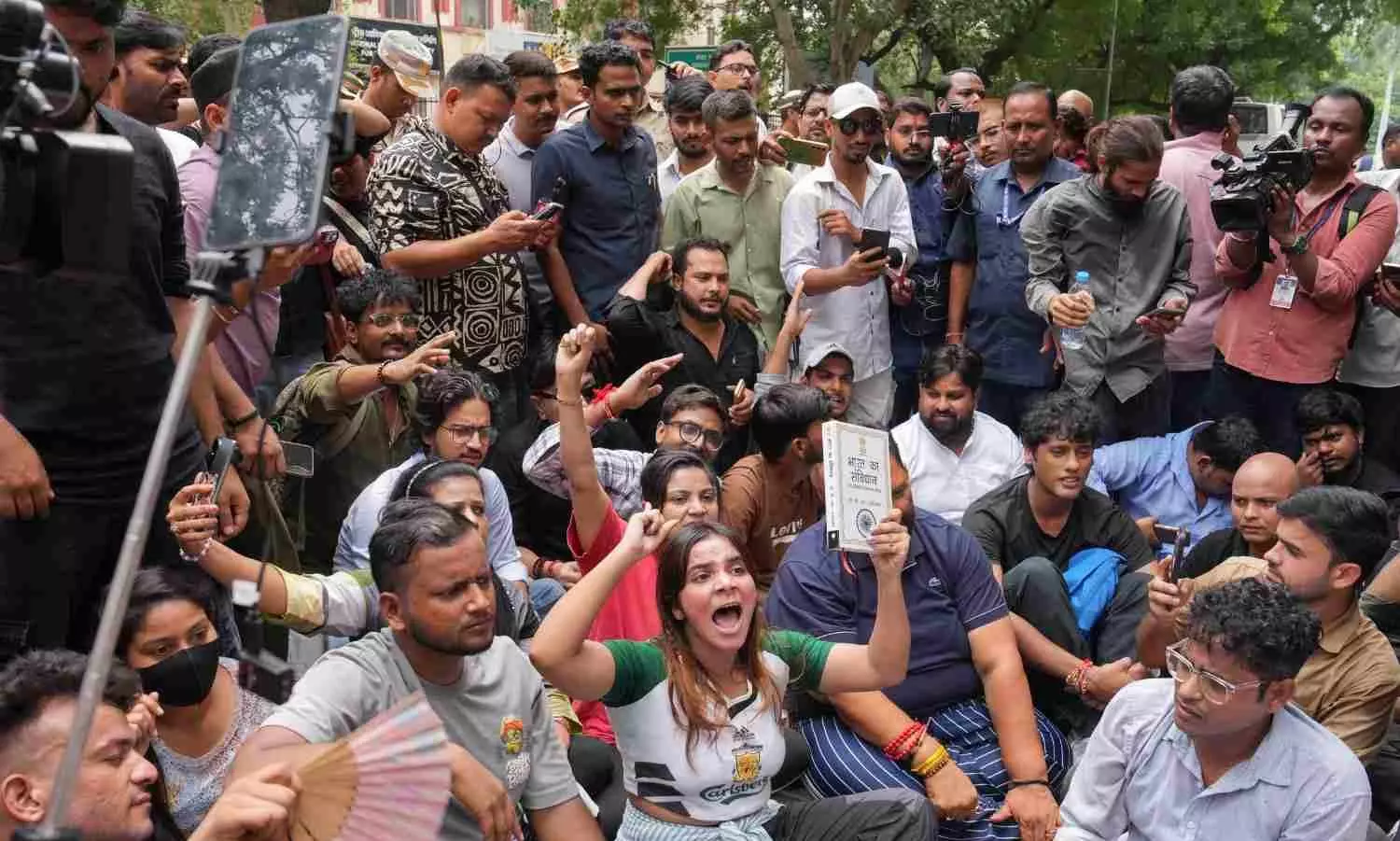
As India’s Gen Z takes to the streets, what do young activists in Nepal and Sri Lanka, who participated in movements that challenged their countries’ ruling establishments, make of the protests here?
When Majid Ansari heard about India’s youth-led protests, his first reaction was a sense of relief. “It was the relief of seeing vibrant democratic discourse led by young people, the generation I belong to, Gen Z, which has so often been dismissed in almost every South Asian country as politically ignorant, indifferent, or disconnected from the realities of governance.”
Nepal’s lessons for India’s Gen Z
Ansari, a law graduate, was part of Nepal’s Gen Z Alliance and of the team that negotiated with the state after the 2025 uprising that brought down KP Sharma Oli’s government. He knows how difficult it is for a youth movement to challenge those in power. His message to India’s Gen Z is one of hope, but also of caution: resist injustice, but do not allow anger to turn into hatred or violence.
Also read | Delhi protests: Top CJP leaders among over 7,000 detained amid security clampdown
“I do not want to lecture you or suggest that Nepal has all the answers,” he says. He wants to share what his country’s experience taught him: the importance of protecting a movement’s moral and democratic foundations, especially when circumstances become difficult.
“India has given the world Mahatma Gandhi’s philosophy of Satyagraha, a powerful tradition of resisting injustice without surrendering to hatred or violence,” he reminds Indian protesters. He says Nepal’s democracy fighters, too, drew on traditions of peaceful resistance inspired by Gandhi. He also invokes BR Ambedkar’s call to “educate, agitate, and organise”, arguing that democratic transformation requires not only resistance, but also knowledge and sustained civic engagement.
“Non-violence does not mean passivity. It does not mean accepting injustice, abandoning the streets, or remaining silent in the face of repression. It means refusing to allow violence to determine the character, methods, and ultimate destination of your struggle,” he warns.
‘Resist injustice without hatred’
Ansari rejects the charge that Gen Z is politically uncommitted. “I have always believed that democracy becomes stronger when political participation extends beyond a relatively small group of committed activists and becomes a concern of ordinary citizens, particularly young people.”
He has followed protests at JNU and other Indian universities, the anti-CAA and NRC protests, Shaheen Bagh, the farmers’ protests and other democratic struggles.
“There is another lesson I would like to share: please do not respond to hatred with hatred.” In deeply polarised societies, he warns, treating political opponents as enemies allows anger and exclusion to spread beyond politics, dividing families, communities and society itself.
He also cautions against replacing one populist, ego-driven leader with another who promises change but reproduces the same political behaviour. “We seek to defeat bad politics, not abandon democratic principles,” he says.
‘Resignations alone are not enough’
Monika Niroula, another Nepalese activist, who like Ansari, was part of the team that drafted the agreement with the authorities, sees both strength and weakness in the Cockroach Janta Party’s (CJP) insistence on narrowly focused demands for the resignation of officials.
“The difference in demands is key. Their demands are straightforward and narrow, which is both a strength and a weakness. When protests demand the resignation of individuals, there isn’t much left to the imagination. This reduces the chances of other forces co-opting the movement for political gains,” she says. “At the same time, if the movement focuses entirely on demanding resignations, a gap emerges in its articulation of the alternative they are seeking.”
Also read | SIR row, CJP’s rise, Delhi crackdown: How global media reported anti-CEC protests
Nepal’s movement faced a different challenge, she recalls. “On the second day, we wanted the resignation of the PM, but the movement collectively didn’t articulate or have a common understanding of what we wanted instead.”
The demands in Nepal were broader and vague, such as an end to corruption. This helped them resonate with a wide cross-section of people, but also brought ideological differences within the movement to the surface.
Niroula wonders whether the CJP and the communist party youth wings share a vision of reform, or whether they are coming together only around demands for individual resignations. “The strategy of demanding resignations seems to be effective and contained; on the other hand, it raises the question: ‘Then what?’”
“The question of whether they succeed in getting the government to reform is larger. What I do not see, outside of the individual resignations, is what CJP's vision for reform is,’’ she wonders.
‘India’s protests reflect deep discontent’
Pubudu Jayagoda is from the Frontline Socialist Party, which played a leading role in the Aragalaya, the mass uprising against President Gotabaya Rajapaksa and Sri Lanka’s political establishment in 2022. He argues that it was not a Gen Z-led movement.
“It is difficult to categorise the Sri Lankan struggle purely as a Gen Z movement,” he says. The island state was facing a severe economic crisis and, in April 2022, the country was declared bankrupt. The foreign exchange crisis led to shortages of essential items, including fuel and gas, affecting everyone.”
“The initial gathering around the President’s private residence occurred with the participation of local residents as a whole; it was not a Gen Z plan and had a spontaneous nature. Even before that, residents participated in evening protests at the village and city levels across the country, without any generational divide. However, later, when public spaces across the country, including Galle Face, were occupied, Gen Z played a leading role in the struggle.”
“In India, the movement was primarily launched with the contribution of youth and student forces. As it appears now, the core force of the struggle is Gen Z, and they enjoy significant public support. However, it has not yet become a full-scale mass movement through workers’ strikes or ordinary people taking to the streets across various regions, though the potential for that exists.”
He sees the protests in India as an expression of deeper discontent. “We view the current struggle in India as an expression of the growing discontent and frustration among ordinary people over economic breakdown and acute inequality, which lie beneath the Indian ruling class’s boasts of becoming a global economic superpower. It is also a protest against the anti-democratic, authoritarian and chauvinistic political policies pursued by the BJP over a long period.”
From street protests to political change
He offers Indian protesters two key pieces of advice. “First, preventing the struggle from sliding into anarchy and turning it into an organised mass movement. In the Sri Lankan experience, we succeeded in doing this. Second, the need for a formal political programme and leadership for that mass movement.”
“Due to the failure to achieve this in Sri Lanka, the struggle could not be directed towards political transformation or, at least, towards empowering the people with political authority. Instead, the old regime managed to consolidate power in a different form. This is a key lesson that the protesters in India should pay attention to.”
But as of now, the CJP is a pressure group for public good and not a political party.
Also read | Meet the faces of India’s Gen Z protest movement
Marisa de Silva, who was an active participant in the 2022 People's Struggle, said, “More strength and solidarity to the students and youth of India.”
“The first thing I see is that India’s movement is different from ours, primarily in a good way. There are a lot of women at the forefront, leading the protests, including, of course, Neha Bora and her colleagues, who are in the footage, addressing press conferences, leading the charge,’’ she adds. Quickly clarifying: “Not that there were no women during our protests; there were plenty of them, but they did not become the face of our movement.’’
“The second thing I notice is that Left organisations, including AISA’s youth wing and student groups such as SFI and AISF, are playing a pivotal role in the agitation; they are good organisers and should be allowed to give direction to the movement,’’ she adds.