How years of research produced the first grammar of the Gaddi language
After over a decade of fieldwork, six linguists have published the first comprehensive grammar of Gaddi, spoken by a pastoral community in Himachal Pradesh

In the villages scattered across the foothills of the Dhauladhar Mountains in Himachal Pradesh, the Gaddi language has long been spoken in homes, fields, and along the migration routes used by pastoral families. But it has existed largely outside formal scholarship.
That changed last month with the publication of ‘A Grammar of Gaddi’ by UCL Press on February 16 – the “first long-form descriptive grammar” of the language, which is also open-access.
Also read | Siddaramaiah opposes Kerala Bill mandating Malayalam in Kannada-medium schools
The book is part of the Grammars of World and Minority Languages series and is the result of more than a decade of collaborative work by six linguists who first encountered the language as students at the Centre for Linguistics at Jawaharlal Nehru University (JNU) as part of their Field Linguistics course with Professors Anvita Abbi, Ayesha Kidwai and Hari Madhav Ray as instructors. Drawing on fieldwork conducted in 2013 and 2015, the researchers pieced together what is now the most detailed linguistic description of Gaddi to date.
Documenting the Gaddi language
The authors – Preeti Kumari, Shreya Mehta, Anjali Nair, Anusuya Nayak, Yangchen Roy, and Vyom Sharma – began their work on Gaddi as student field reports, which gradually evolved into a much greater collaborative effort.
“None of us in the group were native speakers of Gaddi. So in many ways, it was a completely outsider experience for us. We were learning about the language and the community at the same time… I think what mattered to the people was that Gaddi was being put on the map of scholarship. They saw that people who didn’t even speak the language were interested in their culture and language. That itself seemed meaningful to them,” says Anjali Nair, who’s currently working with Pagdandi Collective in Delhi, an education group that facilitates grassroots-based learning experiences for young adults.
For a language spoken by a relatively small, traditionally pastoral community in the western Himalayas, the project represents a significant milestone in documentation.
“The Gaddis (pronounced /ɡəd̪d̪i/) are a pastoral group spread across many parts of northern India. They primarily live in the Bharmaur region of Chamba in the Indian state of Himachal Pradesh… In addition, they also live in other districts of Himachal Pradesh, in Kangra, Mandi, and Kullu, on the outer foothills of the Dhauladhar mountains, as well as at the fringes of the Pir-Panjal mountain range. They are also scattered across the region of Jammu in Jammu and Kashmir… Some also live in the neighbouring states of Punjab and Haryana,” the authors write in the book.
Language, identity and change
They note that, according to the 2011 Census, about 1,81,000 people reported Gaddi, also known as Bharmauri, as their mother tongue, although the census classifies it under Hindi. And as per Government of India data from 2013, the Gaddis have a population of 1,78,130 in Himachal Pradesh and 46,489 in Jammu and Kashmir.
Explaining why the language did not have a grammar until now, co-author Preeti Kumar, currently an Assistant Professor at SRM University in Andhra Pradesh, says, “If you look at the 2011 Census and the number of languages listed as mother tongues, many of them still do not have a documented grammar. Because their use is largely limited to the community itself, they often remain undocumented in formal linguistic terms. Gaddi is not unique in that sense.”
Linguistically, Gaddi belongs to the Western Pahari branch of the Indo-Aryan languages, within the broader Indo-European family.
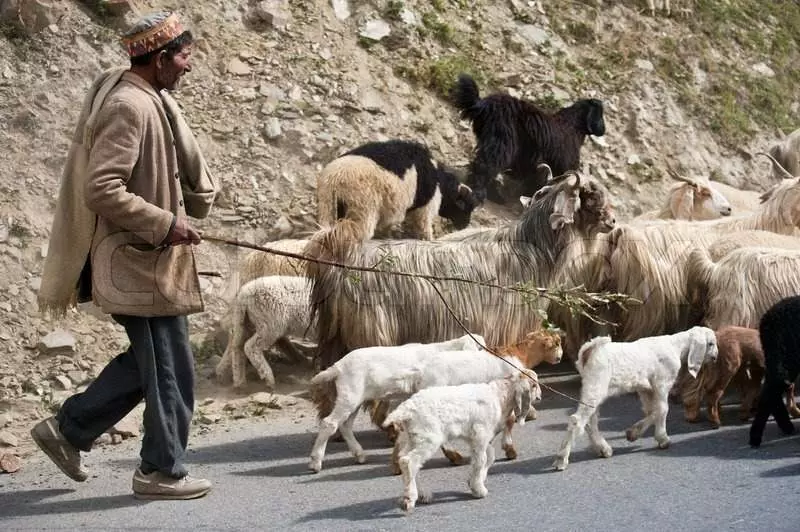
Traditionally, Gaddi life revolved around seasonal migration with flocks of sheep and goats. The authors note that community members often describe themselves as ghomtus – people “born with moving feet.” However, while pastoralism remains an important marker of identity, economic changes have altered livelihoods, with the authors noting that “half of the Gaddi population today does not or cannot earn their livelihood from pastoralism”.
Years of collaborative fieldwork
In her foreword to the book, Prof Kidwai writes that the team had to do “an extraordinary amount of work to meet the demands of a descriptive grammar”.
“From studying and verifying all the data contained in individual reports, to filling in the gaps in the data with fresh fieldwork, all the way to crafting a unified grammatical description, to dealing with the prolonged effects of the COVID-19 pandemic and the writing and completion of their individual PhDs, this first-ever descriptive grammar of Gaddi has been a monumental effort of collaboration and camaraderie,” she writes.
Also read | How India’s linguistic federalism shaped the conflict over a national language
After the 2013 and 2015 fieldwork, a final round of online data collection in February 2022 helped fill remaining gaps. Fieldwork took place primarily in the villages of Saperu, Banuri, and Kandbari near Palampur in Himachal Pradesh, with participants ranging from elderly speakers to young adults.
The book examines the language at multiple levels – phonetics, phonology, morphology, syntax, and clause structure – while also providing appendices with a phonemic inventory, numerals, and a basic word list.
Distinctive features of Gaddi
Gaddi, the researchers found, has a particularly rich vowel system. It contains eight oral monophthongs, three nasal vowels, and nine diphthongs, placing it among languages with a large vowel inventory. Like many South Asian languages, Gaddi follows a subject-object-verb (SOV) word order. But it also has distinctive grammatical patterns.
“In Hindi, you might say Ram ne khana khaya, where ne marks the case. In Gaddi, when this kind of case marking appears, the noun itself changes form – ‘Ram’ becomes ‘Ramma’ and ‘Shyam’ becomes ‘Shyamma’,” says co-author Vyom Sharma, explaining the peculiarities of the language.
Sharma, who now works as an English Language Instructor at the Indian Institute of Technology (IIT) Delhi, also says there are caste dialects.
“One thing I discovered while working on syntax and negation was that there are caste dialects within the Gaddi community. For the word ‘nahi’, one part of the community uses ni as a negation marker while another uses na,” he says.
An oral language tradition
Unlike many languages with long written traditions, Gaddi has historically been an oral language. Community members say it has no widely established script, though Devanagari could easily be adapted for it. Earlier generations are also believed to have used the now-rare Tankri script.
The lack of written material has meant that linguistic knowledge has been passed down almost entirely through speech, songs, and oral narratives.
Rattan Pahl, a member of the Gaddi community who works with the Government of India, says the book could help fill that gap.
“It is only in the last twenty years or so that audio-visual records of the Gaddi language have come up through folk songs. But we don’t have much written material. Right now, the book is in English. But if it is translated to Hindi, it can be very useful,” he says.
The third edition of UNESCO’s Atlas of the World’s Languages in Danger classifies Bharmauri (another name for Gaddi) as “definitely endangered”. But the authors say their fieldwork suggests a more complex picture.
Safeguarding Gaddi’s linguistic future
While the language is still widely transmitted across generations in many areas and is even being used in elementary classrooms, there are signs of change.
Also read | What PM Modi gets wrong on Macaulay and introduction of English education
“Hindi-Urdu, a major language, is found to have encroached on the vocabulary of Gaddi. Documenting the language extensively and equipping it with a script at this stage can prevent it from reaching a critical stage of endangerment. These steps can also facilitate primary school education in the mother tongue and help build language resources for the community,” the authors note.
They recognise that for now, the book remains primarily a technical linguistic resource.
“We understand that this book is quite technical and therefore less accessible to general readers. But a detailed grammar is necessary as a foundation. This work can later be used to create school primers, simpler grammar books, or translations that the community can use,” says Sharma.
More than just grammar
Kumari echoes the point and underscores why such books are important. “Grammar books for minority languages are very important because they represent not just the language but also the knowledge of the speech community. Many of these languages are not taught in schools, but they are still culturally and linguistically significant. Our aim is to highlight that the linguistics of minority languages is as important as that of any other language,” she says.
Nair adds that the book is "not just about grammar".
"It also contains sections on the socio-cultural landscape of the community and things like the numeral system. So even if someone is not interested in the entire book, certain parts of it could still be useful to many people," she says.
The team hopes eventually to produce a Hindi translation or a simplified version that could reach younger speakers within the Gaddi community.
Rediscovering language and identity
For younger members of the community, the book has already begun to shift perceptions. Shivanshu Thakur, a Gaddi student studying engineering in Tamil Nadu, says that growing up, he often believed he was speaking a “broken” form of Hindi.
“Growing up, many of us were told that these were just dialects of Hindi. Combined with the lack of a written script, very little recorded history, and little discussion of language or ancestry among elders, I developed a deep detachment from my heritage… It was only after meeting students speaking Tamil, Telugu, Bengali and Gujarati in college that he began exploring his own linguistic background more seriously,” he says.
Also read | Why BJP minister L Murugan is wrong about learning Hindi in Tamil Nadu
Thakur says the book came at a time when he was trying to research Gaddi on his own.
“When I eventually came across the book, I felt genuinely grateful to see such work being done. Himalayan communities often feel understudied, and the diversity within small mountain regions is rarely fully recognised… I have little to no mutual intelligibility with Churahi and Pangwali despite being under the same umbrella of "western pahadi". That is why a book like this feels like a meaningful step forward for the Gaddi language and the Gaddi community,” he adds.