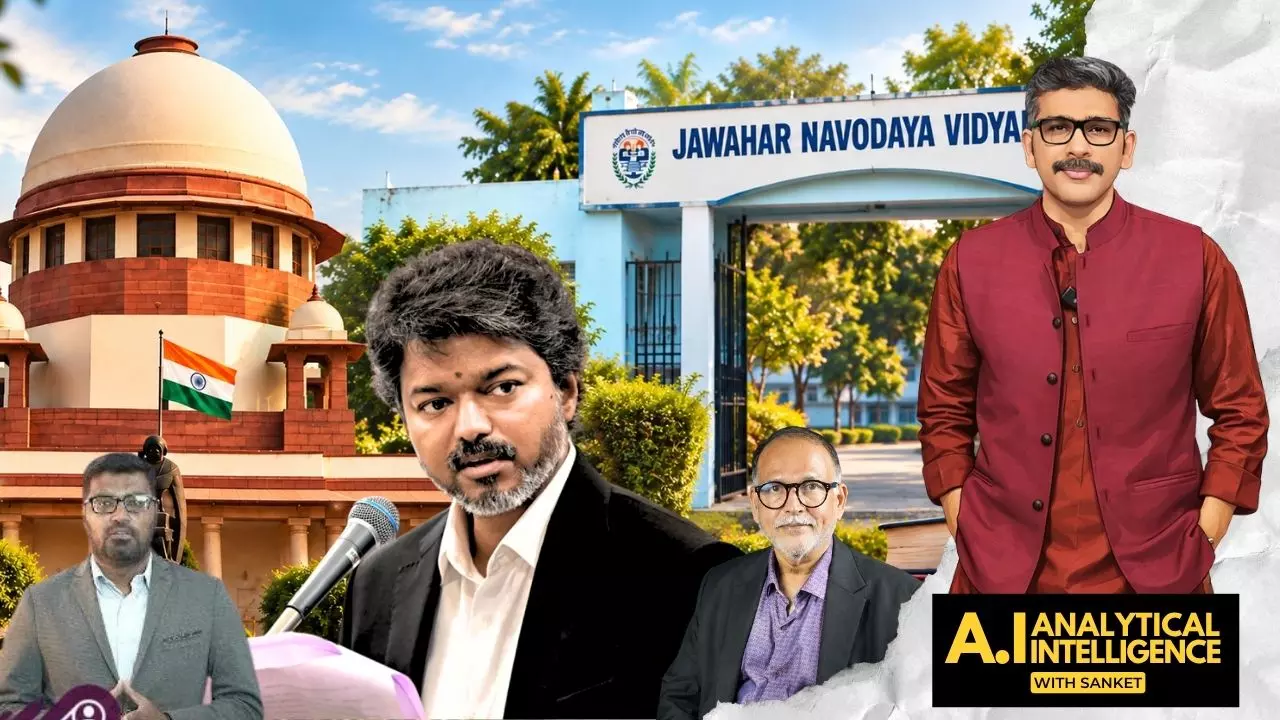
'If I could learn Hindi in Pollachi...': Journalist on Tamil Nadu's language policy
As the Supreme Court asks Tamil Nadu to reconsider its Hindi policy, analysts ask why the state's two-language stand isn't anti-Hindi, it's anti-imposition

The Supreme Court's recent observations on Hindi education in Tamil Nadu have reopened a decades-old debate over language, federalism and the state's two-language policy.
In a conversation with The Federal, senior journalist RK Radhakrishnan argued that the Constitution does not mandate a three-language policy for states. He said the language question needs to be understood through the constitutional debates that preceded the adoption and continuation of English alongside Hindi.
He also rejected the idea that Tamil Nadu generally opposes learning Hindi. He pointed to the Dakshina Bharat Hindi Prachar Sabha in Chennai, an institution that provides Hindi education, and said Hindi can be learnt both within and outside formal education. The institution continues to conduct Hindi examinations and educational programmes.
Learn or impose?
Radhakrishnan also cited his own experience, saying he learnt Hindi at a CBSE school in Pollachi. He argued that the dispute is not whether people in Tamil Nadu should be allowed to learn Hindi, but whether Hindi should be imposed as part of the formal education system.
Also Read: Navodaya was never just about language, it's a Constitutional issue, says TN educationist
Radhakrishnan said the court's remarks reflected an inadequate presentation of Tamil Nadu's position, while Ibrahim argued that the state's opposition is not to Hindi itself but to what he described as language imposition.
The debate followed observations by a Supreme Court bench during proceedings regarding Navodaya Vidyalayas in Tamil Nadu. The court told the state to reconsider its approach towards Hindi and said it could not be that Hindi would not be taught on Tamil Nadu's soil. It also urged Chennai and the Centre to resolve their differences through dialogue.
Tamil Nadu has opposed Navodaya schools because they follow a three-language formula that includes Hindi, while the state follows a two-language policy. The Supreme Court declined to recall its earlier direction relating to identifying land for Navodaya schools and gave the state additional time to comply.
'Why not same importance to other languages?
Political analyst Harish Mohammad Ibrahim also maintained that the objection is to imposition rather than to Hindi itself. He pointed to the presence of Hindi-speaking workers from northern India in Tamil Nadu and argued that people in the state routinely learn Hindi when there is a practical need to communicate.
He said Tamil Nadu's position also stems from concerns over the treatment of Tamil and other classical languages, arguing that if the objective is to promote linguistic diversity, the same importance should be given to all languages rather than placing particular emphasis on Hindi or Sanskrit.
For Ibrahim, the distinction is between individual choice and state policy. He said people should be free to learn Hindi, French, Spanish or any other language, but questioned why Hindi should necessarily become the third language within Tamil Nadu's formal education policy.
Senior journalist R.K. Radhakrishnan said the court’s observations reflected an inadequate presentation of Tamil Nadu’s position, while political analyst Harish Mohammad Ibrahim argued that the state’s opposition is not to Hindi itself but to what he described as language imposition. The Federal spoke to R.K. Radhakrishnan and Harish Mohammad Ibrahim on the issue.
Watch the full discussion: