



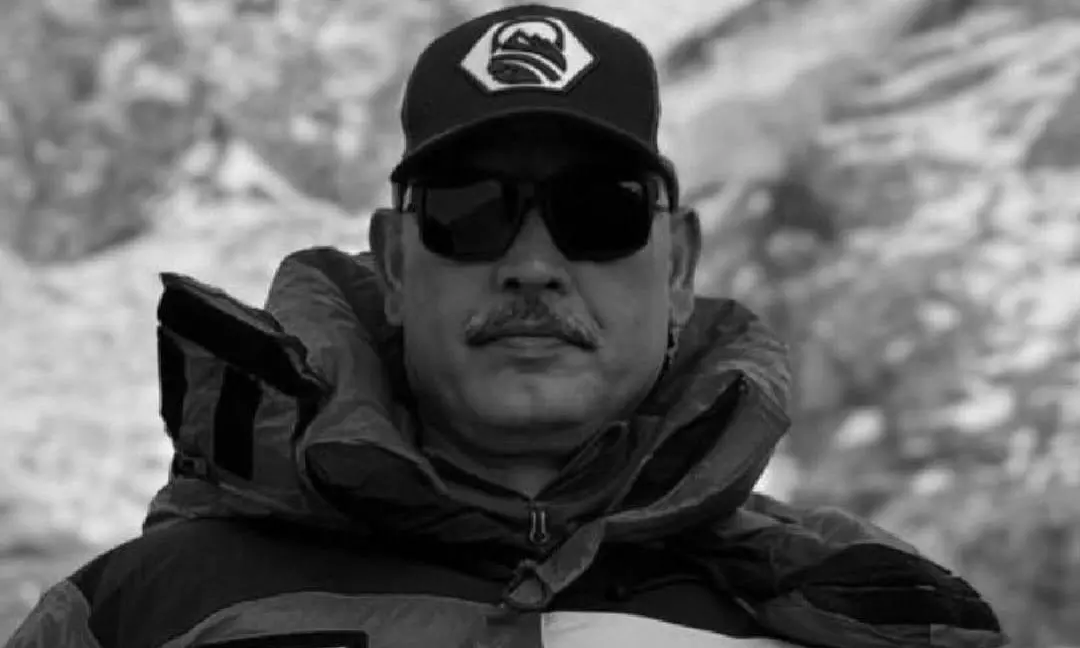
Family to leave Hyderabad climber’s body on Everest, ‘in Shiva’s abode’
Family of Arun Kumar Tiwari will let his remains rest permanently on the peak, citing spiritual beliefs and extreme risks associated with high-altitude recovery

The family of Hyderabad-based mountaineer Arun Kumar Tiwari, who passed away while descending from Mount Everest last week, has decided to let his remains rest permanently on the world’s highest peak.
Moving away from traditional retrieval efforts, the family stated that their decision is deeply rooted in their spiritual beliefs and a desire to honour the climber's profound connection to the Himalayas.
Resting in 'Shiva's abode'
Tiwari, a 53-year-old software professional from Telangana, died near the iconic Hillary Step just hours after successfully reaching the summit on May 21. Following days of deliberations over a potential recovery mission, his family announced on Wednesday (May 27) that they would not attempt to bring his body back home. Speaking to reporters, Tiwari’s brother-in-law, Sudhir Upadhyaya, explained that the family views Mount Everest not as a place of tragedy, but as a sacred space.
"He is in Lord Shiva's abode," Upadhyaya told news agency PTI. "The process of bringing the body... it would have been very badly damaged by the time it reached us. Such operations there are also not known to be successful."
The family emphasized that their choice was dictated by what Tiwari would have wanted as a passionate mountaineer who revered the mountain range. Tiwari was an accomplished climber who had previously scaled major global peaks, including Mount Elbrus, Denali, and Aconcagua. He had attempted to climb Everest in 2025 but turned back at 7,200 meters due to health issues, returning this spring to fulfil his lifelong dream.
The logistics of high-altitude recovery
While spiritual sentiments guided the final decision, the extreme logistical hurdles of high-altitude body retrieval played a significant role. Expedition organizers noted that manual recovery from the mountain’s infamous death zone requires a massive team of eight to ten experienced Sherpas working for days in sub-zero temperatures. The dangerous process involves literally cutting a frozen body out of the ice and lowering it down avalanche-prone slopes using ropes.
Also Read: All hikers caught in blizzard on Tibetan slopes of Mt Everest rescued
According to reports by NDTV, these hazardous operations routinely cost upwards of Rs 71 lakh. Because standard expedition insurance covers helicopter evacuations but excludes manual body retrievals from the summit ridge, many families choose to leave their loved ones on the slopes rather than risk additional lives.
A second tragedy amid peak congestion
Tiwari was one of two Indian mountaineers who lost their lives during the same expedition. The second climber, 46-year-old Sandeep Are, died shortly after reaching the summit on May 20. He developed severe snow blindness and extreme physical exhaustion below the summit ridge. While a rescue team of five Sherpa guides managed to pull him down to Camp II, he succumbed to exhaustion early on May 22. Unlike Tiwari, Are passed away at a lower altitude, which allowed rescue teams to successfully evacuate his body via helicopter.
Also Read: Two Indian mountaineers die during Mount Everest descent after summit push
The double tragedy occurred during a period of unprecedented congestion on Mount Everest. Data from various reports revealed that Nepal issued a record 495 climbing permits for Everest this spring season. During this unprecedented rise in climbers, the mountain experienced a historic bottleneck, with 274 climbers summiting in a single day. This massive influx resulted in a five-kilometre-long queue along the high-altitude ridge, forcing climbers to wait for extended periods in thin air and severely increasing the risk of fatal altitude sickness during their descent.