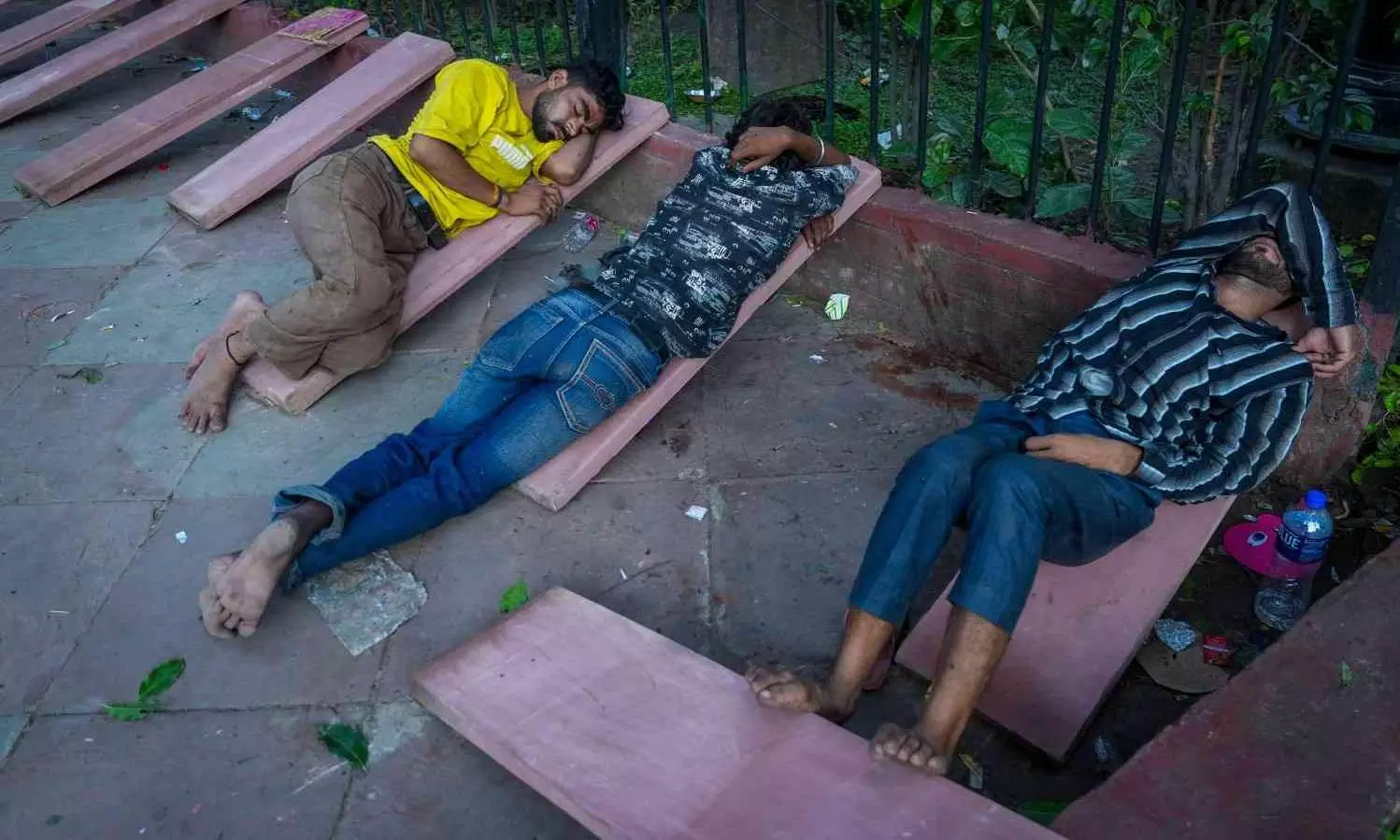
Cockroach Janta Party supporters sleep on stone slabs along a pavement amid the ongoing protest at the Jantar Mantar in New Delhi early Thursday (July 23). Photo: PTI
Degrees, dreams, and despair: Why India’s young graduates are on the streets
From repeated exam failures and recruitment delays to rising underemployment and mounting psychological stress, India’s youth are grappling with an education-to-employment crisis

Anand Kumar, a young civil services aspirant from Kanpur in Uttar Pradesh, killed himself early this week, after appearing for nearly 50 government recruitment examinations. Despite being a B.Tech gold medallist, his repeated failures to secure a government job shattered his confidence.
In Chennai, M Preetha gave up her dream of becoming a doctor after she was asked to reappear for the NEET-UG examination this year following a question paper leak in the first test. Anand and Preetha reflect the growing uncertainty confronting students across the country.
Mounting frustration of young people
Scores of students and young people have experienced mounting frustration in recent years as loopholes in the education and recruitment systems have widened, eroding their confidence in the promise that education would lead to a secure future.
While Delhi's Jantar Mantar has been witnessing protests by thousands of affected students and parents under the banner of the Cockroach Janta Party (CJP), solidarity demonstrations have also been held in several cities across the country.
Also Read: Live: 4 proposals for talks sent since yesterday, says govt; CJP insists on neutral venue
Anand's death and Preetha's disappointment are not merely about examinations. They reflect the crushing pressure faced by thousands of students who spend years preparing for competitive exams, only to encounter repeated setbacks and shrinking opportunities.
"We are forced to appear for multiple examinations while competing for a shrinking number of opportunities. The stress has become unbearable," says Preetha, who has been participating in the protest at Ballan Illam in Chennai for the past three days.
Insufficient quality jobs for growing pool of graduates
Experts say India has made remarkable progress in expanding access to higher education, but has failed to create enough quality employment opportunities for its growing pool of graduates.
According to the latest All India Survey on Higher Education (AISHE) 2023-24 released by the Ministry of Education, India's Gross Enrolment Ratio (GER) in higher education has reached an all-time high of 30 per cent, up from 23.7 per cent in 2014-15. The country also recorded its highest-ever higher education enrolment, with over 4.5 crore students enrolled in colleges and universities in 2023-24.
Also Read: From slaps, social media ridicule to threats: Police brutality under fire amid CJP protests
However, economists and educationists argue that increasing enrolment alone cannot be considered a measure of success.
The labour market tells a more sobering story. While India's overall unemployment rate stood at 3.1 per cent in 2025, the Annual Periodic Labour Force Survey (PLFS) shows that educated job seekers continue to face disproportionately higher unemployment. Among graduates, the unemployment rate was 11.2 per cent, more than three times the national average, while unemployment among youth (15–29 years) stood at 9.9 per cent.
A protester gets his head shaved as a mark of protest during the ongoing demonstration over the alleged NEET-UG examination irregularities at Jantar Mantar in New Delhi. Photo: PTI
Enormous psychological stress
The pressure begins long before students enter the job market. Increasing competition for limited seats in premier institutions, repeated entrance examinations, and prolonged preparation for government recruitment tests have created enormous psychological stress among students.
Preetha says many of her peers spend years preparing for examinations while postponing employment and other major life decisions.
"Every examination becomes a matter of survival," she says. "When opportunities are limited and recruitment gets delayed, students begin to feel that their future is slipping away."
Widening mismatch
Experts say the figures underscore a widening mismatch between the rapid expansion of higher education and the availability of quality jobs. Economist Jothi Sivagnanam believes the disconnect lies not in education alone but in the structure of India's economy. He says many graduates spend years preparing for competitive examinations, while others accept low-paying or underqualified jobs simply to stay employed.
"The country has succeeded in expanding education, but employment generation has not kept pace," he told The Federal.
Also Read: Blood on Capital streets as doctors, students unite in CJP protests
According to him, economic growth has failed to translate into sufficient quality jobs, particularly in manufacturing and labour-intensive sectors capable of absorbing large numbers of graduates.
He points out that although the economy continues to grow, employment opportunities have not expanded proportionately. Private investment remains uneven, technological changes are altering recruitment patterns, and many companies have become cautious about hiring fresh graduates.
Cockroach Janta Party supporters hold placards during a protest over NEET paper leak issue and in support of protestors across the nation at CPI headquarters in Chennai, Tamil Nadu. Photo: PTI
Underemployment erodes confidence
"The problem is no longer simply unemployment," said Sivagnanam. "Increasingly, graduates are underemployed. Many accept jobs that do not utilise their qualifications or pay wages that barely cover their living expenses."
The mismatch has become even sharper as the cost of living continues to rise. Entry-level salaries across several sectors have remained largely stagnant over the past decade, while rents, transportation costs, food prices, and healthcare expenses have increased steadily.
Also Read: Has CJP protest revealed a chink in BJP’s armour? | Talking Sense With Srini
Families invest substantial sums in higher education in the hope that a degree will provide economic mobility. For many graduates, however, the returns are proving far lower than expected.
Compared to rising inflation, salary hikes in many private-sector jobs have remained negligible. Underemployment has further eroded the confidence of young graduates.
‘Biggest dream is to repay education loan’
L Aravindhan, 26, a postgraduate in botany working in Delhi, travelled to Jantar Mantar to participate in the protest for two days because he wanted policymakers to hear the voices of unemployed youth.
"A college degree is no longer just an educational qualification. For many families, it represents the promise of financial security and upward mobility," he says. “But we are unable to repay our education loans because we don't get jobs with decent salaries. I earn just Rs 24,000 a month and have an education loan of Rs 7 lakh. My biggest dream is simply to repay that loan,” Aravindhan told The Federal.
Broader structural changes needed
Experts caution that these anxieties cannot be addressed through examination reforms alone. They require broader structural changes that connect higher education with employment generation.
Higher education has undoubtedly opened doors for first-generation learners, women, and students from disadvantaged communities. But experts argue that expanding access alone is not enough.
Commuters stage a protest outside Janpath metro station as it has been closed due to 'security reasons', in New Delhi on Wednesday (July 22). Photo: PTI
‘People with vested interests occupying key positions’
Educationist Nedunchezhiyan argues that policy discussions have largely celebrated rising enrolment without paying adequate attention to what happens after students enter college. He points out that political appointments to autonomous bodies, the failure to fill vacant vice-chancellor posts, outdated curricula, and attempts to seek political solutions to problems in every sector have contributed to growing unrest among young people.
Also Read: LIVE: Fresh police crackdown on Jantar Mantar protesters; tear gas fired, internet cut off
“The real questions are whether students receive quality education, develop relevant skills, and find meaningful employment after graduation. Instead of appointing experts to key panels and institutions, we often see people with vested interests occupying these positions. When they act to the tune of politicians, the entire education system suffers, and it is the youth who bear the consequences,” Nedunchezhiyan told The Federal.
He explains that higher education policy must move beyond expanding access and focus on improving teaching quality, strengthening industry linkages, and providing effective career guidance and internship opportunities.
(Suicides can be prevented. For help, please call Suicide Prevention Helplines: Neha Suicide Prevention Centre - 044-24640050; Aasara helpline for suicide prevention, emotional support, and trauma help - +91-9820466726; Kiran, Mental Health Rehabilitation - 1800-599-0019; Disha - 0471-2552056; Maithri - 0484 - 2540530; and Sneha's suicide prevention helpline - 044-24640050)