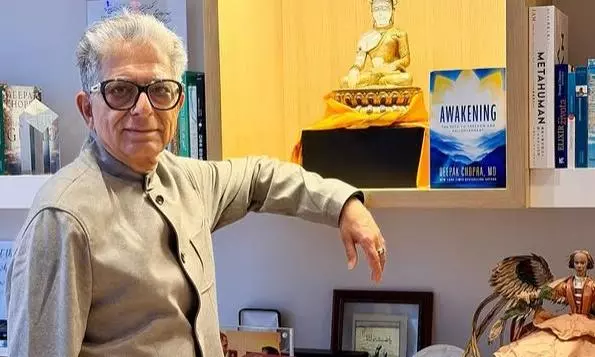
Indian-American wellness author and spiritual teacher Deepak Chopra finds himself at the centre of renewed public scrutiny, after his name surfaced in newly-released documents connected to the late financier Jeffrey Epstein.
The disclosures, part of a large tranche of material from Epstein’s estate made public by the US House Oversight Committee and the Department of Justice, have prompted questions about their association – even as legal experts stress that inclusion in the files does not imply criminal conduct.
Who is Deepak Chopra?
Indian-American Deepak Chopra, 79, is a globally recognised figure in the New Age wellness movement.
Born in New Delhi in 1946, he trained as a medical doctor at the All India Institute of Medical Sciences before moving to the United States in the 1970s, where he completed residencies in internal medicine and endocrinology. He left hospital medicine shortly after meeting Maharishi Mahesh Yogi in 1985.
Over the decades, Chopra went on to promote holistic health, meditation, and alternative therapies – becoming a prolific author, speaker, and founder of the Chopra Center for Wellbeing. A prominent figure in the “New Age” movement, he championed meditation and holistic living, and rose to fame in the 1990s.
Also read: An email, an afterparty, and the Epstein files: Mira Nair’s name surfaces
His books and programmes on mind-body wellness have attracted millions of followers worldwide. He later became a frequent guest on Oprah Winfrey’s talk show.
What Epstein documents show
The recently released records contain emails and calendar entries between Epstein and Chopra dating mainly from 2016 to 2018, years after Epstein had already been a convicted sex offender.
In those communications, the two men discussed a variety of topics, including political figures such as Donald Trump and requests for information about public personalities.
In one of his email exchanges with Epstein in 2016, Chopra reflected on his personal life, noting that his "biological needs" were only occasionally met and no longer held much appeal. He mentioned having three more books to complete before stepping back, and shared plans to spend a week in silence with a small group for greater clarity.
Chopra also added that he enjoys the company of younger, intellectually sharp, and self-aware women, engaging with them to inspire and stimulate.
Another exchange between the two is from November 2016, when Chopra sent Epstein a news article about a woman taking back a lawsuit accusing Donald Trump of sexual abuse at an event linked to the sex offender.
The author asked Epstein whether the case against him had also been dropped. When Epstein confirmed it was, Chopra replied, "Good".
Chopra’s response
In response to the fallout, Chopra issued a public statement on social media platform X (formerly Twitter), apologising for the "poor judgement" in the tone of the email exchanges. "I regret that and understand how they read today, given what was publicly known at the time," he wrote.
Claiming to be "deeply saddened" by the suffering of the victims in this case, Chopra stressed that he was never involved in any criminal or exploitative activity and described his contact with Epstein as limited and unrelated to "abusive activity".
Despite this clarification, criticism has grown on social media, with some questioning Chopra’s judgment in maintaining contact with Epstein after his conviction.
Why it matters
The release of Epstein-related documents aims to throw light on the extent of the late financier’s relationships across politics, business, academia, and cultural spheres.
Chopra’s inclusion in that network underscores how expansive Epstein’s reach remained long after his conviction, raising broader questions about how individuals and institutions engaged with him over the years. But, experts point out that mere appearance in the communications does not mean complicity in Epstein’s crimes.
As more names tumble out of the Epstein files, Chopra’s involvement and that of other prominent names are likely to examined both in mainstream media and public discourse.