For a party infamous for its inertia and indecision, the Congress has lately been displaying uncharacteristic urgency in tackling long-festering organisational troubles.
Part of this activity can, of course, be explained by the recently concluded Assembly elections. Yet, even by that standard, the pace of decision-making has been striking. The Congress high command moved swiftly in Tamil Nadu, dumping a defeated MK Stalin-led DMK in favour of Joseph Vijay’s victorious Tamliga Vettri Kazhagam (TVK). In Kerala, though it took 10 days to settle on a chief minister, the leadership wasted no time in finalising VD Satheesan’s council of ministers.
Picking a side
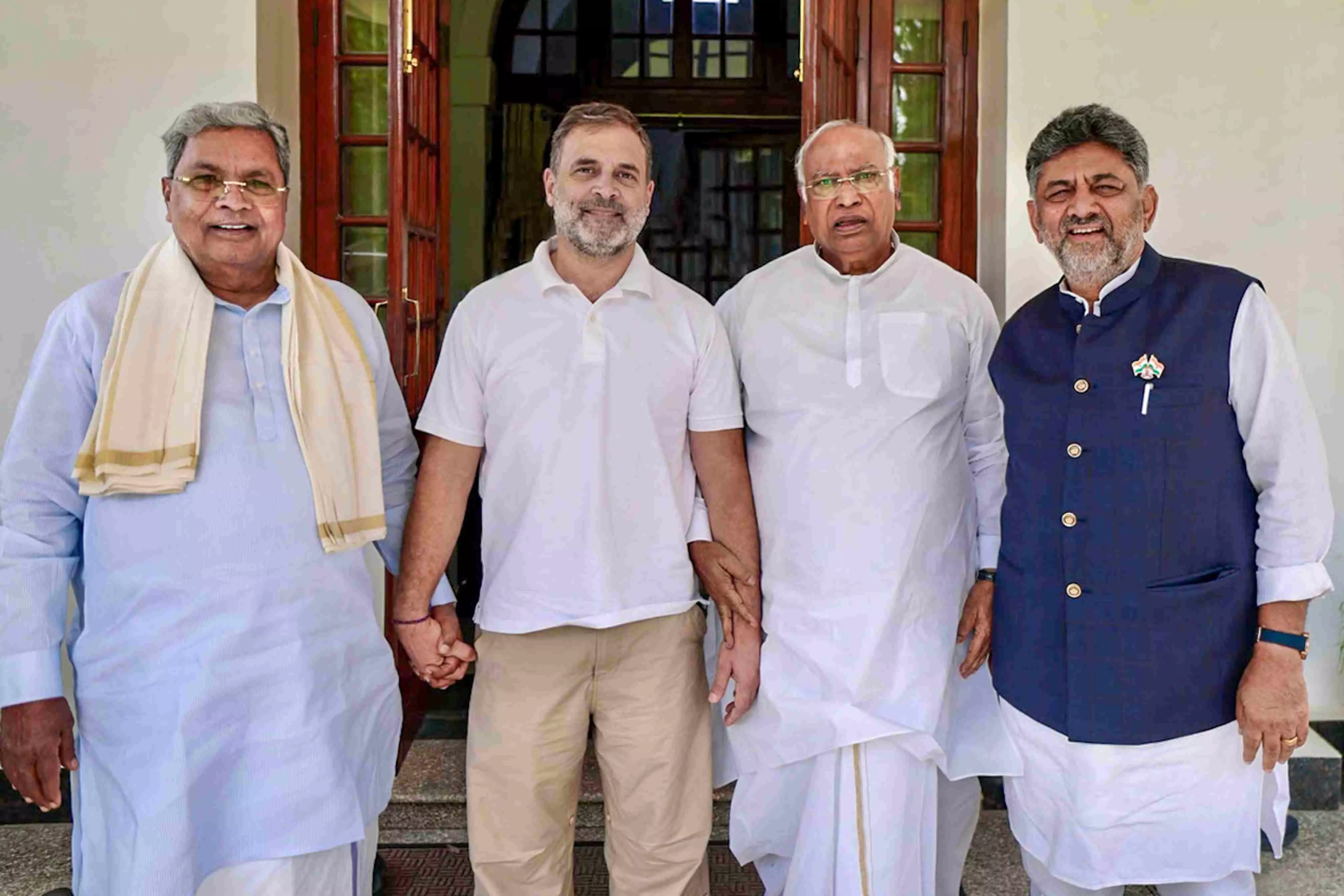
The past week also saw the high command finally pick a side in Karnataka’s protracted power struggle. After more than a year of procrastination, the Congress leadership agreed to install DK Shivakumar as chief minister while ensuring incumbent Siddaramaiah did not rebel.
Late on Tuesday night, Siddaramaiah was inducted into the Congress Working Committee (CWC), the party’s highest decision-making body. The timing was deliberate. Granting Siddaramaiah a seat at the CWC high table just hours before his successor’s swearing-in was intended to signal that while the high command had asked its only OBC chief minister to step down, it continued to value his counsel and stature within the party.
Discussions on the first round of appointments to the new Karnataka cabinet have also concluded. Party sources say the high command was keen that, as in Kerala, the June 3 swearing-in ceremony should coincide with the formation of a new cabinet, even while leaving room for expansion later.
Organisation overhaul
Amid these developments, Congress insiders say the leadership has quietly been working on a blueprint for a sweeping organisational overhaul at both the central and state levels to prepare the party for the string of assembly polls due over the next two years.
“Expect major changes in various state units and at the AICC next,” an AICC general secretary told The Federal.
Goa Congress
Signs of the impending shake-up were visible even last week. While still working through Karnataka’s transition of power, Congress president Mallikarjun Kharge approved the reinstatement of Girish Chodankar as chief of the Goa Congress.
Chodankar had been serving as the party’s in-charge for Tamil Nadu and Pondicherry since February last year. He was among those who had lobbied for an alliance with Vijay’s TVK ahead of the Tamil Nadu Assembly election, much to the displeasure of several senior state leaders, including P Chidambaram and K Selvaperunthagai, who had advised the high command against breaking ties with Stalin’s DMK.
After the May 4 election results made a TVK-led government in Tamil Nadu inevitable, the Congress leadership quickly sealed a power-sharing arrangement with Vijay. With the alliance settled, Chodankar is expected to be relieved of his Tamil Nadu and Pondicherry responsibilities so he can focus on preparations for the Goa Assembly election next year.
His return as Goa Congress chief, a position he resigned from after the party’s defeat in the 2022 Assembly election, has triggered protests from some colleagues. Chodankar, however, sought to downplay the opposition.
“Whenever there is an organisational restructuring, there are mixed reactions. I will reach out to everyone; that is what the high command has directed me to do, and we will work unitedly to ensure that the Congress returns to power next year. My entire focus now will be on Goa,” he told
The Federal.
Next major-shake up
Sources say Tamil Nadu Congress chief Selvaperunthagai could also be replaced. “Things have changed now and the party will naturally look at someone who can work well with Vijay and also ensure greater cohesion within the Congress organisation,” a Congress Lok Sabha MP from the state said.
Party sources say the high command is expected to replace at least half a dozen state unit chiefs in the coming weeks. While Chodankar has already been sent to Goa, the next major shake-up is expected in Punjab, possibly within days.
Over the past several days, the Congress leadership has held multiple rounds of discussions with Punjab leaders. The state, which goes to the polls next year, remains deeply faction-ridden. There is growing pressure from various camps to replace state chief Amarinder Singh Raja Warring, a Rahul Gandhi appointee whose tenure has seen the party lose a string of parliamentary and Assembly by-elections and perform poorly in recent municipal polls.
Sources say the leadership, with inputs from in-house poll strategist Sunil Kanugolu, has almost finalised a restructuring plan. Under the proposal, former chief minister Charanjit Singh Channi, a Dalit, could head the party’s election campaign in Punjab, while former minister Vijay Inder Singla, a Hindu, could replace Raja Warring, a Jat Sikh, as state chief.
The changes would come days after the BJP replaced Sunil Jakhar, a Hindu, with Kewal Singh Dhillon, a Jat Sikh, as its Punjab president. Both Jakhar and Dhillon are former Congress leaders.
Changes in UP, Rajasthan and Kerala
The high command is also considering changes in Uttar Pradesh, Rajasthan and Kerala.
Former Rajasthan deputy chief minister Sachin Pilot, who has long been lobbying for a return to state politics, could finally be entrusted with leading the Rajasthan Congress, replacing Govind Singh Dotasra. Ironically, Dotasra took over the state unit in 2020 after Pilot’s rebellion against then chief minister Ashok Gehlot, when Pilot himself was both state president and deputy chief minister.
In Uttar Pradesh, the party is seriously considering a replacement for Ajay Rai, who has headed the state unit for more than three years. Sources say the leadership may appoint a Dalit chief in a bid to strengthen the party’s appeal among Scheduled Castes while complementing ally Samajwadi Party’s PDA (Pichhda, Dalit, Alpsankhyak) outreach.
In Kerala, a leadership change is expected because incumbent state president Sunny Joseph has been inducted into the Satheesan ministry.
The churn is unlikely to stop at the state level. A senior Congress office-bearer told The Federal that an “extensive revamp” is also under consideration at the AICC, where the leadership is reviewing the performance of several general secretaries and state in-charges.
According to the office-bearer, both Kharge and Rahul Gandhi have already held detailed discussions on restructuring the pool of general secretaries and in-charges. There have been complaints about poor performance and partisan conduct against several office-bearers, while some have acquired new responsibilities after the recent Assembly elections.
Veteran leader Ramesh Chennithala, now a minister in Kerala, is expected to step down as Maharashtra in-charge. The party also needs a new in-charge for Assam after AICC general secretary Jitendra Singh resigned following another humiliating electoral defeat in the state last month.
The leadership is also believed to be reviewing its arrangements in Bihar and Gujarat. In Bihar, demands for the removal of Rahul Gandhi aide Krishna Allavaru have persisted since the party’s rout in last year’s Assembly election. In Gujarat, Mukul Wasnik’s stewardship is widely regarded within the party as ineffective.
There is uncertainty as well over the future of veteran leader BK Hariprasad, currently the Haryana in-charge. While Hariprasad may not figure among the ministers inducted into Shivakumar’s Karnataka cabinet immediately, sources say he could still be accommodated during an expansion later this month after the Rajya Sabha and Karnataka Legislative Council elections.
Should Hariprasad receive a ministerial berth in Karnataka, the party could relieve him of his Haryana responsibilities. A section of Haryana leaders have complained that he has failed to act impartially because of his close association with Bhupinder Singh Hooda.
Many Congress leaders believe Rahul Gandhi may have finally concluded that several figures he promoted as general secretaries and in-charges despite repeated warnings about their effectiveness can no longer be retained if the party is serious about reversing its electoral decline.
Rahul, sources say, continues to favour younger, ideologically committed and more aggressive leaders for the AICC team. At the same time, he is open to retaining experienced veterans in positions where political skill and institutional memory matter.
While many of these changes have long been demanded by sections of the party, two decisions remain the most closely watched.
Two key concerns
The first concerns whether Kharge and Rahul will appoint a new organisational general secretary in place of KC Venugopal. Venugopal’s tenure as general secretary (organisation) since 2019 has been viewed by many within the party as deeply disappointing. Critics accuse him of functioning primarily as Rahul’s gatekeeper, failing to understand political realities on the ground, particularly in the Hindi heartland, and proving unable to resolve factional disputes across multiple state units.
Many party leaders believe the recent Kerala leadership battle, in which the high command spent 10 days managing competing claims by Satheesan and Venugopal for the chief minister’s post, could finally force Rahul to curtail the influence of his trusted lieutenant.
The second question concerns Priyanka Gandhi. Calls for a larger and clearly defined role for her within the AICC have grown steadily louder. A proposal to create an election strategy department under her leadership has been pending with the high command for a considerable period.
Whether Kharge and Rahul finally act on that proposal, assign her a different responsibility, or continue with the status quo – keeping her as a general secretary without a clearly defined portfolio – remains to be seen.
It's becoming clear that Congress leadership has recognised that organisational drift must be addressed now. After years of delayed decisions and half-hearted interventions, the party is moving with a rarely seen sense of urgency.
Whether this burst of activity translates into electoral revival is uncertain, but the scale of the changes under consideration suggests the leadership believes the status quo is no longer an option.