‘Modi’s aura of invincibility dented by memes, not politics’ | Interview
Political scientist Prof Zoya Hasan says the student movement broke fear, forced political accountability and reshaped the relationship between youth, protest and power

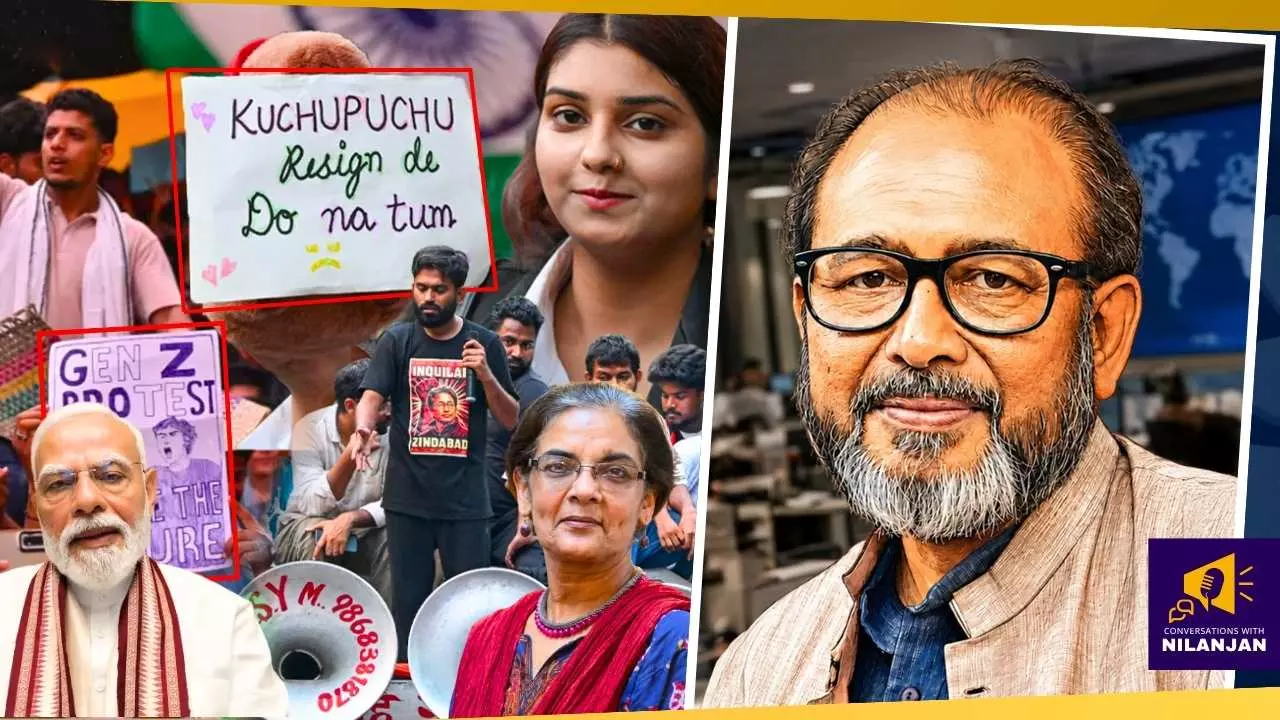
Prime Minister Narendra Modi's carefully cultivated aura of invincibility has been "dented" — not by conventional Opposition politics, but by memes, satire and laughter, says Prof Zoya Hasan, renowned political scientist and Professor Emerita at Jawaharlal Nehru University (JNU).
The resignation of Union Education Minister Dharmendra Pradhan, forced by weeks of student-led protests under the banner of the Cockroach Janta Party (CJP), marks the third major political setback for the Modi government in quick succession, and has fundamentally lowered the threshold for future protest, she argues.
Also read: ‘Delhi cops should have used water cannons; pellet guns meant for rare cases’
In the latest episode of The Federal's Conversations with Nilanjan, Prof. Hasan talks about the roots of the NEET exam paper leak agitation, the extraordinary role humour played in it, and what it means for Indian democracy going forward.
What led to this outpouring of protest after a fairly long period without one?
There have been protests throughout the last 12 years — the farmers' movement, protests against the Citizenship Amendment Act, and recently workers' protests in Noida and several other cities. So it's not as though there have been no protests. But this protest is different, interesting, important, and its scale is of a completely different order.
I think this protest is not something that happened overnight, although it started with the Chief Justice's comments about unemployed youth, and Abhijeet Dipke in Boston put up a post which attracted millions of followers. He then took the very important decision not to be satisfied with just this online social media storm — he decided to turn digital mobilisation into on-ground mobilisation. So on the face of it, it seems it was triggered by a joke. And indeed, that triggered it. But it has also been triggered by accumulated grievances.
Also read: Use of metallic pellet guns permitted in exceptional circumstances: SC
This movement started with a very specific political demand — the resignation of the education minister — and eventually achieved it. Was that enough accountability, or is something more required?
This movement was successful for a number of reasons. It started as a satirical campaign that attracted a lot of people. It was also sectoral — almost a single-issue movement, and that single issue was the demand for the education minister's resignation. There was a major NEET leak in 2024, and since then there have been several more leaks, and obviously not much was done about it. Dharmendra Pradhan has been the education minister throughout this period and is, by all accounts, a very powerful Cabinet minister. So this movement, quite rightly, focused to start with on that one demand.
The Cockroach Janta Party, which started this campaign, focused single-mindedly on the education minister's resignation. But many other student organisations that joined — AISA, SFI, AISF, NSUI — had a much wider template. They have been campaigning against the whole education policy, against centralisation of education, against the NTA and the new education policy more broadly. If the focus had been more broadly on education from the outset, I don't think it would have worked.
But even by focusing on the minister's resignation, they brought the crisis of education to centre stage. We know higher education in India has been in shambles, so for the first time there is a real discussion on education.
Also read: Rhiya Ahir speaks out against cyber bullies: ‘This is not my shame to carry’
Let's talk about the word that started it all — "cockroach". What role did satire play as a political instrument here?
One of the most remarkable and striking features of this student uprising was its very clever use of humour. I can't think of any other protest so infused with satire — parody videos, funny Instagram reels. What began as a satirical intervention remained satirical throughout; the humour dimension wasn't just at the beginning, it was part of this campaign right through, turning it into India's first Instagram-humour-based protest.
The most surprising part was that the principal target of this humour was the prime minister. For over a decade, his strongman image has been carefully cultivated as one of authority, invincibility, near infallibility. This campaign punctured that aura not through articles and books, but through laughter — achieving something conventional opposition politics or criticism of the government had failed to do. It has normalised public ridicule of the country's most powerful political leader.
There's a third aspect too: humour broke through fear. As we know from authoritarian rule in many countries, authoritarian leaders thrive on reverence, on fear, on intimidation. But once people begin to laugh at them, they're laughing at power, and it shows they're not overawed by it. For the last 12 years, even the young — who are normally more irreverent — were overawed by the prime minister's power and authority. So satire wasn't simply a mode of expression; it actually became a form of political resistance.
I'll go one step further — this agitation didn't just use humour, it was organised through humour. It attracted people to Jantar Mantar and different sites across the country.
This is also one of the biggest student movements in the country, or anywhere in the world, if you look at the scale of participation — lakhs of people on July 20 alone. The participation was possibly on the same scale as the student agitations of 1974-75, starting with the Gujarat Navnirman agitation — possibly even bigger.
Also read: The unmaking of Brand Modi: How ‘56-inch chested’ PM bowed to youth power
After the resignation, there have been reports of police identifying and filing cases against protesters. Could this become a flash that fades, with fear returning, or has it energised the Opposition in a lasting way?
There are two or three important issues here. One is whether the demand for the education minister's resignation was achieved — and it has been. This is the first time a resignation of a Cabinet minister under this government has happened under sustained public pressure. That is very significant, so I would not call this a flash.
The second aspect is the police brutality on July 20. Students were simply demanding accountability and, in the long term, educational reform — that did not deserve the kind of police atrocities committed on students wanting to march to Parliament. The government miscalculated from the beginning — it underestimated the strength of this protest and its support.
How much political damage has this actually inflicted on Prime Minister Modi and his government?
These protests have inflicted very significant political damage on Prime Minister Narendra Modi personally, and on his government more generally — though perhaps not in an immediate electoral sense. But we must remember that the education minister's resignation is the third major political setback in a relatively short period. The first was the BJP's failure to secure a majority in the 2024 Lok Sabha elections. The second was the defeat of the Constitution Amendment Bill on delimitation just a few months back, this year. And now, just a few months later, the government has been compelled under public pressure to remove the education minister.
For a decade, the BJP's entire politics has rested on the prime minister's image of decisiveness, control and invincibility. The real significance of this episode is not simply the resignation, but the fact that sustained public pressure forced the government to retreat. It showed that even a strong government with a very strong prime minister can be compelled to make political concessions under public pressure. And once that carefully constructed aura is dented, it also changes — actually lowers — the threshold for protest, because young people may conclude that collective action can produce results.
I'd distinguish between short-term and long-term consequences. The immediate electoral impact is possibly limited. But over time, there is an erosion of this government's and this prime minister's strongest asset — the perception that he is politically unchallengeable. This protest has changed the political landscape and, above all, lifted the pall of fear that had enveloped large sections of people. What is very important is that in 2014, 2019 and 2024, the prime minister was an overwhelming favourite of the youth, and many of voting age likely voted for the BJP, as did many of their family members. The fact that they are now protesting and opposing the government marks a very significant political shift.
This was a completely decentralised agitation with no charismatic leader, in contrast to the Opposition's more structured, if weaker, party organisations. How do you see the interplay between such a movement and party politics going forward?
This is a very important question, really at the heart of this political moment. First, it's important to note the difference between party politics and mobilisation on one hand, and social movements on the other. This campaign was successful precisely because it was non-party. If it had been party-based, I doubt it would have attracted such a wide range of support. Secondly, this campaign did not have established leaders, student unions or parties mobilising support — the majority of people came on their own, responding to CJP's call, which was essentially an Instagram call. This is a protest in the era of Instagram.
Even the CJP and Left-wing organisations could not possibly have expected the huge flood of people who came to central Delhi on July 20, and to different parts of the country, hundreds of thousands. This was spontaneous, with no established leadership or organisation — possibly that was its biggest advantage.