Centre’s push for women’s quota tied to delimitation puts Opposition in a bind
Congress and other opposition parties weigh response as Centre plans early rollout of women’s reservation with delimitation, raising fears of skewed representation

With five days to go before Parliament reconvenes for an extended three-day sitting of the budget session on April 16, the Opposition has a perplexing task at hand. It must decide how to articulate its reservations against the Centre’s wily plan to entwine an early rollout of women’s reservation with delimitation of Lok Sabha and Assembly constituencies while not appearing to obstruct the long-due promise of greater women representation in electoral politics.
Also read | ‘Delimitation by stealth’: Opposition sees Centre’s ploy in early women reservation rollout
What complicates the matter further for the Opposition parties is the fact that the Centre is yet to share with them the draft of its proposed Constitution Amendment Bills to operationalise women’s reservation by the 2029 Lok Sabha polls and to complete before that a delimitation of Lok Sabha and Assembly constituencies. The Bills are to be introduced for consideration and passing by Parliament in the extended session from April 16 to 18.
Opposition plans joint strategy
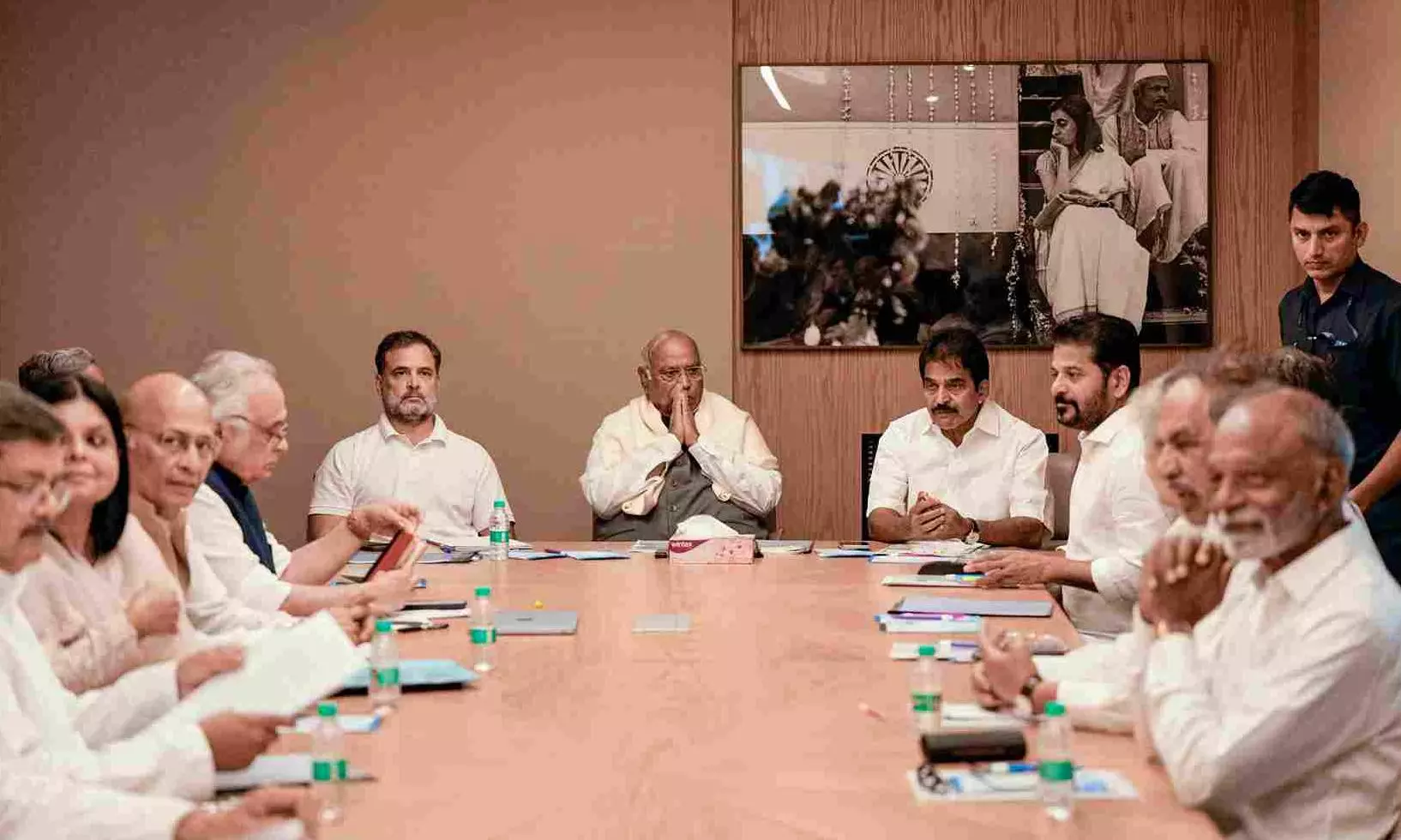
On April 15, Congress president and Rajya Sabha’s Leader of Opposition Mallikarjun Kharge is expected to meet leaders of various Opposition parties to formulate a “common concrete strategy” to blunt the Centre’s move to increase the strength of the Lok Sabha and all State Assemblies by 50 per cent. On Friday (April 10), the Congress’ top decision-making body, the Congress Working Committee (CWC), met at the party’s Indira Bhawan headquarters in Delhi to brainstorm how the party and its allies must respond to the Centre’s bid to scale up Lok Sabha’s current strength of 543 to 816 MPs as an immediate and immutable corollary to early implementation of women’s reservation.
Last month, Union Home Minister Amit Shah had informally shared with a handful of Opposition leaders the Centre’s proposal to amend the Naari Shakti Vandan Adhiniyam, 2023. The Adhiniyam, passed at a special session of Parliament in September 2023, had paved the way for reservation of one-third seats in Lok Sabha and state legislatures for women upon the completion of the first Census after 2026 followed by a delimitation of existing constituencies.
The Opposition, which had cooperated with the Centre to get the Adhiniyam passed unanimously in both Houses of Parliament, had objected to the indeterminate timeline of the reservation rollout. Kharge and other Opposition leaders had urged Prime Minister Narendra Modi to delink the 33 per cent quota implementation from the Census and delimitation exercise only to be told that doing so would be violative of the Constitution.
The Centre’s surprise volte face from its stated position 30 months ago has triggered allegations of political expediency from the Opposition. The Congress and members of the INDIA bloc have strongly criticised the Modi regime for pushing the proposed changes in “violation of the Model Code of Conduct” currently in place for Assembly elections in West Bengal and Tamil Nadu, where polling is due later this month, as well as in Kerala, Pondicherry and Assam, where voting concluded on Thursday (April 9).
Congress flags delimitation concerns
At Friday’s CWC meeting, Kharge told his party colleagues that the Centre wanted to bulldoze the Bills through Parliament days before Bengal and Tamil Nadu vote only to “claim credit and gain political advantage” while asserting that the delimitation exercise that has been reportedly coupled with operationalising women’s reservation “would have serious implications for our electoral system”.
Sources privy to the CWC deliberations told The Federal that several senior leaders present at the meeting were of the “unanimous view” that “delimitation must be opposed in the strongest possible way” but also cautioned that “we must ensure that our position is articulated in a way that there is no scope to twist or misinterpret our position – we are committed fully to ensure women reservation is implemented but we are opposed to the delimitation formula that the Centre is pushing in an arbitrary manner”.
Also read | Delimitation explained: Will 2029 Lok Sabha elections tilt against southern states?
Congress’ communications in-charge Jairam Ramesh told reporters that Telangana Chief Minister Revanth Reddy and his Karnataka and Himachal Pradesh counterparts, Siddaramaiah and Sukhwinder Singh Sukhu, respectively, told the CWC that the delimitation formula the Centre reportedly is keen to push “will neither benefit the southern states, nor the smaller states from the north and northeast... except some large states, all others will be pushed to the margins.”
Reddy, who had strongly criticised the Centre’s “uniform 50 per cent hike” delimitation proposal on grounds that it would politically marginalise Telangana, Andhra Pradesh, Tamil Nadu, Kerala and Karnataka, in an 816-member Lok Sabha as the five states collectively will account for “only 195 seats”, is learnt to have reiterated his stand at the CWC meet. Reddy, sources said, asserted that a uniform 50 per cent rise in seats for all states “is deceptive” and would “in reality, tilt the balance of power against southern states and smaller states and will eventually also rob us of budgetary allocations in central funds.”
Leaders warn of skewed representation
Sukhu and Chandigarh MP Manish Tewari are also learnt to have voiced their strong disapproval of the 50 per cent formula, with Tewari cautioning that the argument against delimitation “must not be framed as a north versus south divide”. Tewari, sources said, stressed that the Opposition must unambiguously “explain how small states like Punjab, Haryana, Himachal Pradesh, Uttarakhand, Chhattisgarh and the north-eastern states will all be deprived of a fair share in representation in Lok Sabha while states like UP and Bihar will not only get a disproportionately higher say but will also practically determine who gets a majority”.
Several party leaders, including veteran parliamentarian P Chidambaram, who had joined the CWC meet virtually, also expressed concern over the “efficacy of a Lok Sabha with 816 members”, pointing out that “even with the current strength of 543 MPs, members have to plead with the Speaker to get even 30 seconds to speak in the House”. Sources said some leaders pointed out that the number of days Parliament functioned in a year had drastically fallen to an average of 55 days in the past 12 years of the Modi regime and noted that merely increasing the number of MPs will serve little purpose when “the functioning of Parliament itself has been severely curtailed”.
Sources said the Congress president, when he meets top Opposition colleagues on April 15, is expected to raise each of these issues and also seek views of the allies on the proposed Bills before the INDIA bloc finalises a “united stand”. The Congress and its INDIA bloc partners are also expected to implore the government once again to defer the introduction and passing of Bills “to any date after polling concludes in Tamil Nadu and Bengal (scheduled to end on April 29 with the second phase of polling in Bengal)” and convene an all-party meeting before that to get the Opposition’s suggestions on its proposals. Congress leaders, however, conceded that the possibility of the Centre conceding to this request is negligible.
Concerns over constituency redrawing
Though discussed only in passing at the CWC, a matter that seems to be agitating the Opposition even more than the skewed representation that different states will have in Lok Sabha if the 50 per cent formula for delimitation is adopted is the manner in which constituencies will be reconfigured during the delimitation process. An overwhelming fear within the Opposition is that the delimitation exercise, to be finalised by a commission comprising a retired Supreme Court judge appointed by the President, the Chief Election Commissioner and state election commissioners, will lead to gerrymandering of constituencies to suit the BJP in a majority of the states.
“We have seen two instances of delimitation at both Lok Sabha and Assembly levels happening in the past five years. The first was in Assam and the second in Jammu and Kashmir. In both instances, there was a clear stamp of the BJP’s influence on the exercise,” a CWC member told The Federal.
Also read | Congress alleges MCC violation over govt's special session on women’s quota, delimitation
“In Assam, the current round of elections as well as the 2024 Lok Sabha elections showed how Congress strongholds were systematically sliced up to remove large chunks of our traditional voters. In the Assembly, a big chunk of seats that were once minority-dominated suddenly became either reserved for Scheduled Castes or Scheduled Tribes or saw the minority population areas carved out and distributed in adjoining seats to change the demography in a way that is more favourable to the BJP. In J&K too, they increased seats in the Hindu-dominated Jammu region. Now imagine this same exercise being replicated at a national level at a time when the Election Commission and especially the current CEC (Gyanesh Kumar) are brazenly acting as BJP agents. How can we expect delimitation to be fair in this situation,” the CWC member added.
Echoing a similar view, a senior Samajwadi Party MP who is a regular at Kharge’s meetings with Opposition floor leaders during Parliament sessions said, “When we can’t even expect today’s Election Commission to act fairly on our complaints or on making the electoral rolls, how can we expect it to be fair when a nationwide redrawing of constituencies is done under the current government... implementing women’s reservation in 2029 is only an excuse; by linking it with delimitation, the government has its eyes of manipulating the elections not for one or two cycles but for the long term and this is the biggest challenge for the Opposition now because even though delimitation commissions are supposed to have MPs and MLAs from all parties, they don’t get a final say in what shape a constituency finally takes; that is a call that the chairman (retired SC judge), the CEC and the state election commissioner take.”