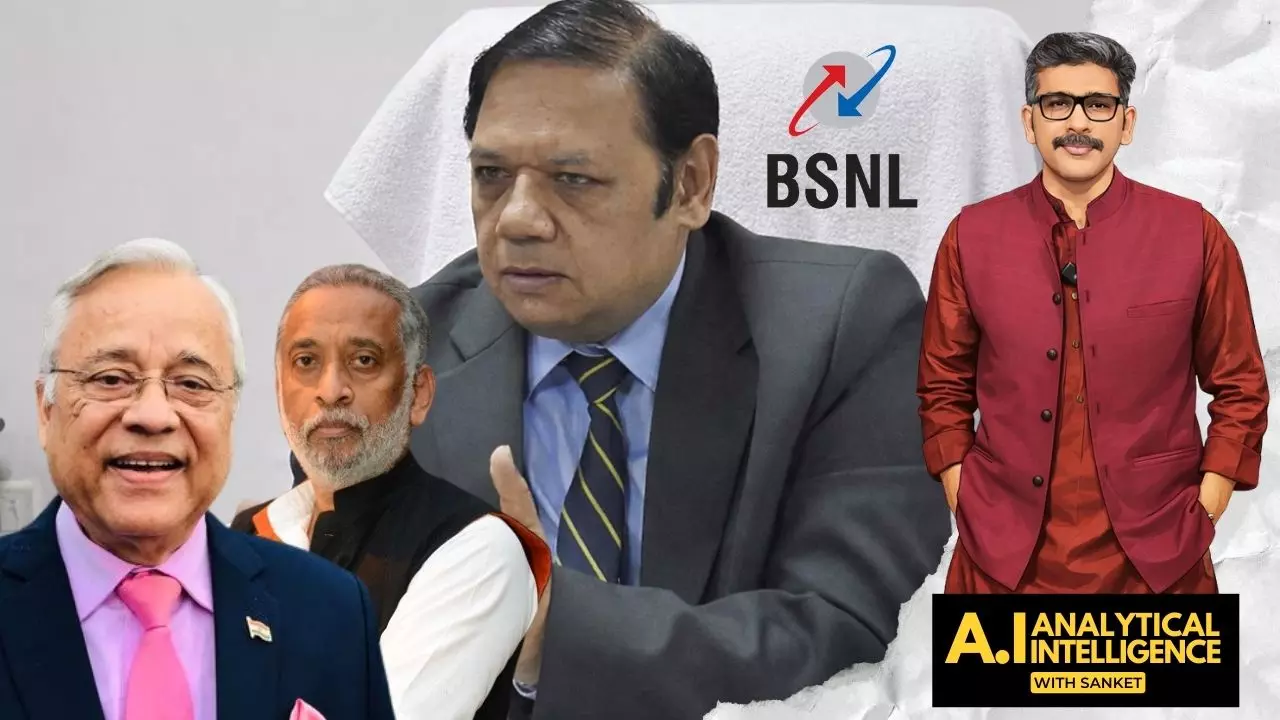
The visit was reportedly cancelled only after the note went viral on social media, triggering widespread embarrassment and public anger.
50 staff, 21 points
According to details discussed on the show, the internal circular outlined a 21-point schedule. It included the deployment of nearly 50 BSNL staff members to coordinate the director’s visit, arrangements for multiple vehicles — specifically white Innova Crysta cars — new towels, and several “kits” containing items such as water bottles, chocolates, fruit juice, slippers, soap, shampoo, oil, combs, mirrors, and undergarments.
The controversy erupted because BSNL, India’s state-run telecom company, has been struggling financially for years. Despite multiple cash infusions from the Union government — including Rs 1.64 lakh crore in 2022 for spectrum allocation and restructuring, and Rs 89,047 crore in 2023 — the company continues to lag behind private competitors in revenue and network expansion.
BSNL remains largely behind in the 4G rollout and has yet to enter the 5G space fully, while rivals continue to expand aggressively.
VIP by default
Dilip Cherian described the episode as symptomatic of a larger societal problem. “This culture that a government employee or functionary is a VIP by definition… we just need to allow these individuals to function as normal citizens without being a burden on taxpayers,” he said.
He pointed out that such incidents are not isolated. “Some we spot, many we do not even know of or don’t get recorded or exposed,” he remarked, adding that entitlement in public office often goes unchecked unless brought into the public domain.
Cherian argued that governance failure often begins at the top. “Simplicity at the top engenders compliance at the next level,” he said, stressing that unless senior leadership models restraint, the culture of excess will persist.
Accountability questions
Professor Mishra was equally blunt. “How can somebody, such a senior officer within the government, dare to seek such favours?” he asked. For him, the deeper issue is institutional.
He highlighted that audit bodies like the Comptroller and Auditor General (CAG) have repeatedly flagged irresponsible expenditure across departments. Yet, he noted, “No heads have rolled.”
The consumer rights advocate linked the issue to the erosion of transparency mechanisms. He recalled the Citizens’ Charter initiative introduced in 1996 to make public services accountable and measurable. While the concept was strengthened during former Prime Minister Dr Manmohan Singh’s tenure, Mishra suggested that such accountability frameworks have since weakened in practice.
“There’s no transparency. There’s no accountability. Most of the time these incidents have to be brought to the highest authority before action is taken,” he said.
Praja and maharaja
A recurring theme in the discussion was what both panellists described as a “maharaja mindset” in public institutions.
Mishra framed it philosophically: “A maharaja is born out of prajas.” In other words, public tolerance enables VIP culture. He emphasised citizen responsibility and invoked the slogan “Jago Grahak Jago,” urging people to demand accountability and refuse to normalise privilege.
“When I stand in a queue and a maharaja arrives, I don’t allow it,” he said, stressing that change does not require revolution but consistent civic assertion.
Cherian echoed the concern, warning that entitlement trickles down through institutional hierarchies. “They report to maharajas above them, and that culture percolates downwards,” he said, adding that internal audits often fail because they are “too close to the maharaja.”
Reform versus culture
The discussion also touched upon reforms undertaken in BSNL, including debt restructuring and capital expenditure aimed at modernisation. Despite these measures, the alleged extravagance highlighted by the circular suggests that cultural change has not kept pace with financial reform.
The host pointed out that BSNL’s average revenue per user (ARPU) remains significantly lower than private competitors, underscoring the disconnect between performance metrics and administrative behaviour.
For Cherian, the solution lies in stronger professional oversight and external audits. “In structures like BSNL, you need external audit as much as internal audit,” he said.
Mishra, meanwhile, emphasised institutionalisation over episodic outrage. He praised the role of media in exposing the issue, noting that the trip was cancelled only after public scrutiny.
“It didn’t bring a revolution. We didn’t need a revolution. A small change happened because it was exposed,” he said.
Symbolism of the white towel
An unexpected but symbolic aspect of the debate revolved around the insistence on new white towels — a long-standing visual marker of bureaucratic privilege in India.
Cherian described the white towel as “the perk of state,” comparing it to a ceremonial footstool of royalty. Mishra traced the practice back to the colonial era, when non-air-conditioned offices required cloth covers for comfort.
“But it has carried on unchanged,” he observed, suggesting that what was once functional has become a symbol of status.
The debate over towels, vehicles, and kits may appear trivial at first glance. Yet, in the context of a struggling public enterprise funded by taxpayer money, the symbolism resonates deeply.
The larger question
Ultimately, the conversation returned to a fundamental question: should taxpayers tolerate such displays of entitlement in public sector institutions dependent on government bailouts?
Mishra insisted that reform must begin with citizens asserting their rights to transparency, accountability, information, and redressal — rights enshrined in consumer protection laws.
Cherian emphasised leadership responsibility and structural reform. “You’ve got to minimise your burden on the exchequer,” he said, dismissing justifications of status and protocol as “hogwash.”
The controversy, they agreed, is not merely about one visit or one official. It is about the culture within public institutions and the standards citizens are willing to demand.
The content above has been transcribed from video using a fine-tuned AI model. To ensure accuracy, quality, and editorial integrity, we employ a Human-In-The-Loop (HITL) process. While AI assists in creating the initial draft, our experienced editorial team carefully reviews, edits, and refines the content before publication. At The Federal, we combine the efficiency of AI with the expertise of human editors to deliver reliable and insightful journalism.