BRICS falling apart: Can India hold together a divided bloc?
BRICS Foreign Ministers' Meeting in New Delhi ends without a consensus as Iran-UAE war of words continues unabated

The BRICS Foreign Ministers’ Meeting in New Delhi, held on 14-15 May, concluded without consensus, even as differences widened between the two member countries, Iran and the United Arab Emirates, over the crisis in West Asia. Effectively, there was a showdown between Iran and the UAE and India has done some tightrope walking.
While Tehran expressed hopes that New Delhi would play a “constructive role” in resolving the ongoing crisis, Prime Minister Narendra Modi slammed Iran's persistent attacks on the UAE during his visit to Abu Dhabi on Friday (May 15).
Tehran's warning shot
The BRICS Foreign Ministers’ Meeting, which began at the swish Bharat Mandapam in New Delhi, concluded without a common position on the ongoing tensions in West Asia, even as Tehran urged member states to avoid “colluding with Israel” following reports of a secret visit to Abu Dhabi by Israeli Prime Minister Benjamin Netanyahu.
Also Read: BRICS meet: Heated exchanges between Iran and UAE over West Asia conflict
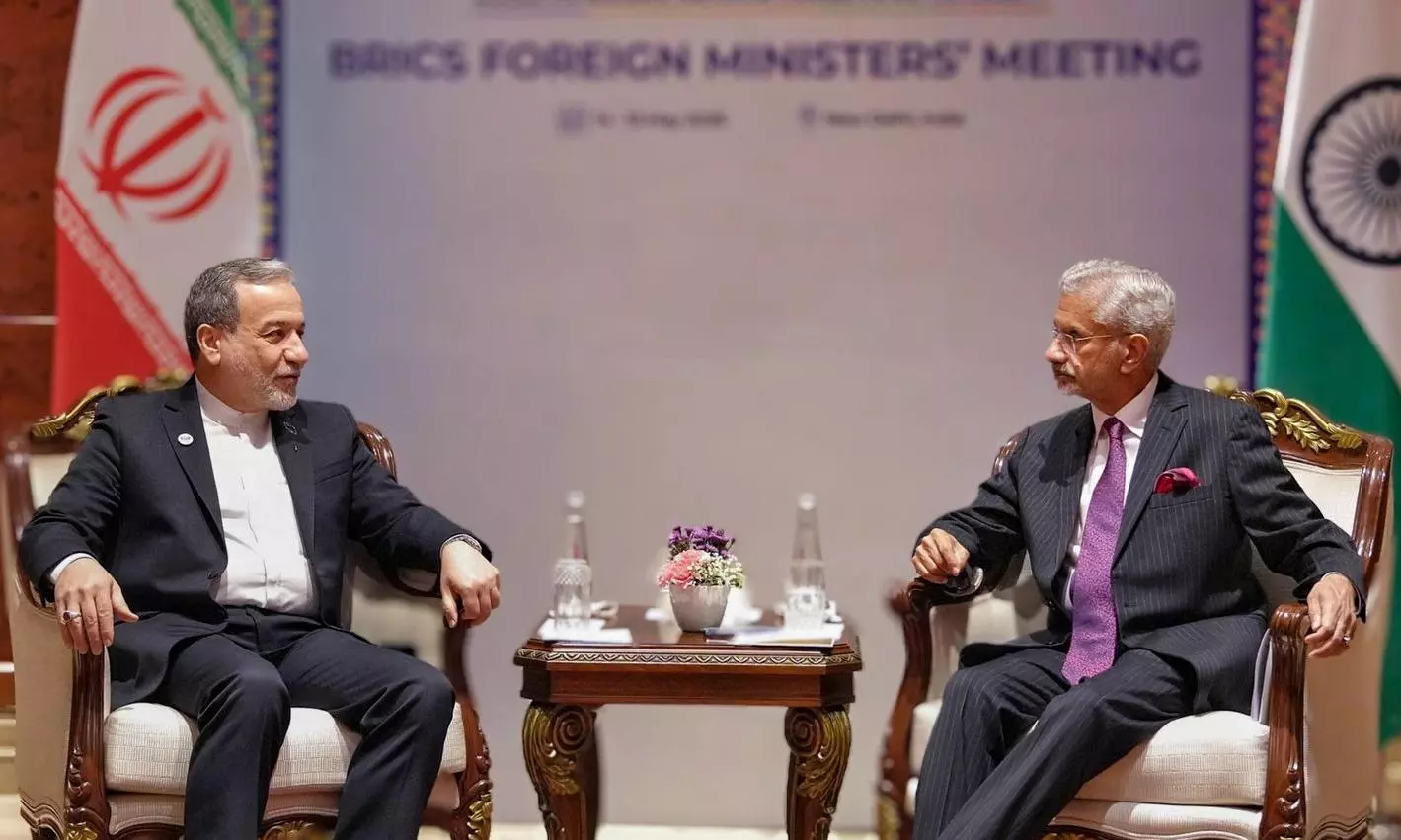
The key meet was chaired by External Affairs Minister S Jaishankar as India is currently holding the presidency of the grouping. On 15 May, a Chair’s Statement and Outcome Document was issued after the conclusion of the two-day deliberations.
The statement said, “There were differing views among some members as regard to the situation in the West Asia/Middle East region. BRICS members expressed their respective national positions and shared a range of perspectives.”
“Views articulated by them included the need for an early resolution of the current crisis, the value of dialogue and diplomacy, respect for sovereignty and territorial integrity, upholding international law, the importance of safe and unimpeded flow of maritime commerce through international waterways, and the protection of civilian infrastructure and civilian lives. The impact of recent developments on the global economic situation was stressed by many members,” it added.
UAE and Saudi not neutral neighbours, says Tehran
During the BRICS Foreign Ministers' Meeting in New Delhi, Iranian Foreign Minister Abbas Araghchi explicitly accused the UAE of being "directly involved in the aggression against my country". Tehran views the UAE and Saudi Arabia not as neutral neighbours, but as “hostile bases” because they host critical US military infrastructure and failed to condemn the initial US-Israeli strikes on Iran.
On May 14, during the first day of the talks, Araghchi called upon BRICS member states and the international community “to explicitly condemn violations of international law by the United States and Israel, including their illegal aggression against Iran; prevent the politicization of international institutions; and take concrete action to halt warmongering and to bring an end to the impunity of those who violate the UN Charter.”
“We believe that BRICS can — and must — become one of the principal pillars in shaping a more just, balanced, and humane global order; an order in which might can never make right,” he said.
Also Read: Trump’s China visit: Will it help resolve Iran conflict?
Addressing the BRICS meet on May 15, Araghchi stressed that it is “high time for us to jointly step up and work towards making clear that those practices belong in the dustbin of history.”
UAE rejects Iran's allegations
On the other hand, UAE’s Minister of State for Foreign Affairs Khalifa bin Shaheen Al Marar, who attended the BRICS meet, categorically rejected the allegations levelled against by Iran and condemned what he termed “unjustified attacks” on civilian infrastructure. Al Marar also defended UAE sovereignty in his national statement at the talks against that saw a direct confrontation with Iran, which eventually prevented a joint BRICS consensus declaration.
“Despite numerous international and regional resolutions and condemnations, Iran has continued its terrorist attacks against the UAE and other countries in the region, in clear disregard of the international consensus,” he said, according to media reports.
Araghchi wants India to play bigger role
Before departing New Delhi, the Iranian Foreign Minister held a bilateral meeting with Jaishankar in which both sides discussed the “complicated situation” at the Strait of Hormuz, Araghchi said at a media conference.
''In a fruitful engagement with my host, I discussed regional developments and clarified that Iran will always carry out its historical duty as the protector of security in Hormuz. Iran is a reliable partner of all friendly nations, who can rely on safety of commerce,” he said in a social media post.
According to Araghchi, New Delhi should play a “constructive role” in resolving the West Asian crisis due to its “good reputation” across the entire Gulf region. The minister said this at a select press meet that was held in Embassy of Iran in New Delhi.
Iran keen on Chabahar Port project
He also said Iran is keen on India developing the strategic Chabahar Port project as that will serve as a “golden gate” for India to access the Central Asian and European markets.
India is currently negotiating with the United States to extend the sanctions waiver it had obtained in 2025 in order to work on the port project.
The U.S. conditional sanctions waiver for Iran’s Chabahar Port project officially expired on April 26, 2026. This expiration followed the Donald Trump administration's broader deployment of ‘Operation Economic Fury’ and the regional military escalation against Tehran.
The U.S. State Department revoked India’s original 2018 sanctions exception under the Iran Freedom and Counter-Proliferation Act (IFCA). The expiry of the waiver also adversely impacts India's long-term access to the International North-South Transport Corridor (INSTC) and its bypass route around Pakistan into Afghanistan and Central Asia.
Iran’s Deputy Minister of Foreign Affairs Kazem Gharibabadi, who is accompanying Araghchi in his India trip, had also reiterated that Tehran is still open to India developing the mega port project.
Russian Foreign Minister Sergey Lavrov also attended the meeting. Araghchi and Lavrov also held a separate meeting on the sidelines of the BRICS talks.
Why has Modi gone to the UAE
On the other hand, during his hurricane tour to the UAE on Friday, Prime Minister Modi met UAE President His Highness Sheikh Mohamed bin Zayed Al Nahyan and “reiterated our strongest condemnation of the attacks on the UAE.”
“Also appreciated my brother’s leadership, courage and wisdom, which have been evident throughout this period. Expressed gratitude for his care and concern for the Indian community in the UAE,” Modi said in a social media post.
The UAE President said his talks with Modi “focused on further strengthening the deep ties between our countries and peoples.”
“There is a long-term strategic and economic partnership between the United Arab Emirates and India, and our discussions today deliberated on measures to give new momentum to cooperation in energy, technology, and other priority sectors. Together, we are committed to ensuring the sustainable progress of our nations and promoting peace and stability in the region and the world,” the UAE President said.
Also Read: A crumbling Iran could turn out more dangerous
The effective closure of the Strait of Hormuz by Iran, has critically disrupted maritime trade routes for the UAE and ignited a widespread energy security crisis on a global scale. Historically, this strategically vital 33-kilometre chokepoint has facilitated the transit of approximately 20% of the world’s seaborne oil and liquefied natural gas (LNG).
As a result of the ongoing blockade, the UAE is facing significant challenges that are reshaping its economic landscape, straining its infrastructure, and complicating its diplomatic efforts.
The ramifications of this disruption extend beyond the regional context, influencing global oil markets and prompting nations to reevaluate their energy dependencies and security strategies amid escalating tensions in the Gulf.
Currently, BRICS is an 11-member intergovernmental organisation — Brazil, Russia, India, China, South Africa, Egypt, Ethiopia, Iran, Saudi Arabia, UAE, and Indonesia—representing major emerging economies focused on reforming global governance, promoting South-South cooperation, and enhancing economic stability.