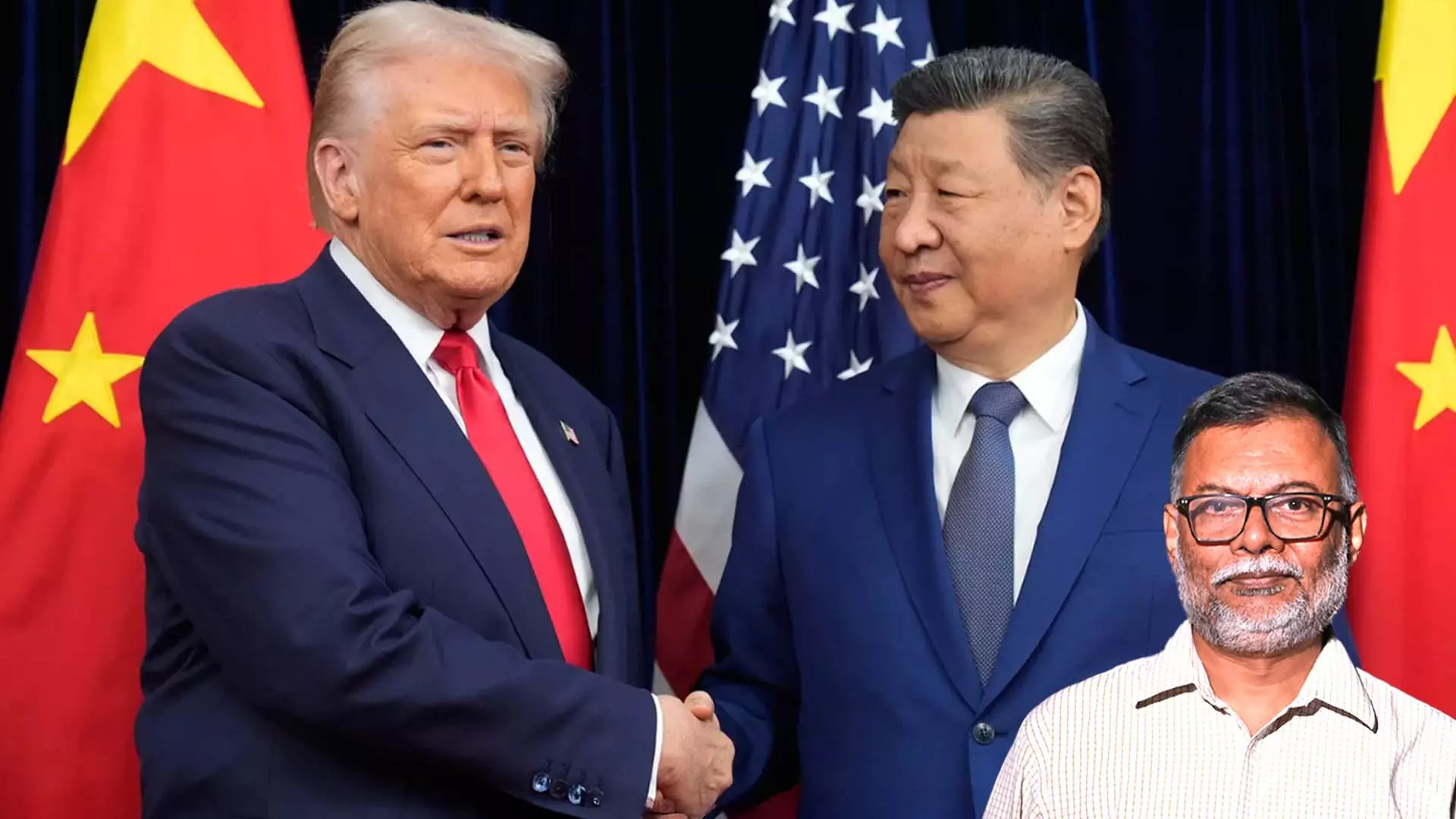
Trump’s China visit: Will it help resolve Iran conflict?
Trump’s China visit puts the Iran war, trade, Taiwan, and India’s future under the spotlight. Is a new power equation emerging?

As US President Donald Trump heads to China amid the Iran war and rising global tensions, the visit could reshape not just US-China relations, but also India’s strategic calculations, says The Federal's Consulting Editor KS Dakshina Murthy in today's (May 13) episode of Worldly-Wise.
Also read: Trump rejects Iran’s peace proposal as ‘totally unacceptable’
With the Iran conflict, tariffs, Taiwan tensions and shifting alliances all in focus, Murthy talks about why the Trump-Xi summit matters, how China’s global role has evolved, and why India may need to rethink its dependence on the United States in an increasingly unpredictable world.
How important is Trump’s visit to China, especially given his tough stance on Beijing? Could it impact the Iran war?
The visit is important for several reasons, particularly because of the tensions that have defined US-China relations over the last several years. But right now, globally, the meeting has gained significance because of the Iran war.
There is ongoing mediation to resolve the conflict, with countries like Pakistan, Saudi Arabia, Turkey and Egypt involved. But China is also playing a role behind the scenes. There are reports suggesting that China is encouraging Pakistan to mediate.
That makes Trump’s meeting with Xi Jinping especially significant. Trump has already said that Iran will be discussed, though he publicly added that he would not simply follow China’s advice.
But such statements are often for public consumption. During actual discussions, both sides will put forward their perspectives. China’s position is likely to align closely with Iran’s, because China is one of Iran’s closest allies and depends heavily on Iranian crude oil.
For Trump, too, the visit is politically important. He needs to show results to the American public at a time when his popularity has declined. Polls reportedly show that a large section of Americans oppose the ongoing war and are questioning why it is happening.
At the same time, Trump remains unwilling to soften his position on Iran’s nuclear programme. He has repeatedly insisted that Iran must first give up its nuclear ambitions.
The hope internationally is that Xi Jinping may persuade Trump to slow down and consider a broader approach. Iran is not refusing talks on nuclear issues, but Trump wants that concession upfront, which is causing the deadlock.
Also read: Iran warns US against attacks on its oil tankers, other ships but ceasefire appears to hold
Has the balance of power between the US and China fundamentally changed over the last decade?
Yes, it has changed significantly.
The United States has been the dominant global power since the Second World War. But over the last two decades, China has grown exponentially — militarily, politically and economically — to become perhaps the only country capable of seriously challenging the US.
At the same time, both countries remain deeply interdependent. A huge number of American goods are manufactured in China, while the US remains one of the biggest markets for Chinese products.
So the relationship is paradoxical. They compete intensely, but they also depend heavily on each other.
The tariff dispute under Trump is a good example. Trump imposed steep tariffs on China, but China retaliated with tariffs of its own and also restricted exports of rare earth materials that are crucial for American technology industries.
That forced the US to back off, and currently, there is a temporary pause in the trade conflict.
So, despite the rivalry, there is also a kind of balance between them. This is another reason why what Xi Jinping tells Trump during this visit could matter greatly, especially regarding the Iran conflict.
Can personal diplomacy between Trump and Xi still shape global politics?
Personal diplomacy does matter in global politics, but only to a certain extent.
Leaders may like or admire each other personally, but national interests ultimately decide policy.
Trump and Xi once had a very good personal relationship. During the early phase of the Covid pandemic, Trump praised Xi and appreciated China’s handling of the crisis.
But once political backlash began inside the US, Trump completely changed his stance and started blaming China for the pandemic, even referring to Covid as the “China virus”.
The same pattern can be seen in Trump’s relationship with Prime Minister Narendra Modi. They shared strong personal chemistry, and Modi publicly highlighted that closeness during events like the Houston rally in 2020.
Yet that relationship did not stop Trump from imposing tariffs on India, including additional punitive tariffs over India’s oil purchases from Russia.
So personal relationships can help communication, but they do not override national interests.
Still, in the present situation, there is hope that the chemistry between Trump and Xi may help reduce tensions over Iran and encourage a more measured approach.
If US-China ties improve, what does that mean for India? Could it hurt India’s interests?
India will be watching this meeting very closely.
India and China see each other as strategic rivals economically, politically and geopolitically. At the same time, India has steadily moved closer to the US over the years, especially through platforms like the Quad involving Australia and Japan.
If China and the US improve relations, India could lose some strategic leverage because India has often depended on US backing against China.
At the same time, Pakistan has become increasingly important in the current geopolitical context because both China and Trump are engaging with Pakistan over the Iran mediation efforts.
That leaves India feeling somewhat isolated diplomatically at the moment.
If US-China relations improve, it may serve as a reality check for India. It could show that depending too heavily on another country, especially an unpredictable one like the US under Trump, is not a sustainable strategy.
India may instead need to strengthen its own direct relationship with China while continuing to address unresolved border disputes and strategic challenges independently.
This summit could therefore push India to rethink its foreign policy priorities and become more strategically self-reliant.
(The content above has been transcribed from video using a fine-tuned AI model. To ensure accuracy, quality, and editorial integrity, we employ a Human-In-The-Loop (HITL) process. While AI assists in creating the initial draft, our experienced editorial team carefully reviews, edits, and refines the content before publication. At The Federal, we combine the efficiency of AI with the expertise of human editors to deliver reliable and insightful journalism.)