



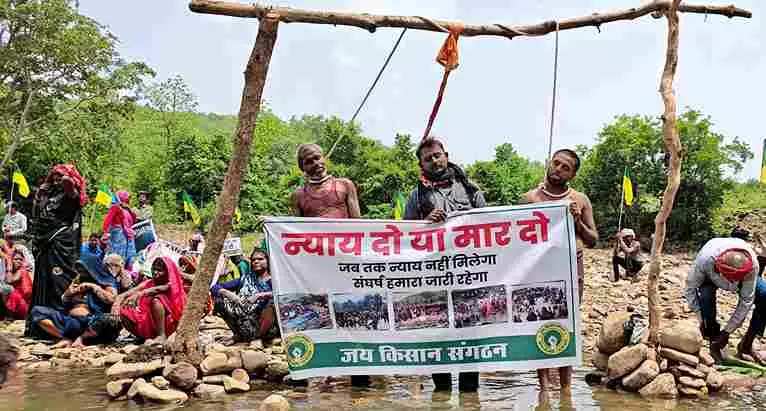
Tribals and farmers affected by the Ken-Betwa river-linking project stage a symbolic 'hanging satyagraha' by placing nooses around their necks demanding full rehabilitation or state-sanctioned euthanasia, in Chhatarpur district, Madhya Pradesh, Wednesday, July 15, 2026. Photo: PTI
Besides Bidadi, India has 1,092 land conflicts; here is a glimpse into 15 of them
The Federal tracks down 15 land conflicts across India as weakened forest safeguards, corporate mining, and mega-infrastructure projects displace people triggering massive resistance

The highly-publicised protests by farmers in Karnataka’s Bidadi and the fierce resistance from environmentalists and human rights activists over the Great Nicobar Island Development Project are not isolated incidents. They are merely the visible tip of a massive national crisis.
According to data from the rights coalition Bhumi Adhikar Andolan, India is currently grappling with a staggering 1,092 active land conflicts. Far from minor localised disputes, these overlapping crises directly impact the lives and livelihoods of 1.42 crore people across the country.
Across India, local communities, indigenous groups, and environmental activists are launching widespread protests against state-led land acquisitions and forest clearing, due to corporate mining, large-scale river-linking projects, and aggressive urban expansion.
Land is being cleared for highways, airports, freight corridors, mining, industrial corridors, real estate and other uses. "What is being presented as 'development' is in reality the transfer of land, forest, commons, water bodies, coasts and working-class settlements from people to corporations," said Bhumi Adhikar Andolan (BAA), a platform of mass organisations working on indigenous peoples’ rights, farmers’ rights and ecological protection, in a statement.
Fuelled by the weakening of legal safeguards and increased coercive acquisitions, these disputes involve widespread displacement and environmental damage, the group recorded 300 such cases over the last year alone and accused authorities of weakening legal protections meant to safeguard people’s’ rights.
Also read: Bidadi is more than just a township row: It's a fight for Vokkaliga heartland
Further BAA said, "This is happening despite legal safeguards under the Land Acquisition, Rehabilitation and Resettlement Act, 2013, the Forest Rights Act (FRA), PESA, the Fifth and Sixth Schedules, social impact assessment provisions and gram sabha consent." It added that these protections are being diluted, bypassed or reduced to empty procedures.
Out of the 1,000 plus land conflicts, The Federal provides a glimpse of 15 such projects, big and small, that are in the eye of the storm.
Madhya Pradesh
1. Ken-Betwa Link Project & Associated Dams
The Project: A massive river-linking initiative that threatens to displace over 7,000 families, submerge vast portions of the Panna Tiger Reserve, and result in the felling of millions of trees.
Protests: Adivasi (indigenous) communities and local farmers have launched the symbolic Chita Andolan and staged Jal Satyagraha (standing in water for extended periods). Led largely by tribal women, demonstrators are demanding fair rehabilitation and adequate compensation before displacement, protesting the destruction of their livelihoods and cultural identity.
Status: The ₹44,605 crore Ken-Betwa Link Project is in the implementation stage, with initial activities like land acquisition and resettlement underway. Scheduled for completion by 2030, its primary components—the Daudhan Dam and associated dams—face ongoing protests from displaced tribal communities and environmentalists concerned over the Panna Tiger Reserve.
Chhattisgarh
2. Hasdeo Arand Coal Mining Project
The Project: The government has opened up dense, ancient forest land in the Hasdeo Arand coalfields for mining operations by the Adani Group. The Hasdeo Arand forest in Chhattisgarh, often revered as the “lungs of central India”, is a biodiverse and culturally vital region now under siege.
The Protest: Indigenous tribes and environmental groups (including the Chhattisgarh Bachao Andolan) have led continuous sit-in demonstrations and work-stoppages. Protesters state the land was acquired illegally, village councils (Gram Sabhas) were bypassed, and the destruction of the forest will permanently harm their ancestral traditions and way of life.
The Legal Status: Protesters suffered a massive setback when the Chhattisgarh High Court dismissed a crucial petition challenging cancellation of the Community Forest Rights for Ghatbarra villagers. The High Court ruled that the original grant of forest titles was a "mistake" because the land had already been allocated for mining, effectively creating a precedent that forest rights under the Forest Rights act can be legally undone.
Backed by this judicial clearance, law enforcement has cordoned off forest sectors to allow continuous tree-felling. Police have detained over 100 protesting villagers during demonstrations to clear the path for heavy mining machinery.
Odisha
3. Sijimali Bauxite Mining Project
The project: The Odisha state government issued a 50-year lease to Vedanta Limited to mine bauxite across 1,549 hectares in the Sijimali hills (Rayagada and Kalahandi districts), which includes clearing nearly 700 hectares of pristine forest land. The Sijimali bauxite project is frequently promoted in terms of “economic growth” and “revenue generation. The project is intended to supply Vedanta's Lanjigarh alumina refinery.
Protests: The Sijimali project is expected to displace nearly 100 families from 18 villages and adversely affect the livelihoods of more than 500 families. The Rayagada district administration recently in April 2026 commenced the construction of a 3-kilometre-long road stretching from Purulang to the Sagabari Valley to facilitate easier access to the Sijimali mining site. This move met with strong opposition from local residents, particularly the Kui and Katiya Kondh indigenous tribal communities. They allege that this project poses a threat to their land, livelihoods, and the environment.
Also read: World Environment Day: 10 Indian infra projects sparking green debates
They staged intense, ongoing roadblocks and demonstrations. Clashes recently turned violent, with villagers accusing the police of late-night raids, cutting power, and making arbitrary arrests to force project entry. Activists warn that the mine will permanently destroy critical natural water resources and that village council (Gram Sabha) consent documents were forged.
The Legal Status: Legal challenges in the National Green Tribunal are pending
4. Niyamgiri Hills Bauxite Mining Revival
The Project: There are attempts by state mining corporations to open up the ecologically vital Niyamgiri hill range for bauxite extraction once again, a decade after a historic Supreme Court ruling originally halted it.
The Protest: The Dongria Kondh tribe has re-mobilised its traditional resistance network (Niyamgiri Suraksha Samiti). Local youths and tribal elders have set up permanent monitoring checkpoints and held massive rallies to stop any secret land surveying or heavy machinery entry into the hills, which they worship as the sacred abode of their deity, Niyam Raja.
The Dongria Kondh tribe had earlier won a historic victory in 2013 over Vedanta and the state-owned Orissa Mining Corporation (OMC) after they had blocked bauxite mining in the sacred Niyamgiri hills. While the state government and corporate entities have previously sought to revive mining to supply the Lanjigarh alumina refinery, the Niyamgiri hills remain legally protected under landmark 2013 Supreme Court Judgment on Vedanta Case rulings.
The judgement upheld their rights, recognising that the constitutional guarantees under Articles 25 and 26 protect not only religious beliefs but also essential religious practices and rituals.
Status: The state government is again making a fresh attempt to mine the ecologically fragile hill. The steel and mining minister has said the state government is keen to hold gram sabhas again for Niyamgiri bauxite mining.
West Bengal
5. Deocha-Pachami Coal Block Project
The Project: Slated to be India's largest coal block, this massive multi-phase extraction project covers thousands of acres of tribal, agricultural, and forest lands across Birbhum district.
The Protest: Led primarily by Santhal and other indigenous tribal women, continuous sit-ins and mass conventions at the site—as well as protest marches in Kolkata—have repeatedly halted ground-clearing and basalt-mining operations. Protesters refuse to surrender their ancestral forests, alleging illegal land acquisition, lack of fair compensation, severe environmental dust pollution affecting local hospitals, and direct violation of the Forest Rights Act.
Civil rights organisations have documented heavy police surveillance, restricted movement and threats used against locals, who openly oppose the land acquisition. Mass detentions of indigenous women have occurred during site blockades.
The Legal Status: The Calcutta High Court has been hearing a series of petitions demanding a judicial probe into financial and administrative irregularities regarding the land package allocations. There is currently no blanket legal stay halting the overall project, allowing the state government to proceed with basalt excavation, though local resistance keeps disrupting ground operations.
Arunachal Pradesh
6. Siang upper multipurpose project
The project: India is pushing forward with the Siang Upper Multipurpose Project (SUMP), an 11,000 MW hydroelectric and flood-control mega-dam proposed on the Siang river in Arunachal Pradesh's Upper Siang and Siang districts. Driven by state-run NHPC, SUMP would become India's largest hydropower project if built, generating an estimated 47 billion units of electricity annually at a projected cost of approximately US$13 billion (roughly Rs 1.5 lakh crore).
Also read: Why land disputes continue to plague Andhra Pradesh despite promises of reform
It is being pushed aggressively by the central government to counter upstream water-diversion threats from China.
The Protest: This has become a violent flashpoint. Led by the Siang Indigenous Farmrs Forum and local tribal councils, communities have strictly barred entry to government survey teams. The massive reservoir threatens to submerge nearly two dozen historical villages, threatening ancestral lands and the local orchard economy. Tensions recently boiled over when a crowd of nearly 2000 anti-dam protestors vandalized 30 houses belonging to residents who allegedly signed documents in favour of the project's feasibility study.
The National Human Rights Commission (NHRC) has stepped in to monitor the heavy deployment of central armed forces in the district.
Status: The project remains in the pre-feasibility and survey stages. Local opposition has successfully prevented state-run agencies (NHPC and NEEPCO) from conducting essential on-the-ground soil testing and surveys.
7. Kalai-II & Dri River Hydroelectric Projects
The Project: The 1,200 MW run-of-the-river project is located on the Lohit River in the Anjaw District. The Union Cabinet approved a ₹14,105.83 crore investment for its development by THDC India Ltd in a joint venture with the state. It is the first hydro project in the Lohit Basin and is targeted for completion in 78 months. These major initiatives in Arunachal Pradesh is central to India's push for energy security.
Protests against the 1,200 MW Kalai-II (Lohit River) and Dri River Hydroelectric Projects in Arunachal Pradesh are driven by indigenous communities citing violations of "Free, Prior, and Informed Consent" (FPIC) norms, threats of displacement, and severe ecological risks. The project received forest and environmental clearances, though it faced opposition from environmentalists over potential threats to the critically endangered white-bellied heron.
Status: The Forest Advisory Committee (FAC) granted in-principle forest clearance, mandating wildlife management plans to protect the White-Bellied Heron habitat. Additionally, THDC has already invited bids for preliminary civil works like diversion tunnels and coffer dams.
It is advancing into pre-construction and implementation phase.
Assam
8. Palashbari Mega Township Project
The Project: A massive, multi-village urban township development involving the proposed acquisition of over 6,600 bighas of fertile farmland and adjoining buffer green zones near Guwahati. The Assam government is pushing for satellite townships to help de-congest Guwahati. A similar industrial township project faced intense pushback from Bodo and Tiwa communities in Jagiroad, forcing the GMDA to scale back and relocate it to the premises of a former paper mill.
The Protest: Two citizen groups in Guwahati are demanding the immediate withdrawal of a proposed satellite township project by the Guwahati Metropolitan Development Authority (GMDA). The groups argue that the project prioritiaes corporate interests over local communities. They warn it will lead to massive displacements and the loss of critical agricultural and tribal belt land across the Azara and Palashbari revenue circles.
The groups also claim that around 500 families have already been evicted due to the project. Hundreds of rural residents and farmers have launched continuous sit-ins and demonstration marches outside local revenue offices. Protesters are raising highly charged slogans targeting the state government and corporate entities (shouting "Adani Hoshiyar"), stating that the urban expansion will permanently uproot 16 villages and destroy their primary forest-and-agricultural livelihoods
The organisations are calling on the government to cancel the township projects, stop the land surveys, protect local wetlands, compensate already-evicted families, and grant permanent land rights to the farmers who have cultivated the area for decades.
Status: The project is currently in its initial planning and land acquisition phase. And the state has enacted the Guwahati Satellite Cities Development Authority (GSCDA) bill to oversee it, allocating ₹2,100 crore for land acquisition.
9. Kaziranga luxury hotels
Project: A proposed luxury tourism project near the Kaziranga National Park is being set up by the Assam Tourism Development Corporation (ATDC). It has acquired and fenced off land on the fringes of Kaziranga National Park to build a five-star luxury resort and Tea Tribes museum.
The Protest: Adivasi and indigenous farming communities are staging ongoing protests, stating that the project unlawfully reclassified and seized vital community grazing and agricultural land. While the government maintains that the projects will boost tourism and preserve the heritage of Assam's tea garden community, indigenous organisations contend that they threaten livelihoods, wildlife corridors and the rights of local communities.
The Gauhati High Court has issued notices to the state government over the lack of proper Environmental and Social Impact Assessments. High-profile arrests of local land rights activists have sparked a wave of secondary demonstrations and international academic condemnation.
The row has escalated into a major political and legal flashpoint, with the recent arrests of indigenous rights activist Pranab Doley triggering fresh protests, sharp political reactions and renewed scrutiny of the project.
Status: The situation remains a tense flashpoint with ongoing legal battles in the Gauhati High Court and the National Green Tribunal.
10. Deepor Beel Elevated Railway Corridor
Project: This ₹536-crore Deepor Beel Elevated Railway Corridor built by the Northeast Frontier Railway (NFR) will pass through a section of a vital freshwater wetland, which acts as a flood buffer and a home for migratory birds.
Deepol Beel serves as a crucial passage for elephants moving between the Rani and Garbhanga reserve forests. Now, the NFR is clearing land for a 4.7-kilometre elevated corridor aimed at preventing train-elephant collisions. Workers have already felled around 100 trees.
Protests: Local environmental networks and community members are doing localised blockades and digital campaigns. Fresh waves of tree felling in the adjacent eco-sensitive forest patches have triggered public anger over the steady degradation of Guwahati's remaining biodiversity corridors and elephant pathway.
According to critics, driving massive concrete infrastructure directly into one of our most fragile wetlands will not solve the ecological crisis. They feel it is just aggravating the poor planning and unchecked urbanisation that fractured Deepor Beel in the first place.
Status: Construction of the corridor is underway after site clearance and is targeted for completion by March 2028.
Maharashtra
11. Chandrapur Iron Ore Mining
Project: The state government is aggressively pushing to clear eco-sensitive forest patches for iron ore mining blocks and a massive cement plant expansion in the Chandrapur district.
The Lohardongri iron ore mine, allotted to Nagpur-based Sunflag Iron and Steel, would require clearing over 18,000 trees across nearly 36 hectares of reserve forest.
The Protest: The project cuts directly through a thriving, critical wildlife corridor used by tigers and elephants. Local farming and tribal communities have organised long-term hunger strikes and village-wide sit-ins. The desperation of the land conflict recently made headlines when five farmers consumed poison at a site to protest coercive acquisitions and inadequate compensation by corporate entities.
Status: After weeks of protests and hunger strikes by activists and concerned local residents, the Maharashtra government temporarily halted further action on the Lohardongri iron ore mining project in the Bramhapuri forest division of Chandrapur district, which had ecologists and environmentalists in a bind for months.
12.The Vadhvan Port and the Fourth Mumbai
These are two interconnected mega-projects in the Palghar district of Maharashtra, approximately 140 km north of Mumbai.
The ₹76,220 crore port is one of the largest deep-draft greenfield projects in the world, while the 'Fourth Mumbai' is a planned industrial-urban region anchored by the port.
Protests: The proposed projects in Palghar district have sparked massive, ongoing protests by thousands of local residents, fisherfolk, and Adivasi farmers. Demonstrators argue these mega-projects will irreversibly destroy local marine ecosystems, displace up to 107 villages, and wipe out traditional intergenerational livelihood.
Tens of thousands of people, spearheaded by organisations like the All India Kisan Sabha and the Communist Party of India (Marxist), have held indefinite sit-ins and massive "long march" protests culminating at the Palghar District Collector's office.
Status: Regulatory clearances are nearly complete, and construction activity is being accelerated. The port is being built by Vadhavan Port Project Ltd (VPPL), a joint venture between the Jawaharlal Nehru Port Authority (JNPA) and the Maharashtra Maritime Board.
Jharkhand
13. Pakri Barwadih and Amrapali Coal Blocks
Project: Massive, long-term coal mine expansions managed by corporate giants like the Adani Group and NTPC, requires the permanent diversion of thousands of hectares of ancestral tribal forest land.
Protests: Affected families have consistently demanded adequate compensation and proper rehabilitation and resettlement, which they claim has not been fairly fulfilled by the authorities or subcontracted mining operators.
The conflict has a volatile history, frequently resulting in violent clashes, police action, and mass arrests of protestors opposing the forcible acquisition and demolition of local homes. The area remains a focal point for Adivasi mobilisation against commercial coal extraction. Communities are protesting the lack of "free, prior, and informed consent" and have accused the project of violating the Forest Rights Act by failing to recognize customary land rights.
Status : Mining operations are officially underway at the Pakri-Barwadih (North-West) captive mine project (CMP) in Jharkhand. According to a statement from NTPC Limited subsidiary NTPC Mining Limited (NML), the project successfully reached its commercial operations date on April 1.
14. Rajasthan
Dol ka badh forest project
Project: The Rajasthan government and RIICO propose to develop commercial projects (including a Fintech Park and PM Unity Mall) worth ₹3,700 crore in this 100-acre urban forest area.
The Dol Ka Badh forest, a natural urban sanctuary near the B-2 Bypass in Taron Ki Koont, Jaipur, is facing severe deforestation. The Rajasthan state government is actively bulldozing the area to construct a "PM Unity Mall," a fintech park, and luxury hotels, requiring the felling of an estimated 2,500 native trees.
Despite the land being administratively zoned for industry decades ago, it has naturally reforested into a vital ecological zone—often referred to as South Jaipur's "lungs". The thriving micro-ecosystem is home to over 85 bird species, nilgai, and more than 60 types of medicinal plants.
Protests: In response, local environmentalists, youth groups, and "Save Dol Ka Badh" citizen collectives have launched continuous peaceful protests, including forming human chains and blocking bulldozers, demanding the commercial project be relocated to preserve the urban forest.
Status: The government has paused the tree felling and the project appears to be in jeopardy. However, activists are keeping a keen watchful eye on the area.
15. Madhya Pradesh/Rajasthan
Parvati Kalisindh-Chambal Link project
The project: The ₹72,000 crore inter-state initiative connects rivers in Madhya Pradesh to water-deficit regions in Rajasthan. It aims to transfer surplus monsoon water from the Chambal basin in Madhya Pradesh to water-deficient regions in 17-21 districts of Rajasthan.
Protests: Farmers in the Chachoura and Binaganj regions in MP are protesting massive dam proposals (such as at Ghatakhedi and Radhepura-Chitaura). Residents formed struggle committees demanding "development, not displacement," arguing that the project will submerge highly fertile, irrigated lands to supply water to areas outside the state.
In January 2026, severe protests and highway blockades broke out in Rajasthan over the proposed Doongri Dam. Villagers fear the submergence of 76 villages, which will wipe out ancestral homes and farmlands.
Under the banner of the Dungri Dam Mahapanchayat, farmers and tribal residents from more than 60 affected villages have organised massive rallies and issued direct ultimatums to the state governments. Marching with banners under the slogan "Give development, not displacement," communities are resisting the loss of their natural resource bases.
Status: Government is going ahead with it and the project is in its implementation stage. A Memorandum of Understanding (MoU) and subsequent Memorandum of Agreement (MoA) for implementation were signed by the governments of Rajasthan, Madhya Pradesh, and the Union Government.