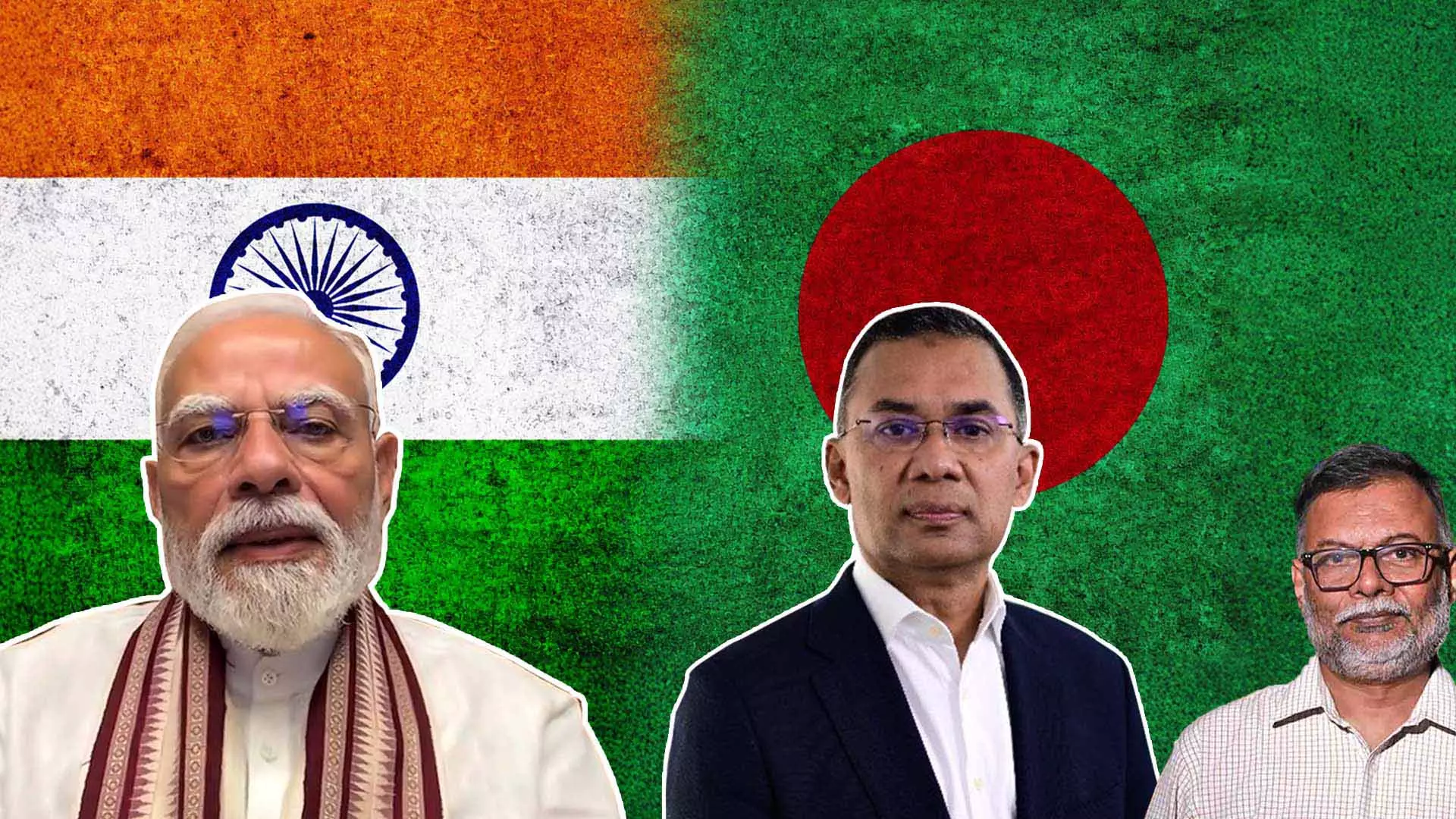
Since Sheikh Hasina's ouster as Bangladesh prime minister in August 2024 and her flight to India, relations between India and Bangladesh have repeatedly hit new lows.
BRICS in Delhi: Will Bangladesh’s Tarique Rahman show up?
Dhaka’s growing proximity to Pakistan and Turkey, coupled with the Hasina dispute, has pushed India-Bangladesh ties to a new low

As BRICS leaders gather in Delhi on September 12-13, the spotlight will fall not only on the agenda but also on notable absentees.
All eyes are on whether Bangladesh Prime Minister Tarique Rahman sticks to his decision to skip the summit despite an invitation from India, or reverses course at the last minute. His choice carries weight far beyond the summit itself — it's a marker of how badly Indo-Bangla relations have deteriorated.
Ties between the two neighbours have rarely been this strained. Since Sheikh Hasina's ouster as Bangladesh prime minister in August 2024 and her flight to India, relations have hit repeated new lows.
Bangladesh's pivot
Bangladesh has moved closer to the Pakistan-Turkey axis than at any point since its founding in 1971. There is now a real possibility Dhaka formally joins the Mecca Pact — a bloc comprising Pakistan, Saudi Arabia and Turkey that includes a mutual-defence clause, effectively making it a de facto military pact.
Also read: Hasina’s return home: Unanswered questions, persisting doubts
If Bangladesh signs on, it could neutralise a long-standing Indian strategic goal: avoiding hostility on both its eastern and western flanks. That goal dates back to 1971, when East Pakistan's split from West Pakistan removed an existential threat from India's east.
India had also worked to keep Dhaka close and Islamabad at arm's length. That strategy now appears to be unravelling, with a new Bangladesh-Pakistan alignment taking shape — one that could let Islamabad regain strategic ground in Bangladesh, given a natural affinity with sections of the country that opposed the 1971 split. Add China to the mix, and India faces the prospect of a Pakistan-Bangladesh-China axis on its borders.
The Hasina flashpoint
Central to the rift is Sheikh Hasina's continued presence in New Delhi. Bangladesh wants her extradited to face war crimes charges tied to the crackdown on student protesters in July 2024 — a case in which she has since been convicted and sentenced to death. India has neither accepted nor rejected the extradition request, saying only that it is "examining" it.
It's a bind for the Modi government: Handing Hasina over would look like abandoning a close ally, while shielding her has enraged anti-Hasina sentiment in Bangladesh. Rahman's BNP holds a comfortable parliamentary majority, but he can't ignore public mood at home by accepting India's summit invite — that would be read as tacit endorsement of Hasina's exile.
Also read: Bangladesh seeks ‘propitious environment’ for PM Rahman to visit India
Tensions worsened when New Delhi allowed Hasina to hold a press conference via the Foreign Correspondents Club of South Asia, angering the BNP government. Her announcement that she would return to Dhaka by year-end hasn't cooled things either, though India has since blocked an Awami League seminar in Delhi — a possible gesture of goodwill.
Where ties stand now
Public opinion reflects the strain. According to a recent Pew Research Center survey, India's favourability rating in Bangladesh has dropped 15 points — from 57 in 2024 to 42 now.
That raises the question of how long India will continue to shelter Hasina, and whether she was under pressure to commit to a Dhaka return despite the risk to her safety. There's no confirmation of that, though back-channel diplomacy on sensitive matters is hardly unusual. Officially, Hasina says she plans to return to restore stability, democracy and secularism — but December is still three months off, and politics rarely waits.
One factor could keep the relationship from fully unravelling: mutual dependence. India and Bangladesh share the longest border India has with any country — over 4,000 km — along with 54 rivers and extensive trade ties neither side can easily walk away from.
Also read: Why did New Delhi allow Sheikh Hasina’s media conference?
The coming weeks, leading up to the BRICS summit and the question of Rahman's attendance, should make clear which direction the two neighbours are heading.