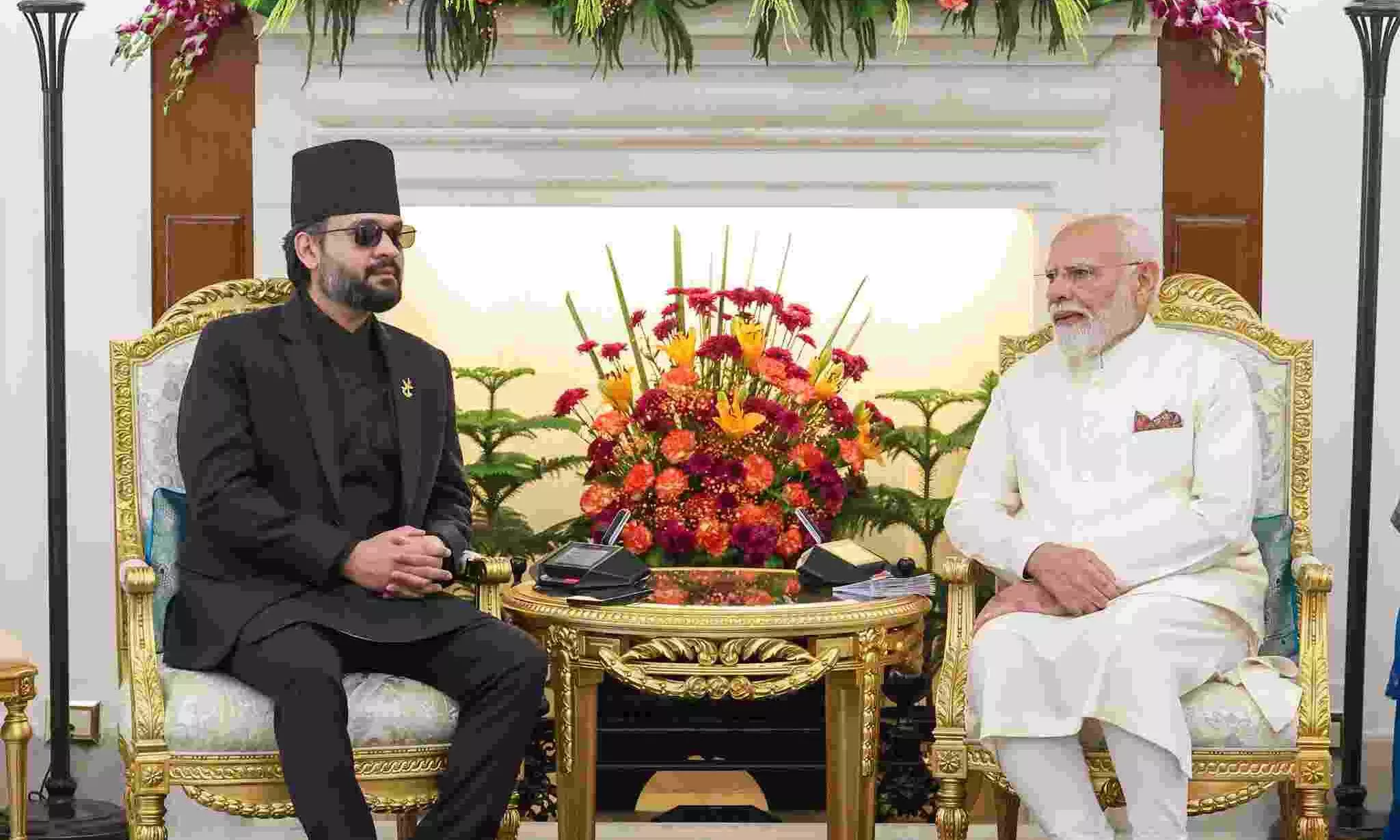
Balen Shah India visit: Modi assuages fears, says shared culture, equality at core of ties
India announces key development, connectivity initiatives, pledges support during calamities, seeks to deepen people-to-people ties, and religious and cultural affinity

The optics were good at the first meeting between Prime Minister Narendra Modi and Balen Shah, Nepal's new young leader. India backed up its efforts to woo the next generation of Nepalese leadership by announcing a substantial development and connectivity partnership, including a 24-billion Nepalese rupee development cooperation package for Nepal.
A vision document aimed at taking the relationship forward was also released. Modi promised India's continued support for Nepal's development, while Shah called for a partnership based on mutual trust, cooperation and shared prosperity.
Mutual praise
Modi heaped praise on the visiting dignitary. "A few months ago, when he addressed the UN as the world's youngest prime minister, we caught a clear glimpse of his visionary outlook. Today, through our discussions over the past few hours, I have sensed his clear vision and commitment towards the future of Nepal and the India-Nepal relationship," Modi said in his opening remarks after the talks. "The historic mandate given to him by the people of Nepal this year reflects the aspirations and hopes of Nepal's new generation."
Also read: India, Nepal eye major push in energy, infra, connectivity as Balen Shah lands in Delhi
"Mutual respect, steadfast trust, and unbroken goodwill are the bedrock of Nepal-India relations. At the heart of this incomparable bond are the peoples of our two countries. The ties between Nepal and India stand as firm as the Himalayas, and as vast as the ocean," Balen Shah said in his opening statement. "As a dependable and trusted neighbour, India has consistently stood as a first responder in times of natural disasters and difficult hours," he said.
India, on its part, went out of its way to assure Kathmandu that it was not looking to dictate terms, stressing the need for a more equal partnership. The Joint Statement released at the end of the visit repeatedly emphasised mutual respect, mutual benefit and the need to reflect contemporary political and economic realities. This is significant given Nepal's longstanding sensitivity about India's Big Brother attitude.
Reviewing 1950 India-Nepal treaty
Both sides agreed that existing bilateral agreements, including the 1950 India-Nepal Treaty of Peace and Friendship, could be reviewed by mutual consent. Outstanding issues relating to water, energy, trade and the boundary will be addressed through dialogue.
Also read: Who is former mayor Balen Shah, frontrunner for Nepal PM's post?
A high-level monitoring group, led by Nepal's foreign secretary and India's ambassador, will meet at least every six months to monitor progress. Its report will go to the India-Nepal Joint Commission, whose next meeting is scheduled for 2027.
Economic and connectivity partnership
The two countries agreed to build a more comprehensive economic partnership, with India announcing development assistance worth Rs 15,000 crore (Nepalese Rs 24,000 crore). This includes Rs 3,500 crore in grants for post-disaster reconstruction and new infrastructure projects, and a rupee-denominated line of credit of Rs 11,500 crore for energy projects. The two sides will also explore cross-border special economic zones and industrial parks to promote manufacturing, exports and investment.
Also read: Ayodhya to Janakpur in 19 hrs: Saryu Kamala Express puts Ramayana tourism on fast track
Connectivity and energy cooperation figured prominently in the joint vision. The two prime ministers welcomed the launch of the direct express rail service between Ayodhya and Janakpur and a motorable bridge across the Mahakali River linking Dharchula in India and Darchula in Nepal.
They agreed to expedite railway projects, including the Jayanagar-Bardibas and Jogbani-Biratnagar lines, and work towards the Raxaul-Kathmandu rail link. A new petroleum pipeline connecting Siliguri and Jhapa will also be built. India will encourage investment in Nepal's hydropower sector, while both sides agreed to push ahead with the Pancheshwar, Saptakoshi and Sunkoshi multipurpose projects and expand electricity trade.
India also announced access to Kandla and Paradip ports for Nepalese exports, an important development for the landlocked country.
The partnership will extend to newer areas such as technology, education, agriculture and sports. India will explore opening an IIT campus in Nepal, support the setting up of a cricket training academy, and assist in developing digital infrastructure, AI and satellite technology. An Agro-Industrial Park will be established in Chitwan with Indian assistance.
Tourism circuits, people-to-people ties
The two sides also agreed to develop religious tourism circuits linking Ayodhya and Janakpur, Lumbini and Buddhist sites in India, and Pashupatinath with Varanasi.
The larger picture is that India is seeking to deepen institutional cooperation with Nepal, extending beyond the traditional areas of infrastructure, connectivity and development assistance. People-to-people ties, and religious and cultural affinity remain at the core of the relationship.
Also read: Balen Shah in New Delhi: Can India win over Nepal’s Gen Z prime minister?
“The relationship between India and Nepal is woven together by threads of shared history, faith, culture, and deep people-to-people ties. Lord Ram and Mother Sita are the symbols of our shared civilisation and faith," Modi said in his address. "Without Nepal, our dhams (pilgrimage sites) are incomplete; without Nepal, even our Ram is incomplete."
Ball in Shah’s court
The previous government in Nepal, a country sandwiched between Asian giants India and China, had often used the China card in times of tension. Shah has not yet done so. No one is very sure of what his policy towards China is. It will evolve as he and his government work out the details.
New Delhi has made its first move to woo Nepal and work out a relationship based on mutual respect. What happens when ties hit a rough patch remains to be seen.