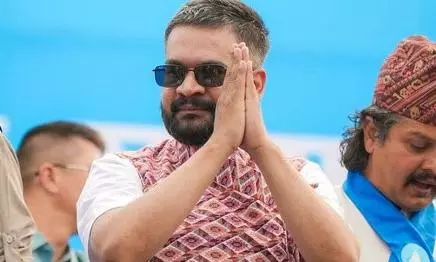
Nepal’s political landscape is being redefined by a new political figure capturing widespread national attention.
Balendra Shah, popularly known as Balen Shah, is a 35-year-old structural engineer, rapper, who is currently a leading candidate to become the Prime Minister of Nepal in the March 2026 general elections.
The rapper-turned-politician is emerging as one of the most talked-about challengers in the race and could potentially become the country’s youngest Prime Minister if the momentum behind his party continues.
Rapper turned politician
Balen first gained national fame as a rapper in the 'Nephop' scene, known for lyrics that criticised corruption and the political establishment. He became a youth icon and in May 2022, he stunned the country by winning the election as Mayor of Kathmandu as an independent candidate, defeating seasoned politicians from major parties.
His sharp criticism of corruption, bureaucratic inefficiency, and entrenched political elites helped him build a large following among young voters.
During his three-and-a-half-year tenure as Mayor, he was known for live-streaming municipal meetings for transparency, aggressively demolishing illegal structures and clearing public land, implementing "textbook-free Fridays" in schools and improving waste management.
However, he ran into controversy, when he faced criticism from rights groups for his "heavy-handed" treatment of street vendors and the urban poor during his city-beautification drives.
Gen Z movement
Balen emerged as a prominent face among young protesters during the Gen Z demonstrations in September 2025.
Young people took to the streets across the Himalayan nation to fight against corruption and social media restrictions.
Prime Ministerial bid
In January 2026, Balen resigned as Mayor of Kathmandu to enter national politics. He joined the Rastriya Swatantra Party (RSP), which is led by former television host-turned-politician Rabi Lamichhane and was officially named their Prime Ministerial candidate for the March 5, 2026, general elections.
In a high-stakes move, he is contesting the parliamentary seat in Jhapa-5, directly challenging the veteran former Prime Minister KP Sharma Oli in his own political stronghold.
Background
He was born on April 27, 1990, in Naradevi, Kathmandu, to a family of Maithili origin. He is the youngest son of an Ayurvedic practitioner, Ram Narayan Shah. His parents relocated to Kathmandu from the Mahottari District of Madhesh Province after his father was assigned to Naradevi Ayurvedic Hospital.
He is almost always seen in public wearing his signature dark sunglasses and sharp suits.
What makes Shah popular?
What makes Shah popular? Shah’s appeal lies in his outsider status. Much like the Gen Z protests that reshaped Nepal’s political scene, his campaign emphasises generational change and the dismantling of traditional political networks.
His foreign policy is largely framed around balanced and pragmatic diplomacy. He believes in maintaining Nepal’s historic economic and people-to-people ties with India, and seeks more equitable economic partnerships and infrastructure cooperation.
Unlike some leaders who have adopted sharper nationalist rhetoric, Shah has generally emphasised pragmatism and economic cooperation, appealing to voters who want stability in cross-border trade, employment, and energy ties.