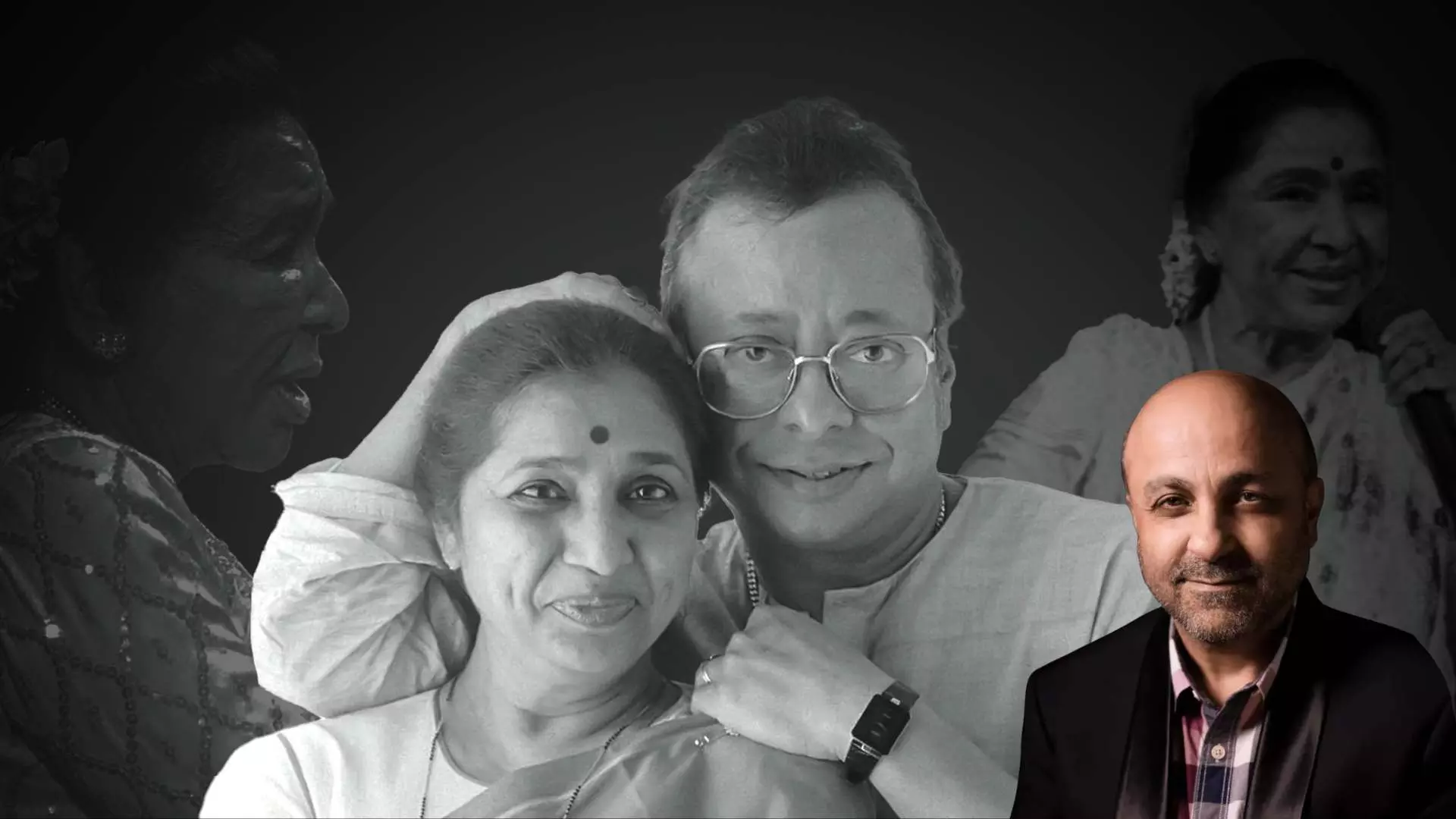
Asha Burman duo redefining music legacy
Why Asha Bhosle-RD Burman symphony still casts its spell? | Filmmaker interview
Filmmaker Brahmanand Siingh reflects on the timeless partnership of Asha Bhosle and RD Burman that redefined Indian film music; archiving such artistic legacies is vital

Reflecting on Indian film industry's most iconic music collaboration, Mumbai-based filmmaker Brahmanand Siingh has this to say: "Asha Bhosle and RD Burman were never afraid of experimentation — and that’s what made their work magical." As India mourns the death of the legendary singer Asha Bhosle on April 12 at the age of 92, and scrambles for authentic information on this music star, Siingh underscores the urgent need to archive artistic legacies for future generations.
The Federal spoke to Brahmanand Siingh, about his documentary on famous music composer RD Burman, Asha Bhosle’s genius, and why her story deserves to be told more fully. His documentary titled Pancham Unmixed: Mujhe Chalte Jaana Hai (An Unending Journey) offers a glimpse into Burman's reflective artistry and the buoyant yet often solitary inner world he inhabited.
Through the voices of close friends like Gulzar, colleagues, younger musicians like Shankar, Ehsaan and Loy and admirers, the film seeks to capture the nostalgia that his melodies continue to inspire, evoking the timeless magic of Pancham’s genius. In the docu, Asha, who had a sizzling partnership with RD Burman to give unforgettable hits after Teezri Manzil (1966), describes Pancham, as she called him, as 'a free bird who could not be caged'.
Here are excerpts from the interview:
What had inspired you to make a documentary on RD Burman?
It’s a long time back that I did the film, but the film has not stopped running. It remains a cult film. It’s seen by thousands of people every new day.
Why I did it was something very simple. We are a country of not very good archivists. There are people who are our legends, our legacies, but we don’t have as evolved an art form as is needed to capture and archive them for future generations.
Fifty years later, a hundred years later, if people want to know who they were, they should be able to. That was essentially what drove me. Everybody spoke about what a genius he was and how ahead of his time he was, but nobody bothered to understand why or how. Those were the reasons that drove me to make the film, and I’m happy I made it.
How did you approach portraying Asha Bhosle and her collaboration with RD Burman?
Asha Bhosle was a very important part of Pancham’s life and he was a very important part of hers. Their collaboration is probably one of the best between a singer and composer.
People think of her only for cabaret numbers or peppy songs, which she sang brilliantly, but she was far more than that. She could sing classical compositions, ghazals, and deeply emotional songs with equal perfection.
Also read: Ilaiyaraaja mourns loss of his 'beloved sister' Asha Bhosle: 'Incomparable voice'
This kind of range is phenomenal. Most artists have range, but this is something else. It’s like Sachin Tendulkar in cricket — she had everything in her arsenal. There was not a single flaw.
Like classical maestro Ustad Bade Ghulam Ali Khan famously remarked about Lata Mangeshkar on how she never went out of tune saying "Kambakht, kabhi besuri nahin hoti" (Damn it, she never goes out of tune). We can say the same thing about Asha.
In your view, what made their partnership so successful?
RD Burman was very good at tapping into the strengths of a singer. We all live our lives through our strengths, not our flaws. He could identify the texture in Asha's voice, understood her attitude, and what she was capable off. He pushed her to her limits.
She, in turn, trusted him completely and flowed with his vision. Their relationship was beautiful — one person exploring the depths and the other trusting and delivering without hesitation.
RD Burman and Asha, both of them, had an inherent nature to experiment. They were never afraid to try something new. Fear stops people more than failure does, and you never saw fear in either of them. They just tried things and pulled it off with aplomb — and what work they created!
Would you describe their connection as instinctive?
I would call it intuition rather than instinct. Instinct is a physical reflex, but intuition is something divine that you tap into. Works of art and intellect have a lot of intuition. Both of them valued that and worked on it. They were open to thinking and experimenting, but they also built upon it.
Also read: Asha Bhosle obit: The unstoppable voice of Hindi playback singing that refused to be typecast
As Picasso said, know the rules like a professional and break them like an artist. That’s exactly what they did.
What did Asha Bhosle share about RD Burman during your interviews?
She spoke a lot about his experimental nature. How, once he got an idea, he would go ahead and try it without worrying about anything.
She described the atmosphere during his compositions — even strangers wanted to witness those moments. That shows the kind of energy and curiosity around him. Asha also spoke about his emotional intelligence. He brought out the best in artists.
Musicians loved playing for him, singers loved singing for him. He gave them freedom, encouraged them, and created an atmosphere of excitement and fun.
What made Asha Bhosle special?
There will never be a singer like Asha Bhosle. Not just as a singer, but as a storyteller — she was a fantastic raconteur.
She had gone through a lot in life, and that resilience showed in her personality. She diffused any grim situation with fun. She created an atmosphere of joy, humor, and creativity. She wasn’t someone who complained or found faults. She believed in being a happy person with music, creativity, fun, jokes — that was her world.
Asha married RD Burman and towards the end they lived separately. He also went through a low phase when his career went downhill. Did you focus on that?
Yes, it captured his loneliness, his low phase, and his industry rejection. The same industry that once celebrated him as a genius stopped valuing him at one point. The film reflects that phase. But, we did not focus on his personal life since the film was on his genius and his work.
Yes, they lived separately and he was very lonely towards the end but now is not the time to talk about that.
How do you reflect on Asha Bhosle’s legacy today?
What made her who she was could not have happened without the ups and downs in her life. These experiences add depth to artists.
Also read: How Asha Bhosle overcame early setbacks to become a legend of Hindi film music
She was intelligent, sharp, and sensitive. What she has left behind is unmatched. You can listen to her songs even a hundred years later.
The most beautiful part is that when she recorded those songs, she never thought she was creating masterpieces. That’s true of most geniuses — masterpieces are decided by others, not the creator. Many think they are creating masterpieces but it does not turn out to be one.
Do you regret not making a documentary on her?
I regret not making a docudrama on her while she was still alive.
When the subject is alive, you have a huge advantage — especially someone like her, who was such a wonderful storyteller. I wish I had made it 7–8 years earlier when she was still in her prime. It's amazing that she continued performing even into her 90s, which is extraordinary. And she never went off-key, even when she grew old, that’s remarkable.
What made her musically so exceptional?
She had a genius lineage and formal training. She learnt from Ali Akbar Khan, who is not an ordinary tutor. Earlier on, both Lata and Asha learnt music with their father Pandit Deenanath Mangeshkar.
She was also open to Western music and collaborations. She had a God-gifted voice and immense talent.
There are songs where it’s hard to tell where the instrument begins and where her voice starts and fades — that’s the level of perfection.
Any personal anecdotes about her?
Not specific anecdotes, but I’ve seen her in many gatherings. She was an excellent mimic. She could mimic anyone, even her sister, with great imagination and humor. She had a wonderful fun side. It was always a lively, enjoyable atmosphere around her.
Why is there a lack of biographies and documentaries on such legends?
Yes, I agree. There’s no proper biography or autobiography on her, which is unfortunate.
Docu-biopics are a valid genre, but not many people explore them. They need support — from corporates or government.
Earlier, institutions like Doordarshan and Films Division made such films, but often within rigid frameworks. The world has moved ahead, but those formats haven’t. Because of that, documentaries got a reputation of being boring. The good ones were too few and that needs to change.
The content above has been transcribed from video using a fine-tuned AI model. To ensure accuracy, quality, and editorial integrity, we employ a Human-In-The-Loop (HITL) process. While AI assists in creating the initial draft, our experienced editorial team carefully reviews, edits, and refines the content before publication. At The Federal, we combine the efficiency of AI with the expertise of human editors to deliver reliable and insightful journalism.