



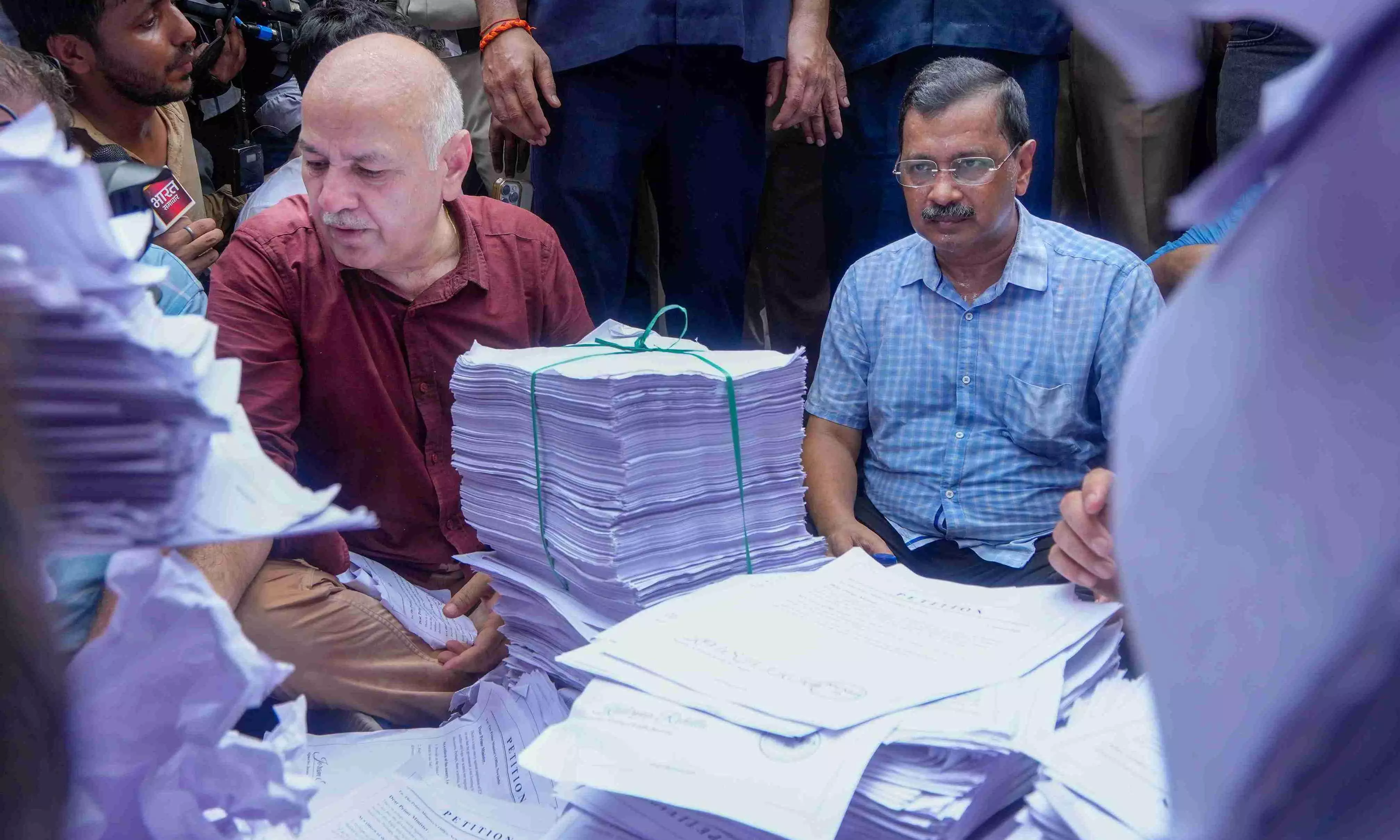
Former Delhi chief minister and AAP chief Arvind Kejriwal (right), party leaders Sanjay Singh and Manish Sisodia and others sit on Firoz Shah Road after being stopped by the police during their protest march on August 4. Photo: PTI
Kejriwal vows to continue anti-E20 protest after police stop march to PM's house
AAP convenor urges citizens to join movement in large numbers to force a policy rethink

Aam Aadmi Party (AAP) national convener Arvind Kejriwal on Tuesday (August 4) vowed to intensify his campaign against the Centre's E20 petrol policy after Delhi Police stopped him and around 100 supporters from marching to Prime Minister Narendra Modi's residence to submit more than 2.3 lakh petitions opposing ethanol-blended fuel.
The protesters were halted midway on Firoz Shah Road, where AAP leaders staged a demonstration after police denied permission for the march.
Campaign to continue
Addressing the supporters, Kejriwal urged people to join the movement in larger numbers, saying public participation was essential to force the government to reconsider the policy. "If people want to stop E20, they will have to come out on the streets in large numbers," he said, adding that the campaign would continue across the country.
Also read: E20 fuel cuts emissions but trims mileage by 2-6 pc, Gadkari tells Lok Sabha
The former Delhi chief minister also announced that the AAP would oppose the implementation of the policy in states where it has a legislative presence. "We have MLAs in Goa and Gujarat, and our legislators will oppose any move to implement E20 there as well," he said.
'We are not terrorists’
Before being stopped by police, Kejriwal told the police officers that the delegation only wanted to meet the prime minister and hand over petitions signed by lakhs of citizens.
"We are not terrorists. We only want to meet the prime minister and discuss the E20 issue," he said.
AAP's Delhi unit chief Saurabh Bhardwaj said the party had repeatedly sought an appointment with the prime minister, including through a letter sent last month, but had received no response. "We have come with lakhs of petitions. We want to discuss ethanol and present people's concerns. There should be a dialogue," Bhardwaj said.
Also read: Why is E20 policy report not in public domain if it's beneficial for India?: Tahseen Poonawala
Kejriwal said the decision to march to the prime minister's residence came after the Centre did not respond to his letter seeking a meeting on the issue. He said the petition campaign had received more than 2.3 lakh signatures, while the party's recently organised "Ethanol Townhall" had drawn widespread participation from citizens.
AAP's demands
The AAP has been demanding that petrol pumps offer consumers a choice between regular petrol and E20 fuel instead of making ethanol-blended fuel the default option. It has also sought a reduction in the price of E20 petrol, arguing that consumers should not pay the same price for a fuel that allegedly delivers lower mileage. The party has further called for bringing the price of regular petrol below Rs 84 per litre.
AAP leaders have argued that the rapid rollout of E20 has raised concerns among vehicle owners over engine compatibility, reduced fuel efficiency and increased maintenance costs.
Also read: BJP-NDA supporters reject E20: 'Government should listen to people's feedback'
AAP MP Sanjay Singh claimed that a reply he received in Parliament indicated that the Centre remained committed to implementing the E20 policy. He also alleged that the policy would ultimately benefit foreign ethanol producers rather than Indian farmers, urging the prime minister to resist pressure to increase ethanol imports.
BJP dismisses campaign
The BJP dismissed the protest as politically motivated. BJP MP Tarun Chugh termed it a "baseless and meaningless campaign", asserting that the ethanol-blending programme had been introduced after scientific assessment and would benefit Indian farmers.
Delhi BJP president Harsh Malhotra accused Kejriwal of attempting to replicate a recent Opposition protest near the prime minister's residence for political attention. He alleged that staging demonstrations without permission and later accusing the government of suppressing dissent had become Kejriwal's political strategy.
Also read: The Cockroach Effect: Two new online movements now target E20 fuel, caste quotas
The E20 policy has increasingly come under criticism from sections of motorists and opposition parties, who have questioned its impact on vehicles, fuel efficiency and consumer costs. Meanwhile, the Centre has maintained that the ethanol-blending programme is aimed at reducing India's dependence on imported crude oil, cutting carbon emissions and improving energy security.