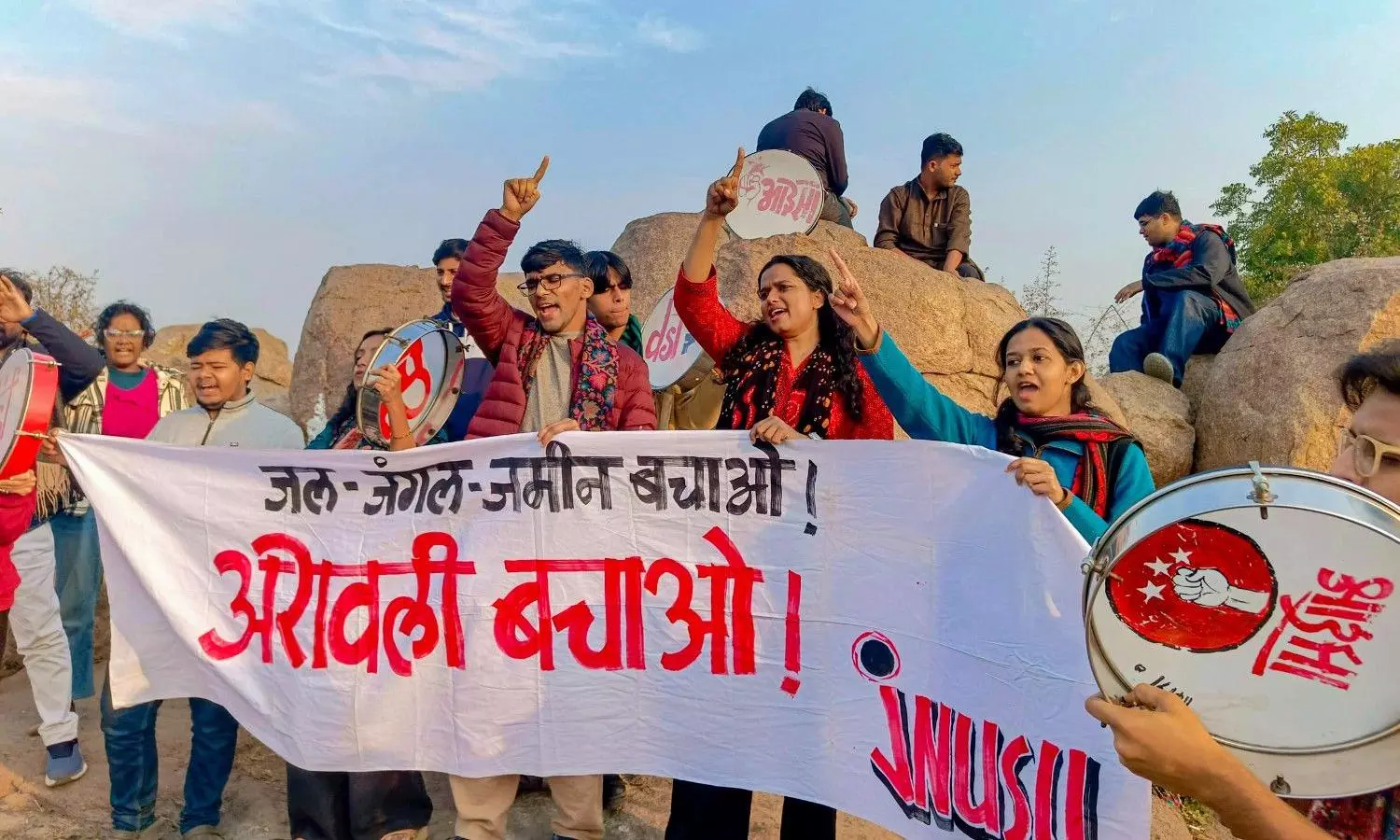
Students display banners during a protest for the protection of the Aravalli Hills at Jawaharlal Nehru University, in New Delhi, Saturday, December 27. PTI
Aravalli Hills case: Activists welcome SC order, call it ‘interim win’
Hearing the suo moto case on Monday, the apex court put its November 20 order, which sought to define the Aravalli hills using a 100-metre height criterion, in abeyance. The next hearing is scheduled for January 21

Environmental activists and experts working on the Aravalli range welcomed the Supreme Court’s latest intervention on Monday (December 29) as a relief, but warned that the future of the fragile hill system would hinge on whether experts and local voices, not “vested interests” and bureaucrats, shape the next stage of decision-making.
Hearing the suo moto case on Monday, the apex court put its November 20 order, which sought to define the Aravalli hills using a 100-metre height criterion, in abeyance. The next hearing is scheduled for January 21.
Also read: SC puts its earlier acceptance of Aravalli hills definition in abeyance
The move had triggered widespread protests and concerns among environmental groups and the public, who warned that it could open large swathes of the fragile hill system to mining and construction.
‘Unprecedented in many ways’
The court also said it would constitute a fresh expert committee to examine the issue, prompting a cautious welcome from activists and experts who have long argued that bureaucratic interpretations of the Aravallis have led to ecological damage.
Environmentalist Vimlendu Jha said the top court’s decision was “unprecedented in many ways”.
“The fact that there has been a notice issued to the Centre and the four states – Gujarat, Haryana, Delhi and Rajasthan, and also asking for an expert committee which has domain experts and not bureaucrats, is a welcome move. The fact that the November 20 order has been put in abeyance, which is unprecedented in many ways because it’s the Supreme Court’s own order which has been stayed, is also welcome. Perhaps there will be some clarification, and taking back of this draconian and anti-ecological definition of the Aravallis,” he said.
Also read: 'Committed to protect Aravallis': Bhupender Yadav welcomes SC stay
Others, however, were more circumspect. Terming the development an “interim win”, Neelam Ahluwalia, founder member of People for Aravallis, said one should be cautious as mining continued unabated despite earlier court interventions.
“It’s an interim win for the people's movement, which is only going to grow stronger on the ground. There is a lot of damage that has already happened. Mining is continuing on the ground, whether it is licensed whether it is illegal, and the government has not stopped it. A huge demand from our side is that a detailed, independent, cumulative social and environmental impact assessment of the entire Aravalli range needs to be done, where the communities who are impacted by the mining need to be heard,” she said.
Ahluwalia also questioned the reliance on expert committees alone and rejected the idea of “sustainable mining” in the Aravallis.
“We cannot leave the Aravallis to expert committees of the government or the Supreme Court anymore, because we have already seen what expert committees do. There is a huge demand from the people who are living in the lap of the Aravalli range that they have to be included in whatever decisions that are being made for the Aravallis, because it's their lives and livelihoods at stake. They are the ones who've been the guardians of the hills and the rivers and the mountains for aeons,” she said.
Cautious hope
Ritu Rao, who works with the Indian National Trust for Art and Cultural Heritage (INTACH) on natural heritage projects, said the Supreme Court’s suo moto cognisance was a “good decision”, but warned against repeating past mistakes.
Also read: Why the new Aravalli definition is dangerous | Neelam Ahluwalia interview
“I like it that they took suo motu cognisance of the protest and the wide discontent that was there in the people about this definition, but we get worried because again they have spoken of a committee… The committee should have independent experts who don’t get carried away by the government or the mining lobby, or the real estate lobby. There shouldn’t be vested interests; they have to see the ecosystem as a whole,” she said.
Ecologist Vijay Dhasmana said the Supreme Court decision had generated cautious hope.
“I think they studied the judgment well, and they not only referenced the previous judgment but also the report (of the previous committee). So, it's a good thing. Now they have asked to create an expert committee, which hopefully will not be bureaucrats deciding on these things, and that they will look at the ecological integrity of the landscape of the Aravallis,” he said.
“It (the expert committee) should have geologists, ecologists, and social workers who are working in the Aravalli region. I think it should be a good, comprehensive mix to understand the Aravallis from a cultural, ecological, and geological perspective. I think that is very, very important,” he added.