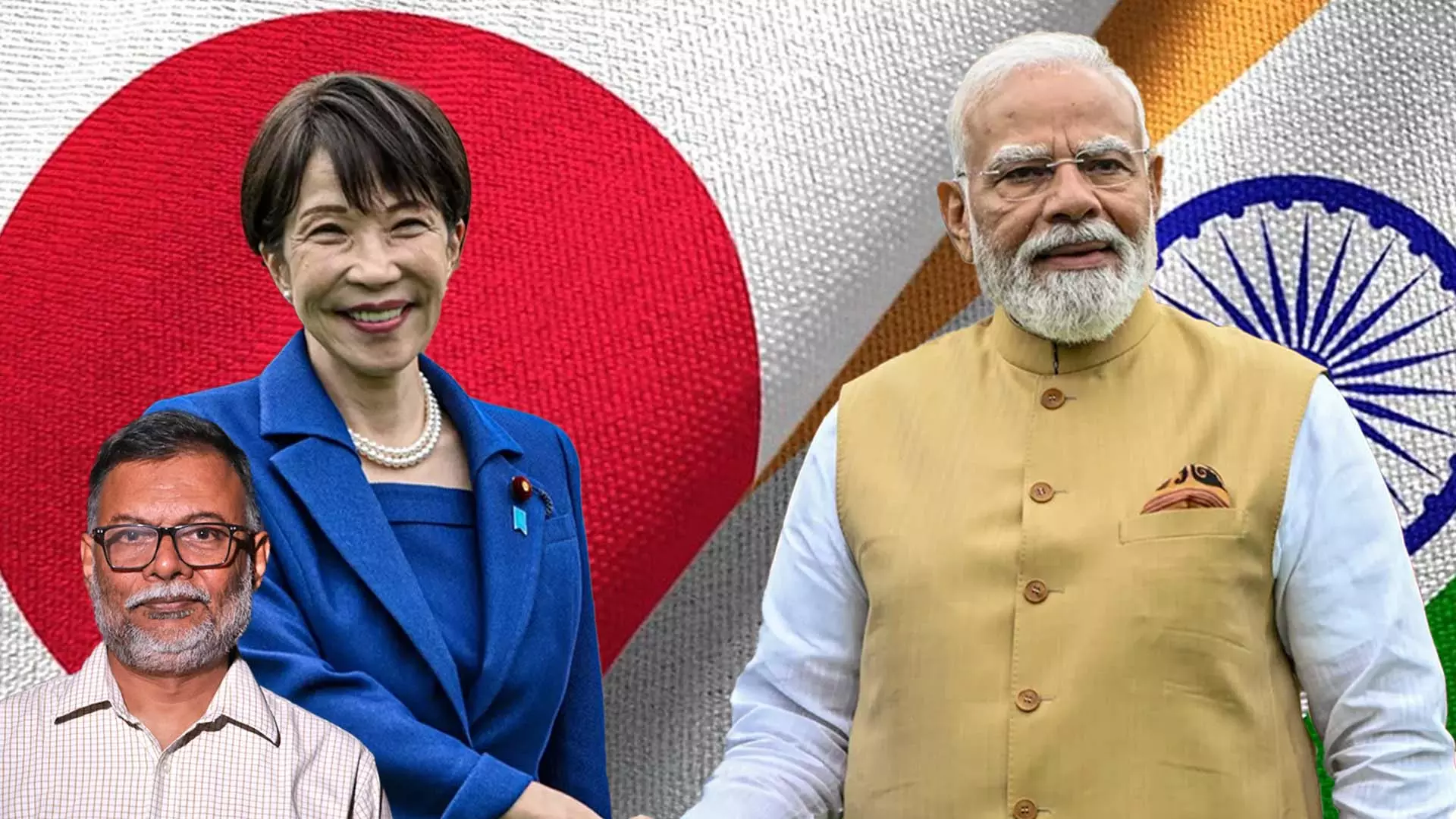
'Japan's tech can help India expand its strategic oil storage capacity'
Worldly Wise eipisode analyses Japanese PM Takaichi's India visit, future of Indo-Japanese ties, Quad, and opportunities and limitations in shaping bilateral ties

Japan and India must deepen their partnership beyond trade and economics, especially in defence and strategic cooperation, as global geopolitical shifts, China's rise, uncertainty in US foreign policy, and instability in West Asia reshape Asia's security landscape, says international affairs expert and The Federal's Consulting Editor KS Dakshina Murthy.
In a discussion, the specialist in international politics talks about the significance of Japanese Prime Minister Sanae Takaichi's visit to India, the future of Indo-Japanese ties, the Quad, China's role, and the opportunities and limitations shaping the bilateral relationship.
Why is Japanese Prime Minister Sanae Takaichi's visit to India important at this point?
The visit comes at a very interesting juncture because the world, India and Japan have all been affected by the recent Iran conflict. Thankfully, there is now a ceasefire, and hopefully some kind of lasting resolution emerges.
Over the past few months, tensions around the Strait of Hormuz created enormous uncertainty because critical commodities, especially oil, pass through that route. Both India and Japan were significantly affected. The ceasefire has therefore come as a major relief for both countries.
Also read: Modi, Japan PM reaffirm rules-based Indo-Pacific amid China concerns
At the same time, this crisis has demonstrated that India and Japan need to reduce their dependence on oil and other essential commodities from the Gulf region. The Strait of Hormuz will continue to remain strategically sensitive, and there is no guarantee that tensions will not flare up again.
Another important factor is China. China remains a major strategic concern for both India and Japan. Both countries are therefore looking at ways to increase their resilience against future geopolitical shocks.
For example, Japan's technology can help India expand its strategic oil storage capacity. There is also growing interest in renewable energy and advanced technologies, areas where Japan is a global leader.
Japan under Sanae Takaichi is also opening up more in the field of defence cooperation. India is looking for dependable strategic partners, particularly at a time when uncertainties have emerged regarding the United States and China's growing influence.
All these factors make this visit far more significant than it might otherwise have been.
Both Sanae Takaichi and Prime Minister Narendra Modi are seen as representing conservative nationalist politics. Does that influence Indo-Japanese ties?
Yes. Sanae Takaichi is widely regarded as a nationalist within Japan's Liberal Democratic Party. Some even describe her as an ultra-nationalist. Prime Minister Modi similarly represents a nationalist political stream in India.
Both leaders are inward-looking in certain respects. Their approaches to issues such as immigration and national identity have similarities. Japan's concerns over immigration mirror India's emphasis on preventing illegal migration and its broader nationalist priorities.
Also read: PM Modi holds talks with Japan PM Takaichi on semiconductors, AI, economic security
However, this ideological similarity does not directly shape India-Japan relations.
The more significant impact is visible in Japan's evolving security outlook. Since the Second World War, Japan has maintained a pacifist Constitution and has limited itself to Self-Defense Forces. Traditionally, Indo-Japanese ties have therefore remained focused largely on economic cooperation.
Last year, bilateral trade stood at nearly $30 billion, with India importing around $22 billion worth of goods from Japan while exporting roughly $7 billion.
What is changing under Takaichi is Japan's willingness to become more active in defence cooperation. Japan is seeking greater flexibility beyond its traditional pacifist approach.
For instance, Japan is working with Australia on stealth frigates and is also exploring whether some manufacturing work could be outsourced to India.
This gradual shift towards defence cooperation reflects Takaichi's broader worldview and could significantly alter the character of India-Japan relations in the coming years.
Does the Quad still provide India with strategic advantages despite questions over its future?
There has certainly been a perception that the Quad has lost some momentum recently.
US President Donald Trump has appeared less enthusiastic about strengthening the grouping. Since the Quad was originally conceived largely as a strategic response to China's growing influence in the Indo-Pacific, Washington's evolving relationship with Beijing has naturally raised questions about the Quad's future.
Also read: Surprise, unease in Japan after Trump uses Pearl Harbor to defend Iran war
However, that does not mean cooperation among the remaining members has weakened.
India, Japan and Australia still have considerable scope to strengthen military cooperation. During her visit, Takaichi herself indicated that India and Japan are looking at expanding joint military exercises.
Australia is also deepening defence cooperation with Japan, while India is exploring similar opportunities.
Even if the United States is less active within the Quad framework, the grouping still provides an important platform for India and Japan to strengthen their strategic relationship.
Its future will ultimately depend on how actively the remaining members choose to utilise that framework.
What are the biggest obstacles to taking India-Japan relations to the next level?
Japan has already invested heavily in India. Around 1,500 Japanese companies operate here, and Japan has contributed significantly to India's infrastructure and development projects.
However, there are structural limitations.
The first is geography. India and Japan are separated by several thousand kilometres, making closer integration inherently more challenging.
The second is language. Japanese remains unfamiliar to most Indians, making communication more difficult. Modern translation technologies have eased this challenge, but they cannot entirely replace deeper cultural and linguistic understanding required for stronger long-term engagement.
Also read: A new trade game in South Asia, where 'reciprocal' means 'unequal'
China is another major factor.
So far, Beijing has largely accepted strong economic ties between India and Japan. However, if bilateral defence cooperation expands significantly, China is unlikely to welcome such developments.
Relations between Japan and China have already become more strained since Takaichi assumed office. Japan's position that it may have to respond actively in the event of a Taiwan contingency has not been well received in Beijing.
India, meanwhile, maintains a complex relationship with China. Despite underlying tensions, both countries remain economically interdependent.
Japan faces a similar situation. Although political tensions with China remain high, both economies continue to be closely linked.
These realities create limitations, but they do not prevent deeper India-Japan cooperation.
Given changing global conditions—including China's rise, instability in West Asia, shifting US foreign policy, and trade disruptions such as tariffs—both countries increasingly recognise that they are natural partners.
The potential for significantly stronger strategic cooperation certainly exists, provided both sides make a conscious effort to realise it.
The content above has been transcribed from video using a fine-tuned AI model. To ensure accuracy, quality, and editorial integrity, we employ a Human-In-The-Loop (HITL) process. While AI assists in creating the initial draft, our experienced editorial team carefully reviews, edits, and refines the content before publication. At The Federal, we combine the efficiency of AI with the expertise of human editors to deliver reliable and insightful journalism.