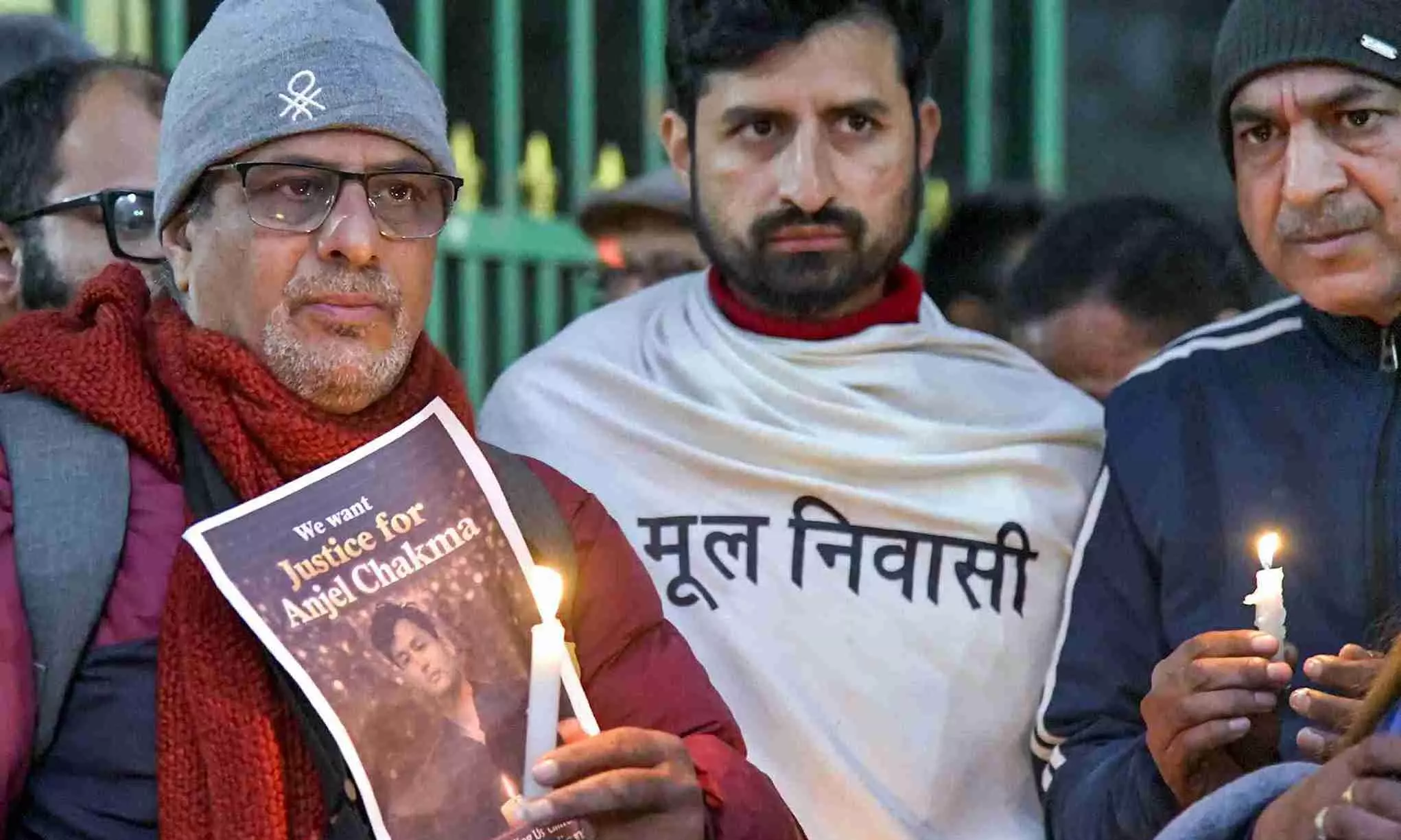
After Anjel Chakma’s death, NE students say core failure is lack of legal recognition
Activists say Bezbaruah Committee recommendations ignored, anti-racial laws and safety measures remain limited to Delhi while hate crimes continue nationwide

More than a decade after the killing of Arunachal Pradesh student Nido Taniam led to the formation of the Bezbaruah Committee in 2014, students from the North East and a member of the committee say key recommendations remain either unimplemented or confined narrowly to the national capital, even as racially motivated violence and everyday discrimination continue across the country.
The renewed scrutiny follows the killing of Anjel Chakma, a student from Tripura, in Dehradun, Uttarakhand. Chakma was allegedly stabbed after objecting to racial slurs on December 9 and succumbed to his injuries on December 26. His death has drawn sharp reactions from North East student organisations and political leaders. Rahul Gandhi, Leader of the Opposition, described the incident as a “horrific hate crime” and criticised the atmosphere of hatred in public discourse, while Congress MP Gaurav Gogoi raised concerns about people from the North East facing racism in other parts of the country.
Meghalaya Chief Minister Conrad K Sangma also condemned the racial violence. “People from the North East are as Indian as every citizen of this country. Racism should never be normalized, and the perpetrators must be punished,” he posted on X. Mizoram Chief Minister Lalduhoma also posted, “Discrimination and racial prejudice have no place in our Constitution, and the rule of law must prevail to ensure justice.”
Chinks in the armour
The outrage over Chakma’s death has reignited discussions about long-standing gaps in legal protection against racial discrimination in India.
Constituted in 2014 by the UPA (United Progressive Alliance) government, the MP Bezbaruah Committee had recommended either a specific anti-racial law—its preferred option—or amendments to the IPC (Indian Penal Code) to recognise racial discrimination as a distinct offence. It also proposed that such offences be made cognisable and non-bailable, investigated within 60 days by special police squads, tried within 90 days, and heard by fast-track or designated courts, particularly in cases involving violence against women and children from the North East.
Also read: No evidence of racism in Tripura student’s killing so far: Uttarakhand Police
Beyond legal reform, the committee had also recommended specialised police units, designated or fast-track courts, dedicated helplines, safe and adequate hostel accommodation, curriculum and teacher sensitisation, and nationwide awareness and training programmes.
When the BJP came to power, then Union Minister of State for Home Kiren Rijiju, in October 2014, assured that the government was committed to implementing the Bezbaruah Committee’s recommendations. Yet, nearly a decade later, most of these measures remain either unimplemented or limited to Delhi.
When racism is part of daily life
Lanchenbi Urungpurel, president of the Manipur Students Association Delhi and a postgraduate student at Delhi University, said racial slurs and stereotyping continue to be part of everyday life.
“I have been in Delhi for four years. The ‘chinky’ thing, everyone calling us chinky, has become a normal thing. Apart from that, when we go to places like the India Gate or the zoo, people want to take selfies with us because we look different. We have been asked to stand in the foreigner line when visiting the Delhi zoo. People ask us if we are from Thailand or Vietnam,” she told The Federal.
While acknowledging the presence of the Delhi Police’s Special Police Unit for North Eastern Region (SPUNER), she said its reach is limited. “They are helpful, and when we complain, they do take action. But these special units cannot be only in Delhi. There are many North East students in Noida, Gurgaon, Uttarakhand and UP as well. We do need better protection and more targeted laws because not all people from the North East fall into the ST or SC category,” she said.
Subtle but persistent
Krishnali Pathak, associated with the All Assam Students’ Association in Delhi and currently studying at the National Museum Institute, described discrimination that is often subtle but persistent.
“People have this tendency of equating North East people to one specific idea… There is cultural stereotyping, like there is this very common thing of associating the North East with momos, like we only eat momos,” she said.
Also read: Rahul Gandhi slams BJP over Anjel Chakma's murder, says ruling party 'normalised hate'
She also credited SPUNER for being responsive, saying it had “acted like a backbone to us” for various security-related issues, but added that coverage remains uneven.
“The patrolling van is mainly active in South Delhi. We have been demanding one in North Delhi for a long time,” she said.
The gap in knowledge
Anthea Jana, president of the Meghalaya Students Welfare Association in Delhi and a second-year law student, said that discrimination stems from a deeper institutional ignorance.
“People from the mainland are very ignorant about the North East being a part of India. They see us as outsiders even if we speak Hindi, even if we are studying the same subjects. There is nothing about the North East in history textbooks, not even for students studying in the North East,” she said.
Incidentally, the Bezbaruah Committee had recommended changes in school textbooks “to bring in the North East ethos in the entire gamut of education”, and also recommended that “all teachers training institutes would be advised to make their syllabus in a way that can sensitize the trainees on the North East”.
On solutions, Jana said symbolic gestures were insufficient. “There should be separate institutions to deal with these cases. Like we have statutory bodies for women or minorities. We need something like that for us, where people feel they are represented and safe,” she said.
Need for safe accommodation
Another Bezbaruah Committee recommendation—on providing hostel accommodation to North-East students, especially at the Barak Hostel at Jawaharlal Nehru University (JNU)—lies compromised.
“The committee recommended several measures, and one of the key problems it identified was accommodation. Especially for students from the North East who come here to study, finding safe housing has always been a challenge because of the general racist atmosphere. Anjel was also staying outside the university. That in itself is telling,” said George Chakma, Convenor of the North-East Students’ Forum-JNU.
Also read: Tripura student’s death: Dhami vows strict action; police hunt for 6th accused in Nepal
“Following the Bezbaruah Committee’s recommendations, DoNER (Ministry of Development of North East Region) provided funding to the JNU administration. A memorandum of understanding was signed, promising that 75 per cent of the seats in the Barak Hostel would be reserved for students from the North East. The hostel was constructed using that funding, but when it came to its inauguration, that clause was completely disregarded, and it became just like any other hostel,” he said.
According to Chakma, North East students now make up less than 10 per cent of the hostel’s residents.
“I think nothing has changed. The government has done nothing. This is a structural problem that requires an institutional response. Just asking people to behave properly is not going to change anything,” he said.
Partial implementation of recommendations
Alana Golmei, a lawyer and member of the Bezbaruah Committee, who is also the General Secretary of the North East Support Centre & Helpline (NESCH), said most recommendations have seen only partial implementation and are largely restricted to the capital.
“Some awareness has been done, but it is concentrated only in Delhi. The Bezbaruah Committee’s recommendations were never meant to apply to Delhi alone; they were for the entire country. Yet outside Delhi, racially motivated crimes are still happening, and there is little follow-up or institutional support. In Delhi, there is the Special Police Unit and the helpline number 1093. But you do not have these in other major cities where racially motivated crimes are still happening… Training is happening for the Delhi Police, but the recommendations were not just for the Delhi Police. Other forces also need to be sensitised. That is not happening,” she told The Federal.
Golmei also said large gaps remain in the sphere of accommodation and education, but most importantly, the committee’s core recommendation had been ignored.
Also read: Tripura man arrested in Bengaluru for insulting Kannadigas
“First, we asked for an anti-racial law. If not that, then amendments. But those things are also not happening… They are saying the new law (Bharatiya Nyay Sanhita) covers what we asked for, but it does not. Nothing has been incorporated, no amendments,” she said.
The most urgent demand
Therefore, students and activists say, the absence of legal recognition remains the core failure and the most urgent demand.
“We are not asking for this in every city… At least major cities should have helplines, nodal officers in police stations and designated prosecutors. And it is not for North East people alone. If anyone faces racial discrimination anywhere in the country, the law should apply. Awareness and sensitisation are important, but the biggest thing is actually the law,” said Golmei.
Referring to racist incidents during the Covid-19 pandemic, she said, “If someone is spat on and called ‘corona’, what do you invoke? There is nothing.”