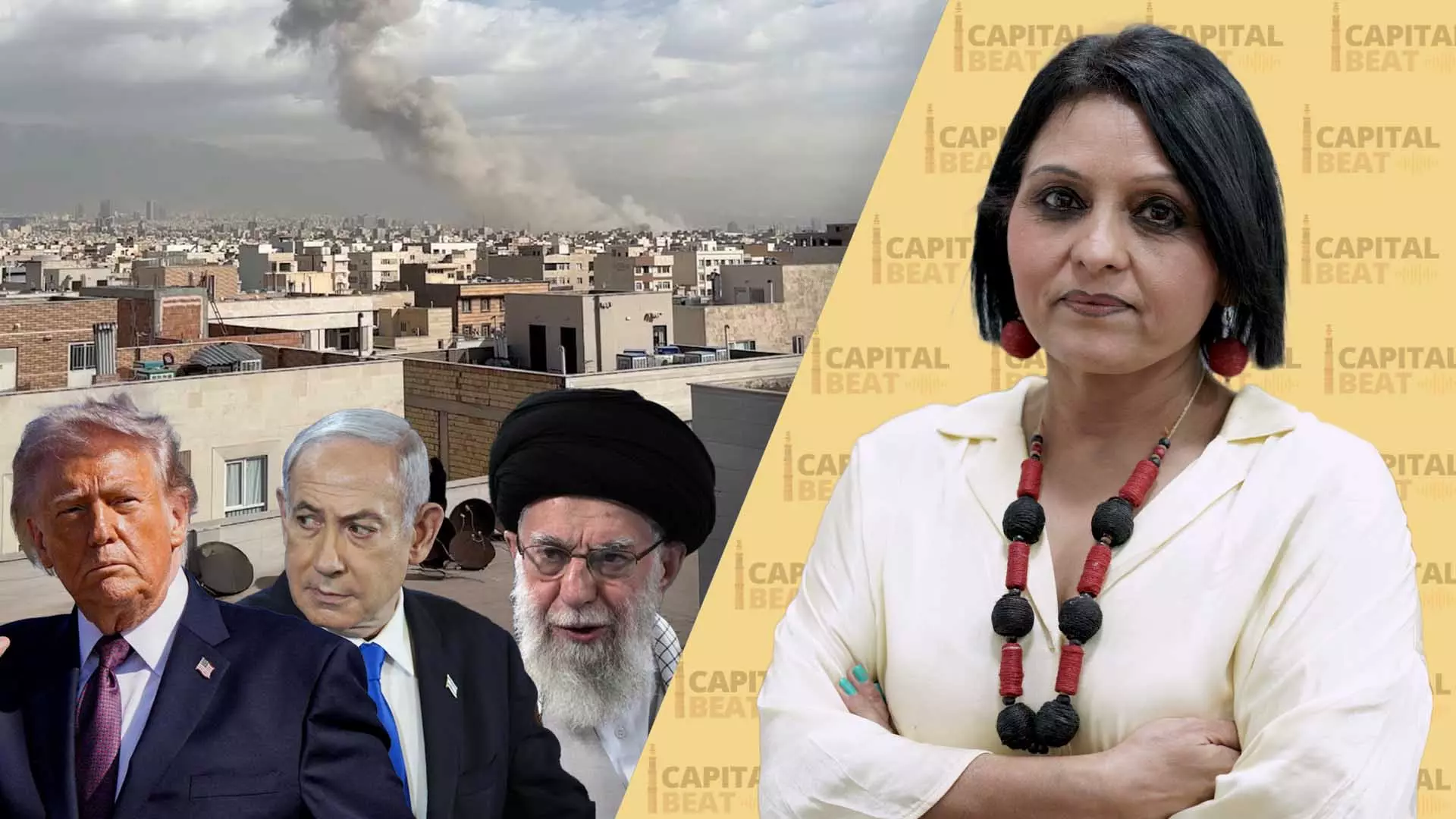
US-Israel strikes on Iran: What it means for India and South Asia
Tehran retaliates after joint attacks; experts assess fallout of the latest explosive situation

In this Capital Beat episode, Dr. Shubhda Chaudhary, Middle East Expert; Sanjay Kapoor, international affairs expert; and KS Dakshina Murthy, Consulting Editor with The Federal, examined the US and Israeli strikes on Iran, Tehran’s retaliation, and the geopolitical consequences for South Asia and India.
The discussion followed US President Donald Trump’s announcement of “major combat operations” in Iran after Israeli missile attacks. Iran retaliated by targeting Israeli and US assets across multiple states, with explosions reported in Tehran and other locations.
Airspace closures were reported across several countries in the region amid the exchange of attacks. Iran’s military announced that a wave of attack drones had been launched towards Israel, describing it as the first large-scale drone offensive carried out from Iranian territory against Israel.
Strategic objectives and official messaging
Israeli Prime Minister Benjamin Netanyahu described the joint strikes as aimed at removing an “existential threat.” Donald Trump outlined multiple objectives, including eliminating threats from the Iranian regime, destroying missile infrastructure, dismantling naval capabilities, and preventing Iran from obtaining a nuclear weapon.
Also Read: Explained: What is Operation Epic Fury? Where is Khamenei? What we know so far
Trump stated, “We will ensure that Iran does not obtain a nuclear weapon. It is a very simple message. They will never have a nuclear weapon.” He also declared, “This regime will soon learn that no one should challenge the strength and might of the United States armed forces.”
Dr. Shubhda Chaudhary said the attack did not come as a surprise. “This attack is not a surprise,” she said, referring to advisories asking officials to vacate Iran and Israel.
Legality and regime change allegations
Dr. Chaudhary described the strikes as “a complete illegal colonial neo-conservative attempt.” She stated, “They never justify.” She also said the action was preemptive and lacked Congressional approval.
India could not take a position openly supportive of Iran, citing reaffirmed ties with Israel and alignment with the United States
Sanjay Kapoor said, “Everybody is confused about why Mr. Trump chose to attack Iran.” He questioned the necessity of renewed strikes despite previous US operations.
Regional alignments and escalation risks
Kapoor described the operation as “an attempt to reorder the entire Muslim world”. He pointed to the Abraham Accords and the role of Gulf states hosting US bases.
He stated, “They were prepared to launch the attacks at various destinations,” referring to Iran’s rapid retaliation.
KS Dakshina Murthy assessed that while attacks and counter-attacks would continue, broader expansion would depend on whether major targets were struck.
Global reactions and India’s stance
European and Australian leaders called for restraint and respect for international law. Russia described the strikes as reckless and urged diplomatic solutions.
Dakshina Murthy stated, “India is not going to say anything.” He said New Delhi would likely issue general statements favoring peace and dialogue.
He added that India could not take a position openly supportive of Iran, citing reaffirmed ties with Israel and alignment with the United States.
Oil security and economic implications
Kapoor identified oil prices as the primary concern for India. “If the Strait of Hormuz gets blocked… then India has to worry,” he stated, noting that a significant portion of global oil flows through the corridor.
He added that disruptions could create economic challenges, especially amid constraints on Russian oil supplies.
Dr. Chaudhary warned that refinery infrastructure could become targets and said escalation might extend beyond military installations.
Broader geopolitical contest
Dr. Chaudhary framed the conflict as a contest between two global blocs. She warned that escalation was unlikely to cool down quickly and referred to information blackouts complicating verification.
Disruptions could create economic challenges, especially amid constraints on Russian oil supplies
Dakshina Murthy described Trump as unpredictable. “None of us know what is in his mind,” he quoted from a US official.
He stated that the conflict was unlikely to yield substantive long-term gains for any party, adding that while Israel views Iran as an existential threat, the United States’ strategic outcome remains uncertain.
The content above has been transcribed from video using a fine-tuned AI model. To ensure accuracy, quality, and editorial integrity, we employ a Human-In-The-Loop (HITL) process. While AI assists in creating the initial draft, our experienced editorial team carefully reviews, edits, and refines the content before publication. At The Federal, we combine the efficiency of AI with the expertise of human editors to deliver reliable and insightful journalism