







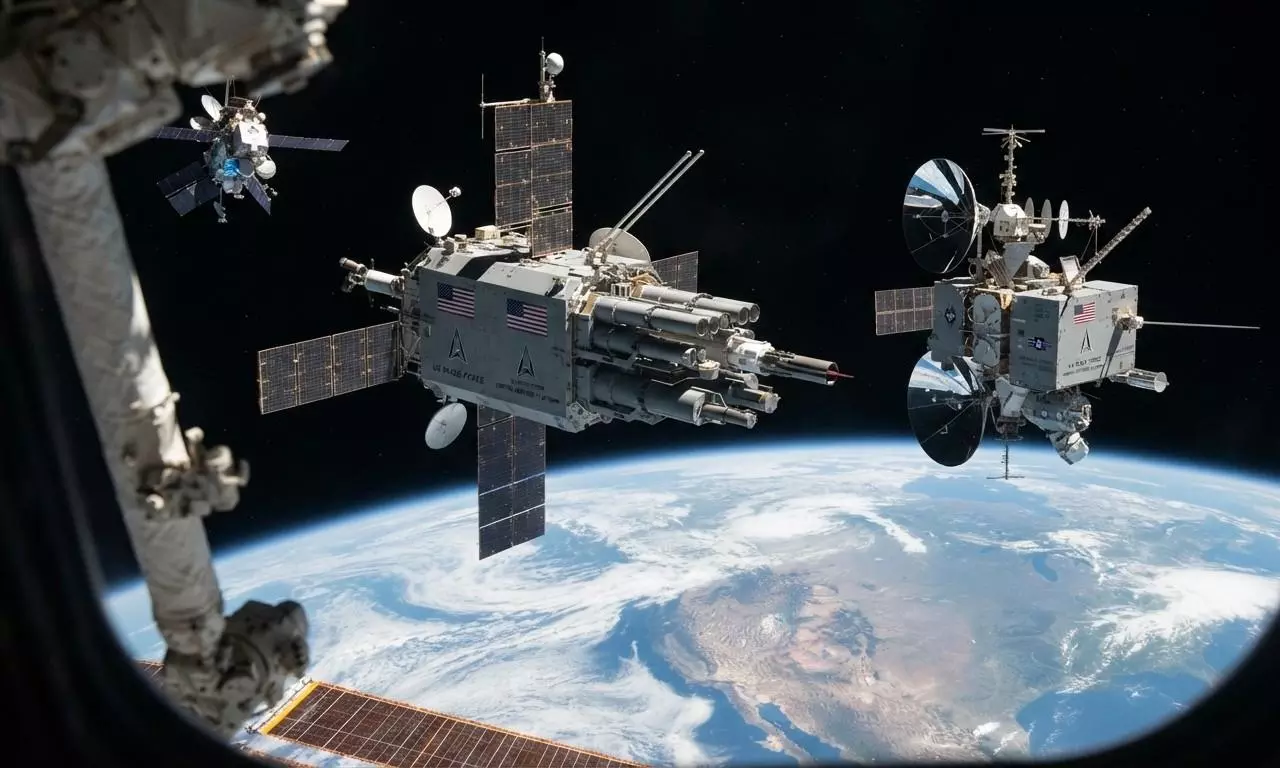
The US's proposed 'Golden Dome' system is intended to protect the US from missile attacks, including by placing interceptors in low Earth orbit to destroy incoming threats. AI-generated image for representative purpose
US confirms for first time it has deployed weapons in space; Russia, China react
The US says the systems can be used for offensive and defensive ‘space control', pointing to potential threats from Russia and China

The United States has deployed weapons in orbit, American officials confirmed for the first time on Monday (September 14), with Russia and China reacting sharply.
US Air Force (USAF) Secretary Troy Meink confirmed the US has “on-orbit space control weapons,” and said the move was aimed at protecting the US from “hostile adversary action”, pointing to potential threats from Russia and China.
He announced the development at the annual Air, Space, and Cyber Conference at National Harbor in Maryland, saying the capabilities could be used for “space control” as threats in orbit evolve.
Key details remain top secret
The US has kept details of the weapons secret. Meink said the systems could be used for both offensive and defensive purposes and could rely on kinetic methods, such as physical impact, or non-kinetic means, including energy and cyber capabilities.
Also read: What is Golden Dome, Donald Trump's new-age missile defence shield?
It remains unclear whether the weapons involve missiles, lasers or electronic jamming systems.
“Space control encapsulates the mission areas required to contest and control the space domain – employing kinetic and non-kinetic means to affect adversary capabilities,” a US statement said. It added that the capabilities could be used for “offensive and defensive purposes”.
Russia, China react
The announcement has drawn sharp reactions from Russia and China, which warned that Washington’s move could turn outer space into a new battlefield.
Chinese Foreign Ministry spokesperson Guo Jiakun urged the US to “cease preparing for a war in space”, accusing Washington of fuelling a dangerous new space arms race. China has maintained that it uses space for peaceful purposes.
Also read: What is the ‘doomsday missile’ that US tested amid Iran war escalation?
Kremlin spokesman Dmitry Peskov also said outer space must remain “free of any weapons”. Moscow called for “broad international consolidation” towards the complete demilitarisation of space.
Why now?
The US is pushing ahead with its multi-billion-dollar missile defence network, known as the “Golden Dome”. The proposed system is intended to protect the US from missile attacks, including by placing interceptors in low-Earth orbit to destroy incoming threats.
The development comes as Washington increasingly views space as a military domain where control over satellites could determine the outcome of conflicts.
GPS navigation, secure military communications, missile warning systems, battlefield surveillance and intelligence gathering all depend heavily on satellites. Disabling or destroying those systems could potentially blind an adversary, disrupt communications and slow down military operations.
Space as military domain
The US Space Force (USSF), established in 2019, has increasingly focused on what it calls “counterspace” threats from China and Russia.
Also read: What is Blue Sparrow, the missile that 'came from space' to kill Khamenei?
Both countries have developed satellites equipped with robotic arms and grappling mechanisms. While such systems can be used for space debris removal, US officials fear they could also be used to interfere with or disable other countries’ satellites.
China, according to the USSF, is developing and operating space and counterspace capabilities as part of its military modernisation. Russia, meanwhile, views space as a potential warfighting domain and considers control of the domain important to future conflicts.
International law
The deployment of conventional weapons in space is not explicitly banned under the 1967 Outer Space Treaty. The treaty prohibits countries from placing nuclear weapons or other weapons of mass destruction in orbit, but does not impose a blanket ban on conventional weapons.
The militarisation of space is not new. Soon after the Soviet Union launched Sputnik in 1957, the US and Moscow began exploring ways to protect their satellites and potentially destroy those of an adversary.
Major powers are developing ways to target satellites that are central to military communications, navigation, surveillance and intelligence.