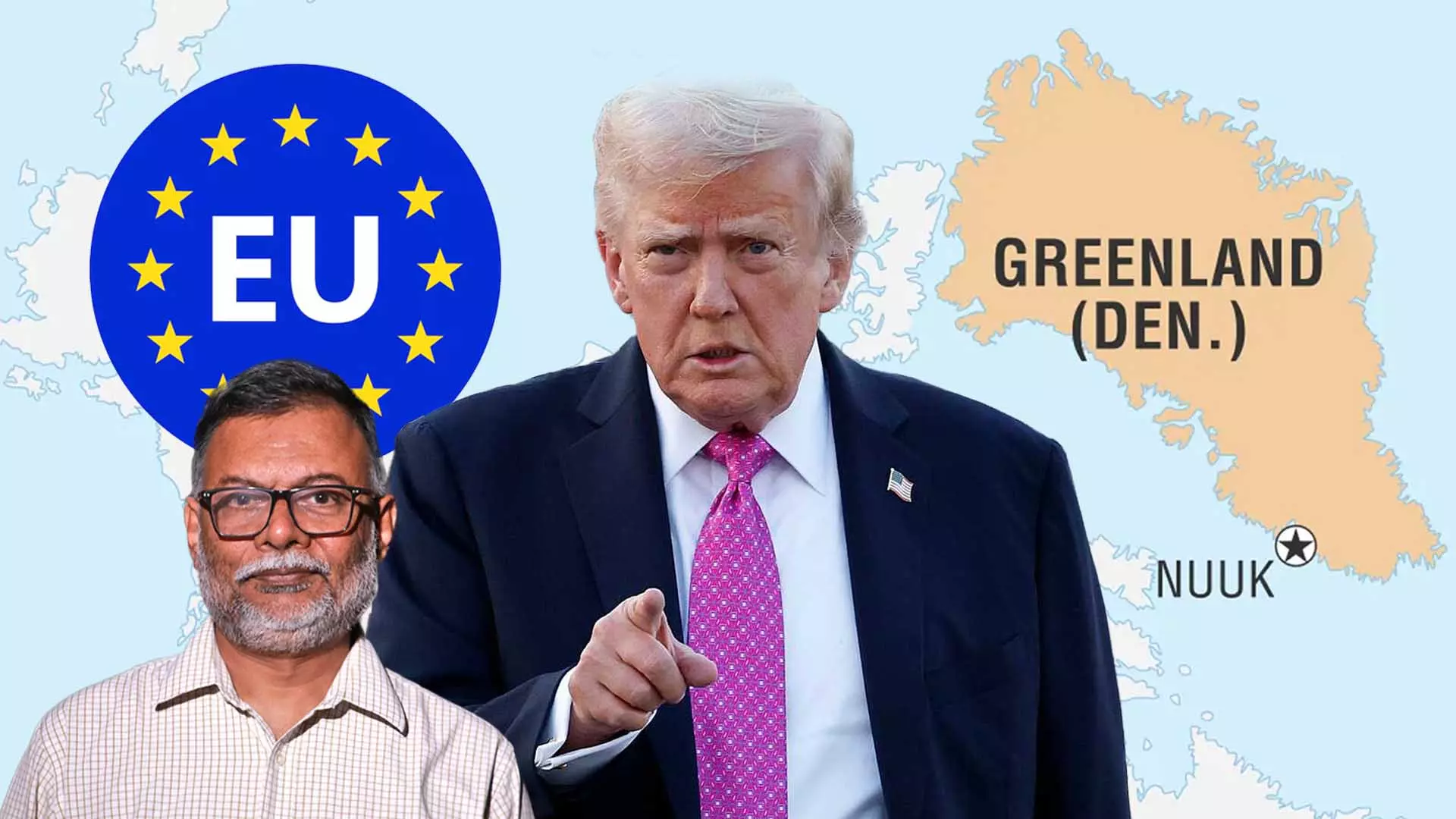
How Trump has taken the US-EU ties to a breaking point
Trump’s tariff threats over Greenland have united Europe against Washington. Is the U.S.–EU alliance ending its dream run? How does this affect India?

K S Dakshina Murthy, Consulting Editor at The Federal, discusses the implications of former US President Donald Trump’s threat to impose punitive tariffs on European countries that oppose his Greenland proposal. The episode has unsettled transatlantic relations, raised questions about NATO unity, and triggered debate over the future of the rules-based global order.
How serious is Donald Trump’s move to acquire Greenland, and why is he pushing it despite the risk of alienating close US allies?
What Trump has managed to do is something unprecedented. The US–Europe relationship has been historic, and there was never a situation anyone could have imagined where a US president would openly pursue a move that goes against the wishes of the European Union. The idea of buying a territory that belongs to a sovereign nation like Denmark, which is itself a close US ally, is extraordinary.
This move is full of ironies and contradictions. It has left the world trying to understand what is really happening, because no one has yet come up with a clear or cogent response. Trump’s reasoning, as he presents it, is rooted in Greenland’s strategic position in the Arctic.
Globally, this episode introduces significant uncertainty. However, for India, the situation could have mixed consequences. Economically, it may create opportunities
With the melting of ice in the Arctic Circle, areas that were earlier inaccessible are now opening up. In that region, Russia is active, China is active, and several European countries are active as well. Trump wants a foothold in Greenland because of its strategic location. From his perspective, if the US controls Greenland, it gains an upper hand and can prevent strategic surprises from China or Russia.
Also Read: Why Donald Trump is fuming at UK over ceding Diego Garcia to Mauritius
There is also the question of resources. Greenland is believed to have vast natural resources, possibly oil and rare earth minerals, although the full extent is not yet known. It is a massive landmass with significant potential. Trump appears to be pursuing this objective without considering the broader geopolitical context. He seems driven purely by the desire to acquire Greenland, which fits his pattern of unpredictability. Whether there are deeper reasons remains unclear.
What are the implications of this move for US relations with NATO allies?
At present, eight countries and all major European powers, including the United Kingdom, France, and Germany, have completely opposed Trump’s proposal. These countries have even sent troops to Greenland for military exercises to signal their alignment with Denmark rather than the United States.
What this indicates is that a relationship that has existed firmly since the Second World War is now under visible strain. Trump’s idea appears to be to buy Greenland, much like earlier US presidents bought territories such as Florida. However, today’s world is very different. Europe is not willing to accept such a move.
If Trump were to escalate further and attempt a military or coercive takeover, the situation would become unprecedented.
Trump has already threatened to impose heavy tariffs if Europe refuses to cooperate. This is significant because the US and Europe share one of the closest trade relationships in the world. The US imports more than 3,000 products from Europe, accounting for over 50 percent of total US imports. Imposing tariffs on the European Union is therefore not a minor action.
If Trump were to escalate further and attempt a military or coercive takeover, the situation would become unprecedented. All parties involved are NATO members. Such a move would rupture NATO and potentially split it. Even a limited conflict would fundamentally alter the global order. While Trump is known for bluster and brinkmanship, pushing issues to the edge and then backing off, the consequences of miscalculation would be immense and difficult to comprehend.
How does Trump’s Greenland move affect the broader global order?
A rupture between Europe and the US would immediately make the world a more insecure place. It would undermine the stability that Europe has enjoyed since the Second World War. The formation of the European Union itself was a response to centuries of conflict, supported strongly by the United States.
The NATO framework ensured that countries like Russia were deterred from encroaching further into Europe. If the US–EU relationship weakens, that balance changes dramatically. Trump’s actions also indirectly benefit China and Russia, both rivals of the US and Europe.
Also Read: Trump's world: Are global leaders sleepwalking into World War I-like crisis?
The implications are visible in the context of the Ukraine–Russia war. If Trump follows through on his threats or uses force, coercion, or economic blackmail, Europe will become more unstable. It would also send a signal to other countries that unilateral action is acceptable.
The world currently operates under a rules-based order. Trump’s approach challenges and potentially breaks that framework. It also creates insecurity for Canada, especially given Trump’s past remarks describing Canada as a potential “51st state” of the US. His comments about Canada and Mexico reinforce concerns that this reflects a neo-imperialist mindset.
What could be the repercussions of this standoff for India?
Globally, this episode introduces significant uncertainty. However, for India, the situation could have mixed consequences. Economically, it may create opportunities. European countries that traditionally depended heavily on the US for trade are now looking to diversify.
India stands to benefit from this shift. The European Union is scheduled to sign a comprehensive trade agreement with India soon. Canada is also reassessing its economic partnerships, and the United Kingdom has recently concluded a free trade agreement with India. As countries search for new markets and partners, India becomes an attractive option.
Politically, however, the situation is more complex. If Trump undermines the rules-based global order, it could embolden China. Any escalation involving Taiwan would have direct implications for India, given China’s position as a strategic rival. While India may gain economically, the broader geopolitical instability could pose long-term security challenges.
The content above has been transcribed from video using a fine-tuned AI model. To ensure accuracy, quality, and editorial integrity, we employ a Human-In-The-Loop (HITL) process. While AI assists in creating the initial draft, our experienced editorial team carefully reviews, edits, and refines the content before publication. At The Federal, we combine the efficiency of AI with the expertise of human editors to deliver reliable and insightful journalism.