Nepal floods: The sky is the only road left as Army races to find missing
With roads and bridges destroyed, Nepal’s rescue effort depends on helicopters battling treacherous weather and rugged mountain terrain

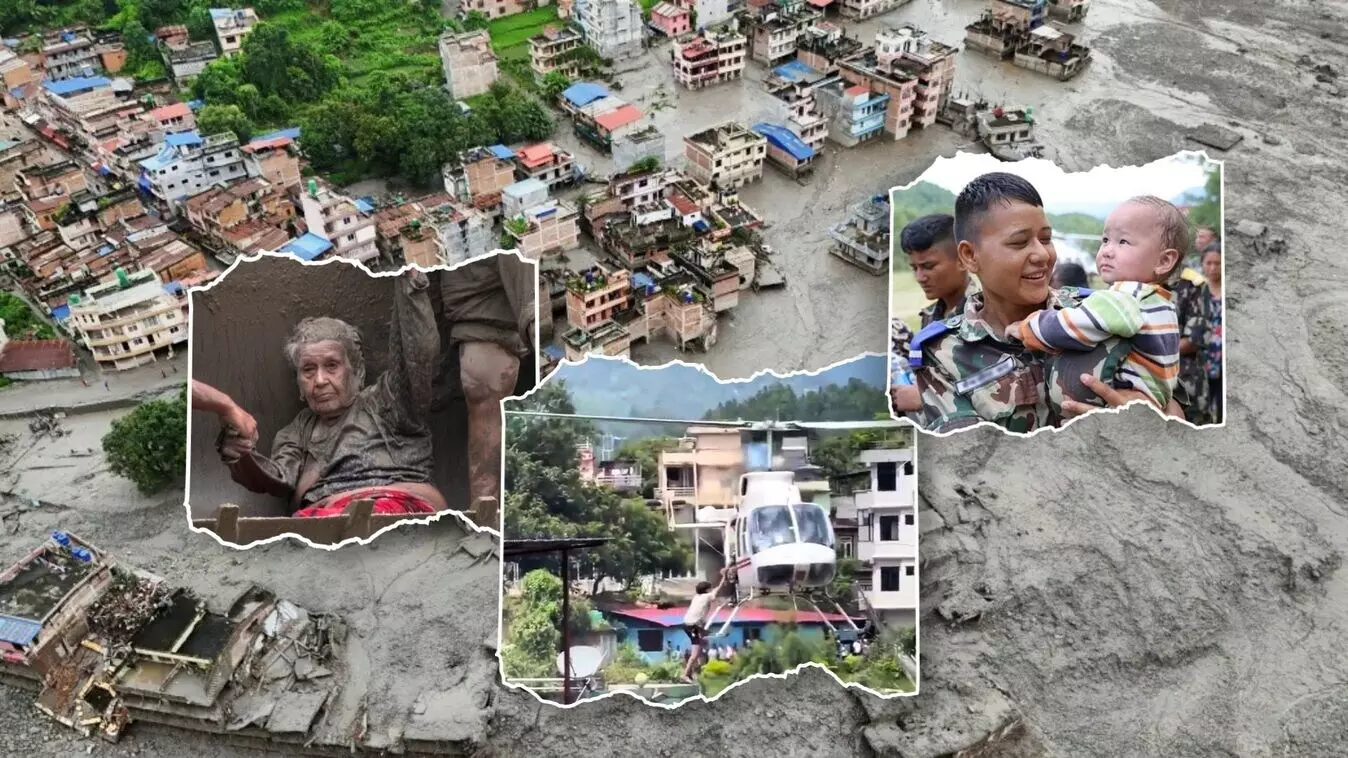
The Nepal Army is racing against time, treacherous weather and devastated mountain terrain to rescue survivors of the catastrophic floods that tore through the country on August 26. With roads and bridges destroyed, helicopters have become the only lifeline for communities cut off by the disaster.
A glacier collapse unleashed a torrent of rock, ice, mud and debris through the Bhotekoshi and Trishuli valleys. Entire towns were inundated, rivers changed course and communities barely 100 or 200 metres apart were left completely cut off from each other.
Also read | Nepal floods: Survivors recall terrifying escapes from raging waters
The rescue operation now depends heavily on the skies. Helicopters generally operate between 10 am and 6 pm, with fading light and worsening weather sharply limiting flying time. The Nepal Army has deployed its helicopters, while private operators have added aircraft to evacuate survivors and ferry food, relief supplies and the bodies of those killed.
Families search for survivors
On Saturday, helicopters brought survivors to the Maithili Army Camp in Nuwakot. Soldiers helped those rescued into tents as families gathered outside the army barricades, anxiously waiting for information about missing relatives. The Maithili military facility has become one of the places where families search for names on lists of those rescued.
For many, the wait has brought little information. Rani Gupta, a flood victim from Rasuwa, said she had lost her home and was still unable to find out what had happened to her family. “My family’s name is not there. They have even put up photos, but we don’t know anything. It has been three days. No update about any of my family members. I am the only one left. I don't know where to go.”
At Tribhuvan University Teaching Hospital, photographs of missing people cover the walls as relatives search for familiar faces. Families are waiting for even the smallest piece of information — whether their loved ones are alive, injured or among those who have died.
The scale of the destruction has made the search especially difficult. Roads have been cut off, bridges washed away, communications disrupted and access to remote mountain settlements remains limited. The Nepal Army is also trying to reach people trapped inside a hydropower tunnel in Rasuwa, where the entrance has been blocked by mud and debris.
Remote villages await rescue
Further north, near the China border, some villages remain inaccessible. With mobile networks down, rescuers have struggled to establish contact with people in isolated communities. Authorities have even asked people awaiting rescue to use smoke signals to attract the attention of helicopters.
Also read | Nepal disaster puts North Bengal’s vulnerability to Himalayan floods in focus
The situation was worsening as rescue teams continued their work. Entire small towns have been swept away. Helicopters are flying out every few minutes. People are waiting outside the barracks for their families.
The Nepal Army has been stretched by the scale and geography of the disaster. Rapidly changing weather, damaged roads, fallen bridges, a shortage of helicopters and a lack of heavy equipment have all slowed rescue and recovery operations. The Army had initially deployed 14 helicopters, including six military and eight private aircraft, according to Radio Nepal.
The question of foreign assistance has also become part of the rescue debate. Kathmandu has favoured a single command structure rather than allowing multiple foreign teams to operate independently on the ground. The concern is that too many teams could create confusion around narrow landing sites and damaged mountain tracks.
Nepal controls rescue efforts
There is also a painful precedent behind that caution. During the 2015 earthquake, a US Army helicopter crashed, killing eight crew members. Officials and experts have pointed to the dangers of unfamiliar Himalayan terrain, unpredictable winds and rapidly changing river conditions.
The approach has effectively been: one door, one command. Nepal wants the rescue operation to remain coordinated and under its own control rather than having several foreign teams working simultaneously in the same difficult terrain.
But the humanitarian pressure continues to grow. Hundreds have died and thousands remain missing. The missing include foreign tourists, pilgrims and workers, with Indians making up a significant share of those still untraced. The latest figures reported on August 30 put the combined death toll from the Nepal-Tibet disaster at at least 750, with more than 3,000 people missing across the two sides of the border.
Helicopters carry fragile hope
Among those searching for missing workers is transport and helicopter operator Sunil Shrestha. He described the terrifying moment when he realised there was no trace of vehicles carrying his staff.
“My brother called me asking, ‘Have you heard any news regarding the flood that occurred at the Gyirong border? Even our staff were missing at the time.’”
Shrestha said repeated calls to the missing workers went unanswered. He eventually gave his pilot the GPS location of one of his vehicles. When the pilot returned with photographs showing no sign of the vehicle, Shrestha said he lost hope.
For relief workers, the disaster is far from over. Tamra Demuria of Corus International said some communities further north remain completely cut off. “We are still in the search and rescue period. Further north, some communities are completely cut off. The damage is insurmountable.”
Also read | ‘Like a miracle’: Nepal house stands firm as raging floodwaters sweep away other buildings
Rescue operations were also briefly paused after a new lake raised fears of another flood before operations resumed. The danger remains in a landscape where rivers, slopes and weather can change within hours.
For families outside army camps and hospitals, however, the immediate priority is much simpler: finding their loved ones. The Nepal Army and private helicopter operators continue to fly into the mountains, carrying out survivors and supplies and bringing back the dead.
The sky offers Nepal its only route into many of the worst-hit areas. But with daylight limited, weather unpredictable and thousands still unaccounted for, the race against time continues.