



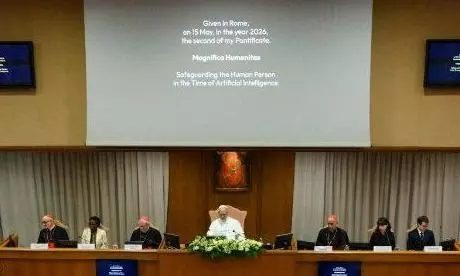
"Magnifica humanitas" is promulgated in the Vatican. Photo: X/Vatican Media
Top 15 things that Pope says in 'Magnifica Humanitas' | AI, human dignity
In a landmark message, Pope Leo XIV calls for human dignity, ethical technology and limits on machine power

Pope Leo XIV’s Magnifica Humanitas, issued on May 15, the 135th anniversary of Rerum Novarum, is being seen as the Catholic Church’s most comprehensive statement yet on artificial intelligence and its impact on humanity, labour, ethics and democracy.
Here are the 15 most significant declarations from the Vatican document.
1. AI must never replace the human heart, the Pope said, asserting that humanity has a “pressing duty to remain profoundly human” and insisting that no machine can replicate the grandeur of human life.
2. Declaring that AI is not morally neutral, the Pope said it must be “disarmed” — not by rejecting technology, but by ensuring it does not dominate humanity. He warned that every AI system reflects the values embedded in what it measures and optimises, and called for AI to move away from monopolistic control and reflect the diversity of human cultures.
Also read: Olah and the Pope: What's Anthropic doing in the Vatican?
3. Warning against what he called the “Babel Syndrome,” the Pope cautioned against the worship of profit, homogenisation and the belief that human beings can be reduced to data through a universal digital language. He instead advocated the “way of Nehemiah,” centred on humility, collaboration and diversity.
4. In one of the strongest statements in the document, the Pope argued that the traditional “just war” theory is no longer adequate, saying it has too often been invoked to justify conflicts. He instead stressed dialogue, diplomacy and forgiveness as better paths for humanity.
5. The Pope firmly rejected autonomous weapons, insisting that decisions involving lethal force must never be handed over to machines. Moral judgment, he said, requires conscience and personal responsibility that algorithms cannot possess.
6. Calling data a “common good,” the Pope said algorithms, digital platforms and information resources should serve all people rather than remain concentrated in the hands of a few. He warned that the growing concentration of AI power risks creating new forms of economic, political and epistemic inequality.
Also read: Pope Leo XIV visited Tamil Nadu, Kerala twice; vicars recall ‘a simple, kind man’
7. The Church also issued a formal apology for its historical role in tolerating slavery. Acknowledging that even the Apostolic See had at times legitimised subjugation, the Pope said, “For this, in the name of the Church, I sincerely ask for pardon.”
8. Drawing parallels between historical slavery and the modern digital economy, the Pope warned that AI is already creating new forms of exploitation — from underpaid data workers and children mining rare earth materials to trafficking networks operating through digital platforms.
9. Stressing that “every design choice reflects a vision of humanity,” the Pope said AI developers carry direct moral responsibility and must build systems grounded in transparency, accountability and ethical values.
10. The Pope criticised transhumanist visions that seek to eliminate human limitations through technology, describing them as incompatible with authentic humanism. Treating humanity as something to be perfected or surpassed, he warned, risks devaluing certain lives.
11. Human weakness and vulnerability, the Pope argued, are not flaws to be erased but essential parts of the human experience through which compassion and maturity emerge. Eliminating all weakness, he suggested, would ultimately destroy love itself.
Also read: Pope Leo XIV identifies AI as main challenge for humanity
12. The Pope warned that AI-driven disinformation threatens democracy by blurring the line between truth and falsehood. Citing political philosopher Hannah Arendt, he said societies unable to distinguish fact from fiction become vulnerable to authoritarianism, and called for transparent algorithms, responsible journalism and digital literacy.
13. Stressing the need to protect children online, the Pope urged lawmakers to establish age restrictions and hold digital platforms accountable for harms such as grooming, AI-generated abuse imagery and social media addiction.
14. Criticising GDP as an inadequate measure of progress, the Pope said current economic models often ignore human wellbeing, dignity of labour, inequality and environmental care. He argued that new measures of development are needed in the age of AI.
15. Concluding with the metaphor of “Babel versus Jerusalem,” the Pope said humanity now faces a choice: build a digital world driven by power and reduction of people to data, or rebuild society through shared responsibility, care and human dignity.