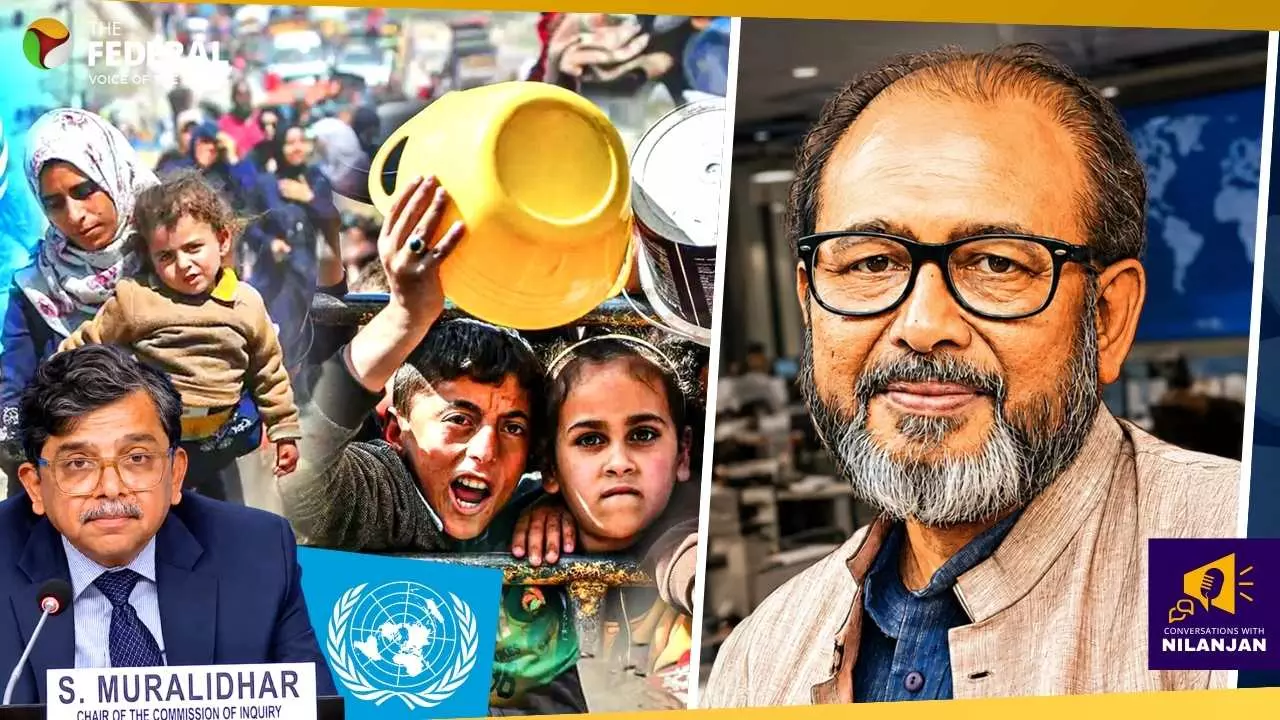
20,000 children killed in Gaza | 'For some Israelis, every child is an enemy'
Justice Muralidhar, Chair of the UN Independent International Commission of Inquiry on the Occupied Palestinian Territory, discusses the evidence on child deaths, Israel's response, and international accountability

Justice S Muralidhar, Chair of the UN Independent International Commission of Inquiry on the Occupied Palestinian Territory, including East Jerusalem and Israel, says the Commission found evidence suggesting that Palestinian children were deliberately targeted during Israel's military campaign in Gaza, adding that some Israeli political leaders had described "every child" as an enemy. He argues that these findings reinforce the Commission's earlier conclusions on genocide and raise serious questions under international humanitarian and criminal law.
The conflict in Gaza has remained one of the world's most contentious humanitarian crises since October 2023. In this episode of Conversations with Nilanjan, The Federal spoke to Justice Muralidhar about the Commission's mandate, its latest report on children in Gaza, its investigative methodology, and the challenges of accountability under international law.
Many people were unaware that this UN Commission even existed. Could you explain why it was formed, how it functions, and what makes it different from earlier UN mechanisms?
The Commission was established by a resolution of the United Nations Human Rights Council. It is an independent international commission of inquiry on the Occupied Palestinian Territory, including East Jerusalem and Israel.
Earlier, the UN had constituted ad hoc commissions to investigate specific incidents in the region. Apart from those, there are other UN mechanisms such as Special Rapporteurs, working groups, independent experts, and fact-finding missions.
In conflicts such as Rwanda, the former Yugoslavia, and Cambodia, the Security Council created ad hoc tribunals because of the scale of atrocities, reparations, and enforcement issues. In this case, however, the Human Rights Council decided that instead of creating another ad hoc body, it would establish a permanent commission with no fixed tenure.
What makes this Commission unique is that it is not limited to investigating individual incidents, such as the Hamas attack of October 7, 2023. It is also tasked with examining the root causes of the conflict. That allows us to go back to developments beginning in 1947, when the United Nations proposed the two-state solution through its resolution establishing separate states for Israel and Palestine.
Our mandate covers all violations of international human rights law and international humanitarian law. International human rights law includes the Universal Declaration of Human Rights, the International Covenant on Civil and Political Rights, the International Covenant on Economic, Social and Cultural Rights, the Convention on the Rights of the Child, CEDAW, and other treaties.
Also Read: Gaza's genocide is no secret but global silence is deafening
International humanitarian law includes the Geneva Conventions and their Protocols, governing the conduct of parties during armed conflict, and the obligations of an occupying power. Israel, as an occupying power in parts of Palestine, has obligations under this body of law.
The third branch is international criminal law. Since the Rome Statute of 1998, more than 120 countries have accepted obligations relating to genocide, war crimes, and crimes against humanity.
Our Commission investigates alleged violations under all three branches of law, and our findings are intended to assist international accountability mechanisms.
The Commission consists of three independent members selected through a rigorous process. Justice Florence Mumba of Zambia has served on international tribunals for Yugoslavia, Rwanda, and Cambodia. Mr Miloon Kothari has extensive UN experience, including work on Myanmar. I bring more than four decades of legal experience.
Although our headquarters are in Geneva, we largely function online because Israel has not permitted us to enter the territories.
We are completely independent. We are not controlled by either the Human Rights Council or the Security Council. Our work is carried out free of political direction.
Your latest report says over 20,000 children were killed and more than 44,000 injured. What were the Commission's principal findings?
The period we examined was from October 7, 2023 until the announcement of the ceasefire in October 2025.
The October 7 attack by Hamas and affiliated groups involved grave human rights violations. Israeli civilians were taken hostage, more than 2,000 people were killed, and there were incidents of rape, looting, and other serious crimes.
Our earlier reports examined those events, genocide in Gaza, sexual and gender-based violence, and the role of non-state actors. The report on children is part of a series of thematic reports.
We chose this two-year period because of the unprecedented intensity of Israeli air strikes.
When high-yield bombs are repeatedly dropped on densely-populated civilian areas, it is entirely foreseeable that children will suffer disproportionately because they are physically more vulnerable.
Within the first two weeks of the bombing campaign, the number of child deaths had already become extraordinarily high. Despite knowing this, Israel continued the bombing campaign.
One conclusion we reached is that there was a clear intention demonstrated through continued military operations despite knowledge of their devastating impact on children.
We also documented cases where children were specifically shot in the head, neck, and upper torso. The pellets used leave square-shaped wounds. These tungsten-coated pellets fragment inside the body, destroying tissues and internal organs and almost certainly causing death. Medical evidence supports these findings.
Also Read: UN Commission says Israel committed genocide in Gaza
We documented cases where breastfeeding infants were shot in the head by quadcopters while their mothers watched helplessly. We found instances where children walking with parents were killed while the parents themselves were unharmed.
There are numerous examples indicating that children were deliberately targeted.
One element of genocide is the targeting of children, either by preventing births or forcibly transferring children to another group.
What we documented is another manifestation of that principle — using weapons in ways that specifically target children and produce large-scale fatalities among them.
This report strengthens the findings we presented in our September 2025 genocide report. The evidence suggests that children were targeted because they were viewed as the future bearers of Palestinian identity.
One objective of genocide is to erase the identity of a protected group. Destroying future generations becomes one means of achieving that objective.
Why do you believe children were targeted with such precision?
It was not merely a consequence of war.
If you examine statements made by far-right Israeli politicians in the Knesset and in public forums, some have openly declared that every child in Gaza is an enemy. Some have even described every Palestinian child as a future terrorist.
Such statements reflect a mindset in which children are viewed as legitimate targets solely because they are born into Palestinian families.
That is one of the reasons why we considered these attacks within the broader framework of genocide.
How does the Commission investigate alleged war crimes when it is not allowed to enter the occupied territories?
We have explained our methodology in detail in paragraphs 8 and 10 of the report.
Several months before beginning work on a report, we issue a public call for submissions. Anyone anywhere in the world with relevant information can send material to the Commission. Through this process, we receive open-source material as well as submissions from individuals.
We interview Palestinians who have managed to leave Gaza and reached countries such as Jordan and Egypt. We also receive information from Israeli civil society organisations that are prepared to cooperate with us despite the Israeli government's instructions discouraging such engagement.
Doctors who have worked in Gaza, the West Bank, and East Jerusalem have also testified before us. During one of our recent public hearings in Geneva, three doctors gave detailed depositions, and those testimonies are available on the Commission's website.
We also receive evidence from journalists, lawyers representing victims, victims themselves, parents of children and, in some cases, children.
In addition, Israeli soldiers have themselves recorded some of these incidents and uploaded the videos to social media or spoken about them in television interviews. Some documentaries have also documented these actions, and we have referred to them in our report.
Also Read: Sonia slams Modi govt's 'silence' on Gaza, says stance hurts India's strategic interests
However, we do not rely on a single source.
Every piece of evidence is rigorously verified. We cross-check eyewitness accounts using metadata extraction, geolocation techniques, chronological analysis, and multiple corroborating sources before reaching any conclusion.
We also examine every submission for possible bias.
Israel frequently alleges that our findings rely entirely on information provided by Hamas. I want to reiterate that we are extremely cautious about any material originating from Hamas or Hamas-affiliated organisations precisely because we recognise that it may be biased.
Similarly, we do not rely solely on media reports. Although thousands of reports have been published on Gaza and the West Bank, we only use information that can be independently verified through scientific methods. Unless that standard is met, the Commission does not rely upon it in reaching any finding.
What efforts have you made to engage with Israel, and how has Israel responded?
As Chair of the Commission, I formally issued what is known in diplomatic practice as a note verbale to Israel's Permanent Mission to the United Nations. We invited Israel to engage with us, provide information, and facilitate our visit to Israel, the West Bank, East Jerusalem, and the Occupied Palestinian Territory.
We have never received a response.
When our reports are still in draft form, copies are sent both to the State of Israel and the Palestinian Authority, giving them more than two or three weeks to comment before publication.
Israel has consistently chosen not to respond.
From Israel's perspective, there is deep distrust of the United Nations, particularly the Human Rights Council. Israeli representatives often argue that the Council is influenced by an Islamic bloc of countries and is therefore biased against Israel.
Israel has also established a Ministry of Diaspora Affairs with a substantial budget to promote counter-narratives challenging UN findings.
Also Read: Israel launches major Gaza City offensive amid UN genocide claim
Whenever reports are released, Israel typically dismisses them as biased and claims it was not heard, without acknowledging that it declined repeated invitations to participate in the Commission's work. That is unfortunate, because we remain fully willing to engage with Israel, examine any evidence it wishes to provide, and apply the same rigorous standards that we apply to every other source.
Our Commission has also documented Hamas' violations.
We have never approached this work with any preconceived agenda. Justice Florence Mumba comes from Zambia, I come from India, and our colleague comes from Australia. None of us has anything to gain by making false allegations against Israel or Israeli soldiers.
What is also significant is that Israel has not produced evidence contradicting many of our findings. Nor has it denied the authenticity of incriminating material placed in the public domain by Israeli soldiers themselves.
Given that, it is difficult to dismiss the Commission's work as lacking credibility.
Have you been able to identify specific Israeli military units, and can international legal action be taken against them?
Yes. Our report on children identifies 11 different Israeli military battalions, units, and divisions. We have linked particular military formations to specific incidents involving alleged violations against children. If any member of those units is found in another country, that country may request the Commission to share the relevant evidence.
Under international law, many national courts can exercise what is known as universal jurisdiction.
For example, if an Australian citizen served in the Israeli Defence Forces and participated in war crimes, genocide, or crimes against humanity, Australian authorities have the legal power to investigate and prosecute that individual after they return home.
Also Read: Netanyahu slams genocide case, says Israel will continue to defend itself
That process has already begun in some countries. Proceedings have been initiated against members of the Israeli Defence Forces in certain jurisdictions. This is an important development because accountability should apply not only to Israeli nationals but also to foreign nationals serving in those forces.
More than 13,000 American citizens, along with thousands of nationals from countries such as France and Germany, have served in the Israeli Defence Forces.
Countries that have ratified relevant international conventions have obligations under international law to investigate and prosecute individuals accused of such crimes.
Have countries actually begun acting on these obligations?
It would not be correct to say there has been complete silence. While some major powers remain complicit, several countries have approached the Commission seeking evidence with the intention of pursuing prosecutions. That is an encouraging development.
South Africa has already brought proceedings against Israel before the International Court of Justice, and our findings are being used in those proceedings. Similarly, the International Criminal Court has initiated proceedings, and arrest warrants have been issued against Benjamin Netanyahu and others.
Both courts are able to use our evidence because our evidence-gathering protocols are designed to align with their legal standards.
At the same time, we are only an investigative body.
Those courts will independently assess all the evidence before arriving at their own judicial conclusions.
How do you assess India's position on Israel's military offensive and the broader conflict over the past few years?
India's position has to be understood at different levels.
It is perfectly reasonable for India to maintain trade and defence cooperation with Israel. We know that India exports small arms to Israel, and countries naturally pursue bilateral relationships.
However, India also has obligations under international law. It is in India's own interest that institutions such as the International Court of Justice and other UN mechanisms function effectively because India itself has relied upon these institutions.
For example, when Kulbhushan Jadhav was denied a fair trial in Pakistan, India approached the International Court of Justice. The Court ordered an effective review of his conviction and death sentence. That demonstrates why these international mechanisms are important.
Also Read: Israel declares Gaza City a combat zone, recovers remains of two hostages
By becoming a party to international conventions, countries accept that no matter how powerful a nation may be, it remains accountable under international human rights law. Every country has a responsibility to uphold these principles.
While maintaining trade or strategic relations, there should still be a clear line beyond which violations of international law cannot be supported. Many countries have already imposed sanctions or taken other measures in response to such violations.
India is not outside this international legal framework. Given India's historical role in global affairs, it is in the country's own interest to ensure that no nation is allowed to undermine the international legal order or enjoy impunity simply because it is powerful.
These institutions were created precisely to prevent such impunity, and India should support that objective.
Political scientists have often drawn parallels between Zionism and Hindutva. As someone who has studied Indian politics and now leads this Commission, how do you view those comparisons?
This is actually an issue that falls within the Commission's broader mandate because we are expected to examine the root causes of the conflict. At present, that work is still in progress.
As we investigate different themes, we also study the historical, political, and ideological factors that have contributed to the present situation. Since that work has not yet been completed, it would not be appropriate for me to comment in detail at this stage.
However, I am aware that many political scientists have explored these questions extensively. They have examined the historical links and documented the admiration that some early Hindutva leaders expressed for the Nazi regime.
Many scholars have also pointed out what they consider a historical paradox — that while certain sections initially expressed sympathy towards Nazi Germany despite its persecution of Jews, they later became strong supporters of Zionism.
These are issues that scholars have studied, and our Commission is continuing its own examination of the broader historical context.
Your recent report also examines non-state actors. What were its main findings?
The report focuses on developments in the West Bank. Israeli settlers have increasingly occupied land that rightfully belongs to Palestinians. Territory that should form part of a future Palestinian state is gradually being taken over through forced occupation.
The International Court of Justice has already issued a provisional order directing Israel to vacate these occupied properties. However, the opposite has happened.
With each passing day, more settlers have occupied additional land, forcibly evicted Palestinians from their homes and agricultural fields, and destroyed houses, schools, and other civilian properties. These actions are carried out by settlers, who are non-state actors, but they receive support from the Israeli state.
They are armed, provided logistical assistance and, in many instances, Israeli authorities fail to intervene when settlers attack Palestinians.
Also Read: Famine declared in Gaza, first ever in the Middle East
The report also examines Hamas and affiliated organisations. After Hamas won the 2007 elections in Gaza, the situation evolved significantly. Today, Hamas and associated groups have themselves committed serious human rights violations against Palestinians.
People accused of collaborating with Israel have been publicly executed. Children have been forced to witness these executions. Children have also been subjected to severe punishments for relatively minor alleged infractions. These abuses are documented in our report of June 15, 2026.
It is therefore important to understand that our work does not focus solely on violations committed by the State of Israel. We also investigate abuses committed by settlers, Hamas and affiliated organisations.
In addition, we are preparing another report for submission to the UN General Assembly examining the conduct of the Palestinian Authority.
The situation is extremely complex. Even within Israeli society, there are instances where certain groups of Jews discriminate against other Jewish communities. The deeper we investigate, the more layers of complexity emerge.
When your reports criticise Hamas or the Palestinian Authority, does Israel acknowledge those findings?
Not really. Some individuals in Israel do comment on social media, saying that the Commission has finally recognised Hamas' violations.
However, that does not change the broader official position. From the Israeli government's perspective, recognising any part of our work would also give legitimacy to the Commission itself.
Instead, the effort remains focused on discrediting the Commission in its entirety.
Do you expect Israel's approach towards the United Nations to change after the upcoming elections?
At the moment, I do not see much indication of that.
Elections are expected in Israel later this year, but looking across the political spectrum, there appears to be little appetite for fundamentally changing the country's approach towards the United Nations or towards the various UN mandate holders working on the Palestinian issue.