



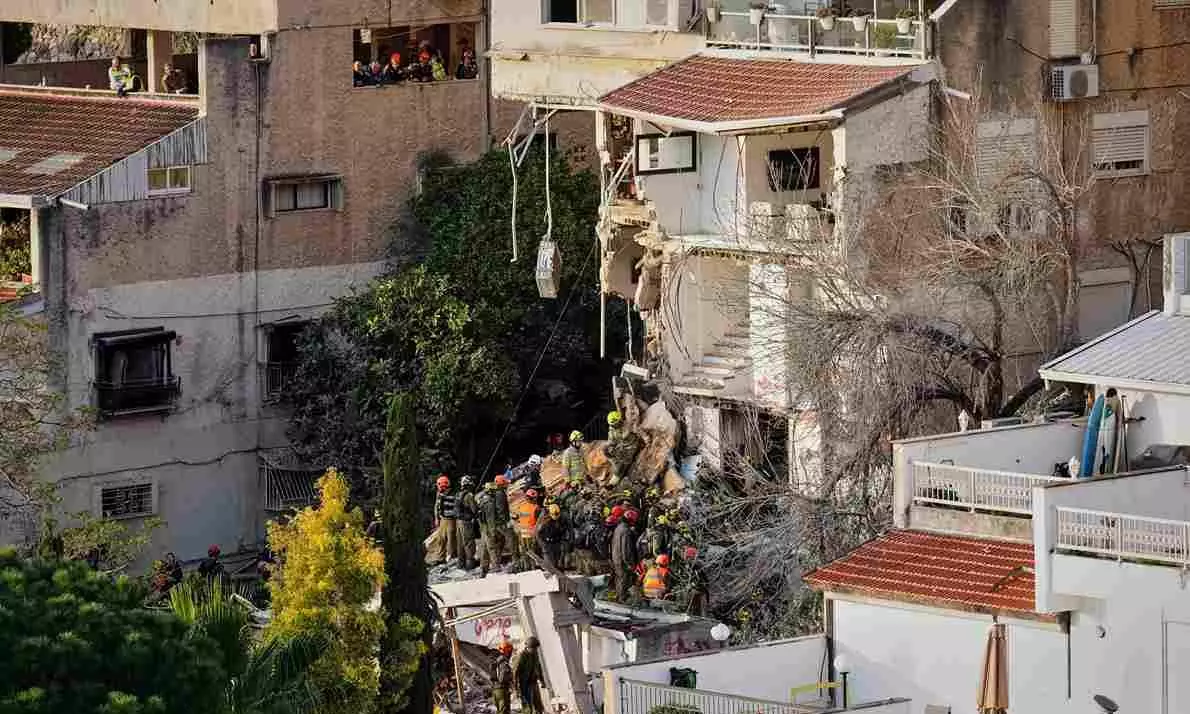
Israeli rescue teams search for missing people amid the rubble of a residential building a day after it was struck by an Iranian missile in Haifa, Israel, Monday, April 6, 2026. Photo: AP/PTI
Israel isn’t just responding to threats – it’s reshaping Middle East
Jerusalem’s new doctrine is a proactive one as it seeks to dismantle neighbour states, fuel regional rivalries to ensure no rival power can ever truly stabilise

Discussions about Israel’s role in the Middle East still revolve around threats and responses. Yet recent developments suggest that Israel isn’t only reacting to events, but is increasingly shaping the conditions in which they occur.
This involves both direct interventions that affect the security and cohesion of neighbouring states — as seen in its policies on Syria and Iran — and the cultivation of regional relationships that sustain ongoing tension.
Understanding how these two dynamics interact is key to making sense of the region’s current trajectory. They’re distinct but interconnected. Together, they expand Israel’s room to manoeuvre and redefine its regional position.
What’s emerging is a more assertive approach to regional order in the Middle East, combining the use of force, selective military interventions, security partnerships and the management of surrounding political conditions.
Weak, fragmented states
This approach is most visible in Gaza, Lebanon, Syria and now Iran. Military operations increasingly extend beyond immediate tactical goals, contributing to the erosion of governance capacity, infrastructure and territorial cohesion.
The objective is not only deterrence, but the creation of political environments where state authority remains weak, fragmented and unable to consolidate.
Also read: Iran war tests India’s strategic autonomy as it walks a diplomatic tightrope
This logic is not always tied to imminent threats. It reflects a broader preference for environments in which adversaries — actual or potential — remain divided and constrained.
These developments are happening in a changing international environment, particularly Israel’s current relationship with the United States, which grants greater operational autonomy and lowers the political costs of unilateral action.
Regional fragmentation
A second part of this strategy works at the regional level by maintaining divisions and tensions. This is especially visible in the Eastern Mediterranean.
Israel’s deepening partnerships with Greece and the Republic of Cyprus are evolving into an alliance: an integrated security framework based on shared technologies, intelligence co-operation, joint exercises and converging strategic interests.
Greece’s acquisition of Israeli defence systems — in areas such as air defence, surveillance and drone warfare — makes it easier for its forces to work together, and connects Israel more closely to the region’s security system.
This relationship doesn’t just reflect shared interests; it actively shapes the strategic environment.
Israeli officials have increasingly portrayed Turkiye as a future challenger, suggesting it will become a major concern following the Iran war.
That means Israeli co-operation with Greece and Cyprus encourages them to adopt a more assertive stance in disputes with Turkiye over maritime boundaries, energy exploration and airspace. From one perspective, this is standard defence co-operation among aligned partners. From Turkiye’s perspective, however, it looks like a wider effort by potentially hostile neighbours to surround it.
Also read: A crumbling Iran could turn out more dangerous
But these partnerships don’t need open conflict to work. Israel’s goal isn’t necessarily to fight Turkiye, but to position itself in a region where tensions remain constant.
Examples from further afield
This regional approach supports the internal dynamics described earlier. Weakening states limit adversaries from within, while regional divisions limit them from the outside by preventing stable alliances.
A comparable pattern can be observed in the Horn of Africa. Israel’s recognition of Somaliland as an independent state introduces a new political entity in a strategically sensitive area near the Bab el-Mandeb Strait. The waterway separates the Arabian Peninsula from Africa and leads to the Red Sea and the Suez Canal.
This move overlaps with Turkish influence in Somalia, where the Turks have built close ties and taken on a major role in providing military and naval security. But Somaliland is a breakaway region, not an internationally recognised state. Israel’s recognition risks creating new tensions along the Somali coast, complicating the maritime space Turkiye is helping to secure.
Also read: Iran war: Trump lit the fire, now wants the world to help extinguish it
As in the eastern Mediterranean, the aim isn’t direct confrontation, but insertion into a complex regional landscape that adds new forces to the mix, diversifies alignments and complicates the consolidation of rival influence.
Israel’s new security doctrine?
Israel’s security doctrine has deep historical roots, including traditions that emphasise force, strategic autonomy and coercive capacity over negotiated order.
Under Prime Minister Benjamin Netanyahu, these ideas have been further developed, radicalised, and put into action.
This is making the international environment inherently unstable and persistently hostile. Peace is not a durable end state, but a temporary and reversible condition. As a result, power — including the use of force — is treated not as a means to an end, but as the primary and only guarantee of survival.
By weakening states and keeping the Middle East and the eastern Mediterranean region divided, Israel is creating a situation where neither country nor alliances can fully stabilise. With this approach, the Israeli advantage comes from managing or manipulating ongoing tensions — not resolving them.
(The Conversation)