



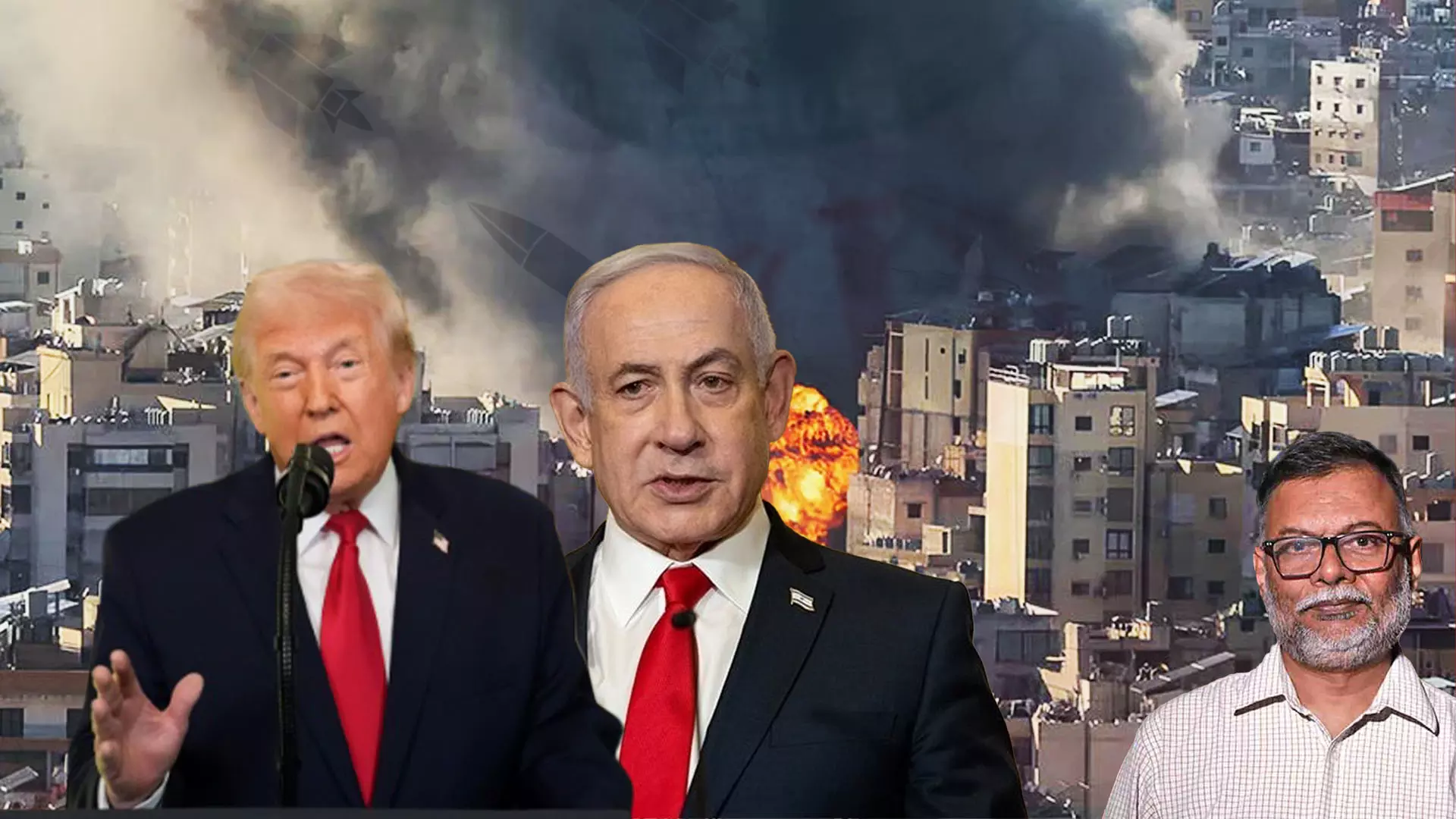
Trump claims ‘victory’ but no regime change in Iran; so who’s winning this war?
Trump’s tenure is limited but Iran as a state will endure; it may be a short-term setback for Iran, but the war won’t produce a decisive outcome in the long run

As the United States signals it is close to achieving its objectives in Iran, the conflict is increasingly revealing a deeper reality—military strikes may not translate into lasting strategic gains. With competing claims of victory from all sides, the question of who is actually winning remains unresolved. The Federal spoke to consulting editor KS Dakshina Murthy to unpack who is gaining—and at what cost—in the Iran war. Edited excerpts:
In a war where both sides claim success, how should we define “winning”? Is it military dominance, regime change, or survival?
In a conventional war, if one country occupies another’s territory and the other pushes it back, that is a clear win. That is what happened during the Iran-Iraq war in 1980, when Iraq tried to encroach upon Iranian territory and Iran eventually pushed them back. Similarly, when Iraq invaded Kuwait and was pushed back, that too was clearly a win.
But in the current war, where the US and Israel are attacking Iran, what constitutes a win is very unclear because the motive itself was unclear. Before the conflict began, the US was negotiating with Iran to open up its nuclear programme for international inspection and to transfer enriched uranium under supervision, similar to what was achieved in 2015.
Also read: Trump’s speech ‘misleading’, ‘lacks clarity’; where is Iran war headed? | Capital Beat
However, once the attacks began, the US objective shifted to demolishing Iran’s nuclear capabilities, neutralising its ballistic missile programme, and ensuring Iran never becomes a nuclear power. To some extent, the US has succeeded in damaging key nuclear facilities.
But Israel’s objective was different—it wanted regime change in Iran, given the long-standing hostility since the Iranian revolution. That has not happened. Though top leaders were assassinated, the new leadership has taken the same position, refusing negotiations.
So, on the question of regime change, Iran has held its ground. Even though it has suffered damage, it continues to resist. In that sense, Iran has not lost.
Has the US-Israel campaign failed to turn tactical gains into strategic victory?
What we are seeing is that even if Iran has suffered damage, it can rebuild over time. It has the technology, the people, and support from other countries. This is not a permanent setback.
On the other hand, political leadership in the US is temporary. Donald Trump’s tenure is limited, but Iran as a state will endure. It will bide its time and recover.
Also read: US-Iran ceasefire talks linked to Strait of Hormuz reopening: Report
So, even if this is a short-term setback for Iran, in the long run, the strategy of bombing Iran does not make much sense. It will not produce a decisive outcome.
Does the lack of a clear US endgame signal strategic confusion?
The US, particularly under Donald Trump, does not seem to have a clear strategy. The assumption was that Iran would quickly buckle under pressure and come to the negotiating table. That has not happened.
Trump has repeatedly claimed that Iran is seeking a ceasefire or that negotiations are underway, but Iran has categorically denied this. There is no direct communication between the two sides—only intermediaries like Pakistan, Turkey, and Egypt.
This shows confusion. The US and Israel do not know how to end the conflict because neither side wants to appear as the loser. Iran is not giving that opportunity to the US, and that has left Washington struggling.
This is why we see inconsistent statements—from ending the war quickly to threatening massive escalation. It reflects a lack of clarity and direction.
Who is actually benefiting from the geopolitical fallout of this war?
One of the biggest outcomes is that the US has lost credibility among its own allies. European countries like Britain, France, Italy, and Spain have refused to support the war and have even denied the US access to their bases.
When the Strait of Hormuz issue escalated, the US sought help from NATO allies, but they refused. This is a major diplomatic setback.
Also read: UK-led coalition of over 35 nations to explore reopening of Strait of Hormuz
In contrast, Iran has gained sympathy globally. There is a perception that the war lacks justification. Moreover, Iran is an ancient civilisation, and the destruction of its cultural heritage has drawn global concern.
So, diplomatically and morally, Iran has gained, while the US has lost ground.
Where does India stand in this conflict, and can it continue balancing ties?
India has traditionally maintained a balancing approach, keeping ties with the US, Israel, and Iran. But this has also made its position somewhat ambiguous.
India has significant stakes in West Asia, including millions of workers and long-term relationships with multiple countries. So, it cannot easily take sides.
So far, the government has avoided a clear stance. It has neither criticised the US and Israel nor openly supported Iran. At a practical level, India has helped Iran—for example, assisting ships—and Iran has reciprocated.
Also read: Iran war: IRGC threatens 18 US tech, infra companies; fully prepared, says US
However, if the situation intensifies, India may be forced to take a position. It cannot remain silent indefinitely.
India also missed an opportunity to act as a mediator, which could have enhanced its global standing. Instead, countries like Pakistan have stepped into that space.
So, India’s current approach may not hold if the conflict deepens.
(The content above has been transcribed from video using a fine-tuned AI model. To ensure accuracy, quality, and editorial integrity, we employ a Human-In-The-Loop (HITL) process. While AI assists in creating the initial draft, our experienced editorial team carefully reviews, edits, and refines the content before publication. At The Federal, we combine the efficiency of AI with the expertise of human editors to deliver reliable and insightful journalism.)


