



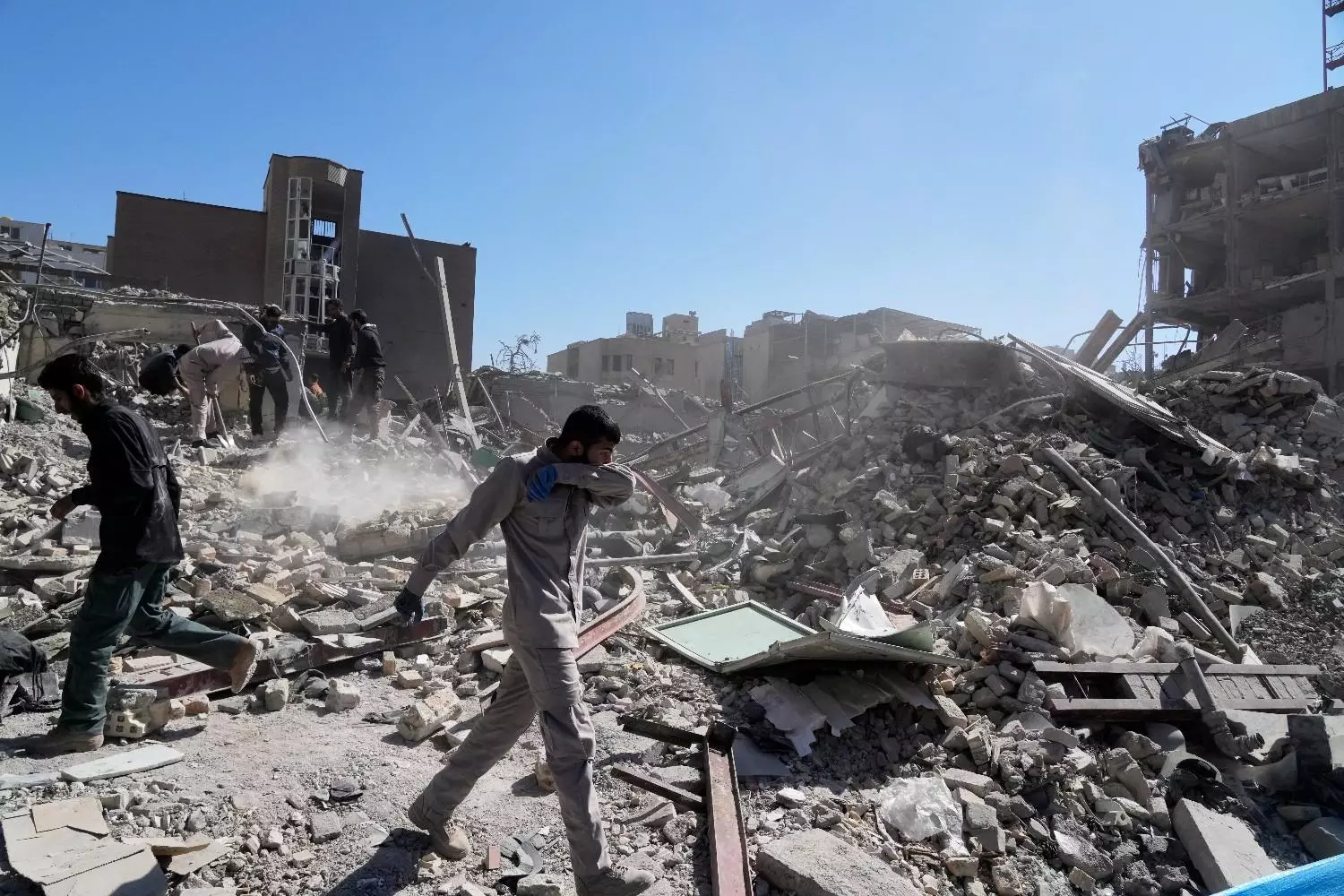
A group of men inspects the ruins of a police station struck Monday amid the US-Israeli military campaign in Tehran, Iran, Tuesday, March 3. AP/PTI
Where do major nations stand with Trump-Netanyahu on Iran?
Starmer on Monday (March 2) defended his decision not to join the US-Israel strikes on Iran over the weekend, saying his Labour Party government did not believe in “regime change from the skies”

As the United States and Israel launched a sweeping military campaign against Iran's nuclear infrastructure, the world's major powers scrambled to define their positions.
While Washington's closest allies — including the UK, France, Germany, and Canada — broadly backed the strategic objective of preventing Iranian nuclear proliferation, none joined the military operation.
Also read: 'No sovereign nation will accept what US, Israel are dictating to Iran'
Europe walked a careful diplomatic tightrope: condemning Iran's retaliatory strikes across the Gulf while calling for restraint and a return to negotiations. Canada echoed similar sentiments from afar.
How have countries reacted to the US-Israel attack on Iran?
United Kingdom
British Prime Minister Keir Starmer chaired a meeting of the government's emergency COBRA committee as the country weighed its response to the attacks and Iran's retaliation across the Gulf.
The UK did not participate in the military action, but deployed RAF Typhoons to Qatar to protect the Al-Udeid airbase and allied bases across the region. The UK government stated it "does not want to see further escalation into a wider regional conflict," while emphasising that "Iran must never be allowed to develop a nuclear weapon."
Also read: How Iran war will stoke inflation, even if oil supplies do not dry up
The UK has criticised Iranian attacks on civilian locations in Bahrain, Kuwait and the UAE. The Prime Minister spoke to leaders in Bahrain, Kuwait, Jordan, Oman, the UAE and Qatar.
Starmer on Monday (March 2) defended his decision not to join the US-Israel strikes on Iran over the weekend, saying his Labour Party government did not believe in “regime change from the skies”.
Starmer was updating Parliament on his earlier announcement that the UK had granted permission for the Americans to use British bases for "limited defensive purpose” in West Asia.
His statement to MPs in the House of Commons came after US President Donald Trump said he was “very disappointed” that the UK PM took “far too long” to change his mind over the use of British bases.
Also read: Limited UAE-India flights resume amid Iran war
“This government does not believe in regime change from the skies,” Starmer told the Commons.
“The United Kingdom was not involved in the initial strikes on Iran by the US and Israel. That decision was deliberate. We believe that the best way forward for the region and for the world is a negotiated settlement in which Iran agrees to give up any aspirations to develop a nuclear weapon and ceases its destabilising activity across the region.
“That has been the long-standing position of successive British governments. President Trump has expressed his disagreement with our decision not to get involved in the initial strikes, but it is my duty to judge what is in Britain’s national interest. That is what I’ve done, and I stand by it,” he said.
France
French President Emmanuel Macron described the strikes as an "outbreak of war" that "carries serious consequences for international peace and security," and called for an urgent meeting of the United Nations Security Council (UNSC).
Macron urged Iran's regime to "enter into good-faith negotiations" to bring an end to its nuclear and ballistic programmes, calling it "absolutely essential for the security of everyone in the Middle East."
Later, France's Foreign Minister Jean-Noel Barrot stated that France is "ready" to defend Gulf countries and Jordan against Iran if necessary, expressing "full support and complete solidarity" with Saudi Arabia, the UAE, Qatar, Iraq, Bahrain, Kuwait, Oman, and Jordan.
Germany
Germany held its own emergency security meeting to discuss the situation.
German Foreign Minister Wadephul stated that the German government does not intend to participate offensively in the US-Israeli campaign against Iran, saying: "We do not have the corresponding military resources, and the German government definitely has no intention of participating in any way."
However, Germany also signalled readiness to protect its own personnel: Iran's attacks hit a German army camp in the east of Jordan, though there were no casualties reported.
Joint Statement by UK, France & Germany
Hours after the US and Israel launched strikes on Iran, Germany, France, and Britain issued a joint statement condemning Iran for hitting countries across the Middle East. The three leaders said: "We condemn Iranian attacks on countries in the region in the strongest terms," and called for Iran to refrain from indiscriminate strikes while demanding a resumption of negotiations.
British PM Starmer, French President Macron, and German Chancellor Friedrich Merz confirmed their countries did not take part in the strikes on Iran but are in close contact with the US, Israel, and partners in the region.
By Sunday (March 1), the three went further: France, Germany, and the UK said they were ready to defend their interests and those of their allies in the Gulf if necessary through "defensive action" against Iran. They were "appalled by the indiscriminate and disproportionate missile attacks launched by Iran against countries in the region, including those who were not involved in initial US and Israeli military operations."
European Union (EU)
A joint statement by the European Commission and the EU Council called the developments in Iran "greatly concerning" and reaffirmed the EU's "steadfast commitment to safeguarding regional security and stability." The EU urged "maximum restraint" from all sides. EU foreign policy chief Kaja Kallas called the conflict "perilous" and said she was working with Israeli and Arab officials to pursue a negotiated peace, while noting that Iran's ballistic missile and nuclear programs "pose a serious threat to global security."
Spain
The Spanish government was the only European government to condemn the initial US-Israel attack. Spain's Prime Minister Pedro Sánchez said Madrid rejected "the unilateral military action by the United States and Israel, which represents an escalation and contributes to a more uncertain and hostile international order," while also rejecting the actions of the Iranian regime.
Spain has also refused to allow the US use its military bases to attack Iran. “Based on all the information I have, the bases are not being used for this military operation,” Foreign Minister Jose Manuel Albares told Spanish public television on Monday, according to a report in Al Jazeera.
“The Spanish government will not authorise the use of the bases for anything beyond the agreement or inconsistent with the United Nations,” Albares said, referring to the Rota naval base and the Moron airbase, the report added.
Canada
Canada's official stance was laid out clearly by Prime Minister Mark Carney and Foreign Minister Anita Anand: "Canada's position remains clear: the Islamic Republic of Iran is the principal source of instability and terror throughout the Middle East, has one of the world's worst human rights records, and must never be allowed to obtain or develop nuclear weapons."
Carney backed the US and Israeli strikes but ruled out any Canadian military participation, stating: "We have not been party to the military buildup to this, or the military planning of this."
Canada reaffirmed Israel's right to defend itself and explicitly supported the United States in its mission to prevent Iran from acquiring nuclear weapons. Canada also urged the protection of all civilians in the conflict.
China
China appears guarded in its reaction to the assassination of Iran's Supreme Leader Ayatollah Ali Khamenei, as US President Donald Trump is due to visit Beijing on March 31. Iran enjoys close ties with China.
Chinese Foreign Ministry spokesperson Mao Ning reiterated China’s firm opposition to the use of force in international relations or infringement on other countries’ sovereignty and security.
The priority now is to immediately halt military operations and prevent the spread and spillover of the conflict. China stands ready to work with the international community to call for peace and stop the conflict, resolve issues through dialogue and negotiations, and maintain peace and stability in the Middle East and the world at large, she said.