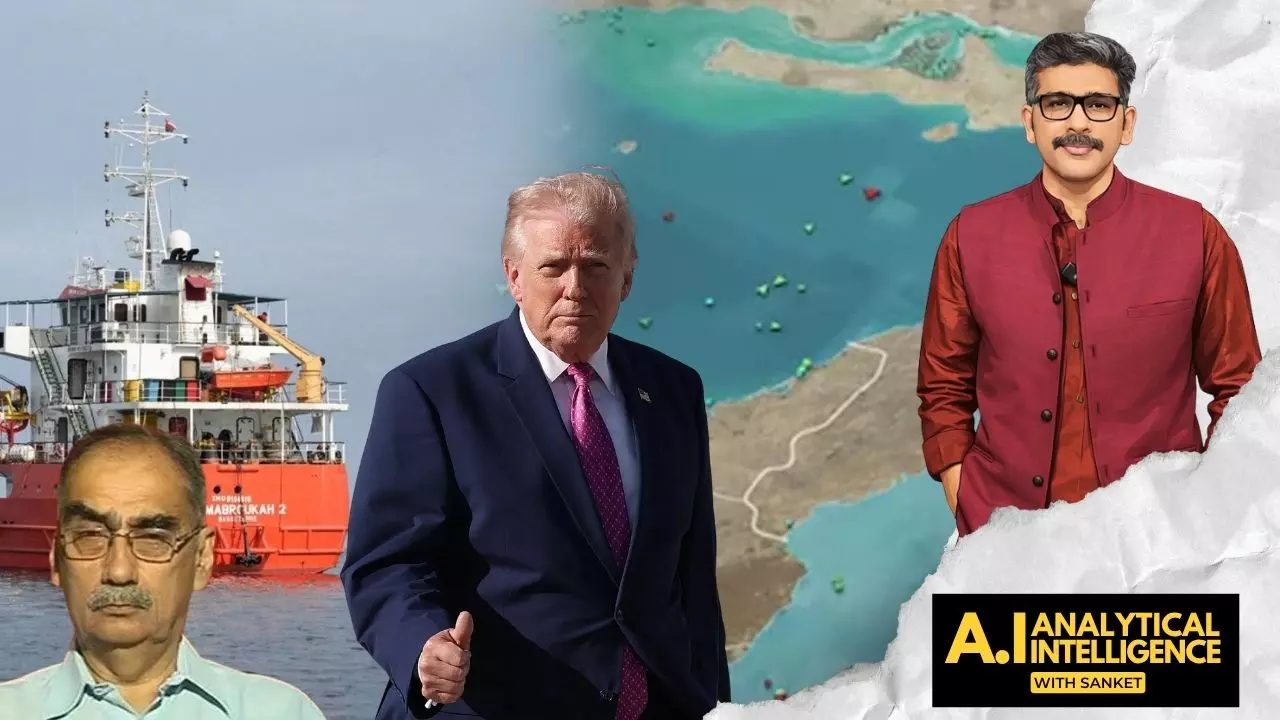
With both Iran and the United States tightening control over a critical global trade artery, the risks of economic disruption and military escalation are rising sharply.
Hormuz blockade could trigger global crisis, warns Vivek Katju
The former diplomat explains the fragile ceasefire, Pakistan’s intermediary role, and why the next 72–96 hours could shape the conflict’s trajectory

As tensions escalate over blockades in the Strait of Hormuz, former diplomat Vivek Katju warns that choking off 20 per cent of the world’s hydrocarbons could turn the conflict into a truly global war. With both Iran and the United States tightening control over a critical global trade artery, the risks of economic disruption and military escalation are rising sharply.
The Federal spoke to Vivek Katju, former Indian Foreign Service officer, on the fragile ceasefire, Pakistan’s intermediary role, and why the next 72 to 96 hours could be critical for the region and beyond.
What is your assessment of Pakistan’s role as an intermediary, especially after the inconclusive talks?
Look, I have negotiated a lot with the Pakistanis, and I have also done some negotiations with the Iranians. On Pakistan acting as an intermediary, we have to look at facts objectively. We have a certain view of Pakistan, and we are perfectly right in having that view - I share it. Their record of involvement in violence in India is deplorable and unforgivable from our perspective.
Also read: Trump’s Hormuz blockade: 'A complicated war is getting more complicated'
But diplomacy teaches you that how we look at a country is not necessarily how others do. Every country is guided by its own interests and experiences. So, when you say the talks have failed, I would refer to the diplomatic terminology — no agreement was reached, and doors have been kept open for further negotiations.
Yes, Pakistan would have fervently wanted a memorandum of understanding to emerge from these 21-hour talks. They must have been devastated that it did not happen. But that does not mean their intermediary role has ended. It could well happen again; we simply don’t know yet.
How do you see the current ceasefire and the broader trajectory of the conflict?
At the moment, the ceasefire is holding, and I think it has been around 36 hours since it was announced. That is significant. Both the Americans and the Iranians have not indicated that it will break, at least for now.
But it remains fragile, and that is the correct term to use. Both sides have also indicated their points of difference. From the American side, there is no accommodation on the nuclear issue. They have made it absolutely clear that they do not want Iran to have a nuclear weapon or even come close to acquiring one. That means no enrichment.
This is not new. The Joint Comprehensive Plan of Action (JCPOA) had addressed it, but when Trump walked away, the issue reopened. On other matters, like reparations or Iran retaining some self-defence capability, there may be room for negotiation. But on nuclear issues, there is no flexibility from the American side.
What does the dual blockade in the Strait of Hormuz mean for global trade and security?
This is a very serious development. The Americans have announced a naval blockade on ships going to and from the Iranian coast. It is supposed to come into operation at a specified time, and we will have to see how it unfolds.
Now, there is some confusion between what Trump has said publicly and what the operational advisory from CENTCOM says. Trump suggested that any ship passing through the Strait of Hormuz or paying tolls to Iran could be blocked. But the CENTCOM advisory specifies that the blockade applies to vessels coming from Iranian ports.
Also read: Strait of Hormuz blockade: ‘Indian friends’ need not worry, says Iran
So, there is ambiguity, and that is why the next 72 to 96 hours are critical. The American aim is clearly to choke off Iran’s hydrocarbon revenues. But how Iran reacts to this will determine the next phase.
If Iran retaliates by targeting Gulf countries, it could escalate dramatically. By controlling the Strait of Hormuz, Iran is already affecting nearly 20 per cent of global hydrocarbons. That makes this conflict qualitatively different; it has the potential to become a truly global crisis.
Could China be drawn into the conflict because of these blockades?
China has so far been relatively unaffected because Iran has allowed its ships to pass. But the American blockade changes that equation.
If China is affected, I expect it to respond, but not through direct military confrontation. That would be extremely inflammatory. China’s style of diplomacy is different — they may respond through economic or political means.
They could postpone high-level engagements, use trade levers, or take positions that hurt American interests indirectly. For instance, issues like rare earth supplies or trade tensions could come into play.
But I don’t think China will directly challenge the United States militarily in this situation.
Is it even feasible for the US to enforce such a large-scale blockade?
Enforcement is only one aspect. The bigger issue is insurance. If insurers are unwilling to cover vessels passing through the region, then shipping effectively stops.
We saw similar dynamics in the past - once risks rise, commercial traffic dries up. So, even without strict enforcement, the blockade can have a significant impact.
Also read: Iran signals possible Bab el-Mandeb blockade amid Strait of Hormuz disruption
The Chinese, Russians, and others may condemn the move, but whether they will physically challenge it is another matter. Based on past examples, they are unlikely to do so.
What are the risks of further escalation, especially for the Gulf region and India?
The biggest risk is that this turns into a wider regional conflict. If Iran is pushed too far, it may retaliate by targeting Gulf countries, places like the UAE, Qatar, or Bahrain.
That would be a nightmare scenario. Not just because of energy supplies, but also because of the large number of expatriates. There are close to a crore Indians in the region, and if you include other South Asians, the number exceeds two crore.
If critical infrastructure like desalination plants is hit, the humanitarian consequences would be severe. The world can ill afford such a scenario.
Do you think the ceasefire will hold, or are we heading toward escalation?
At the moment, the ceasefire is holding, and both sides have not indicated otherwise. But the situation is extremely delicate.
There are actors who may not want the ceasefire to hold. If another round of attacks begins, it could involve strikes on infrastructure, energy facilities, or even civilian areas.
Also read: The Tehran 'toll booth'? Iran eyes to cash in on Strait of Hormuz disruption
The question then is — will Iran surrender under pressure? I think the chances are that it will not. Instead, it may retaliate, leading to further escalation.
So, we are at a very uncertain moment. The next few days will be crucial in determining whether diplomacy prevails or whether the situation spirals into something much more dangerous.
The content above has been transcribed from video using a fine-tuned AI model. To ensure accuracy, quality, and editorial integrity, we employ a Human-In-The-Loop (HITL) process. While AI assists in creating the initial draft, our experienced editorial team carefully reviews, edits, and refines the content before publication. At The Federal, we combine the efficiency of AI with the expertise of human editors to deliver reliable and insightful journalism.