



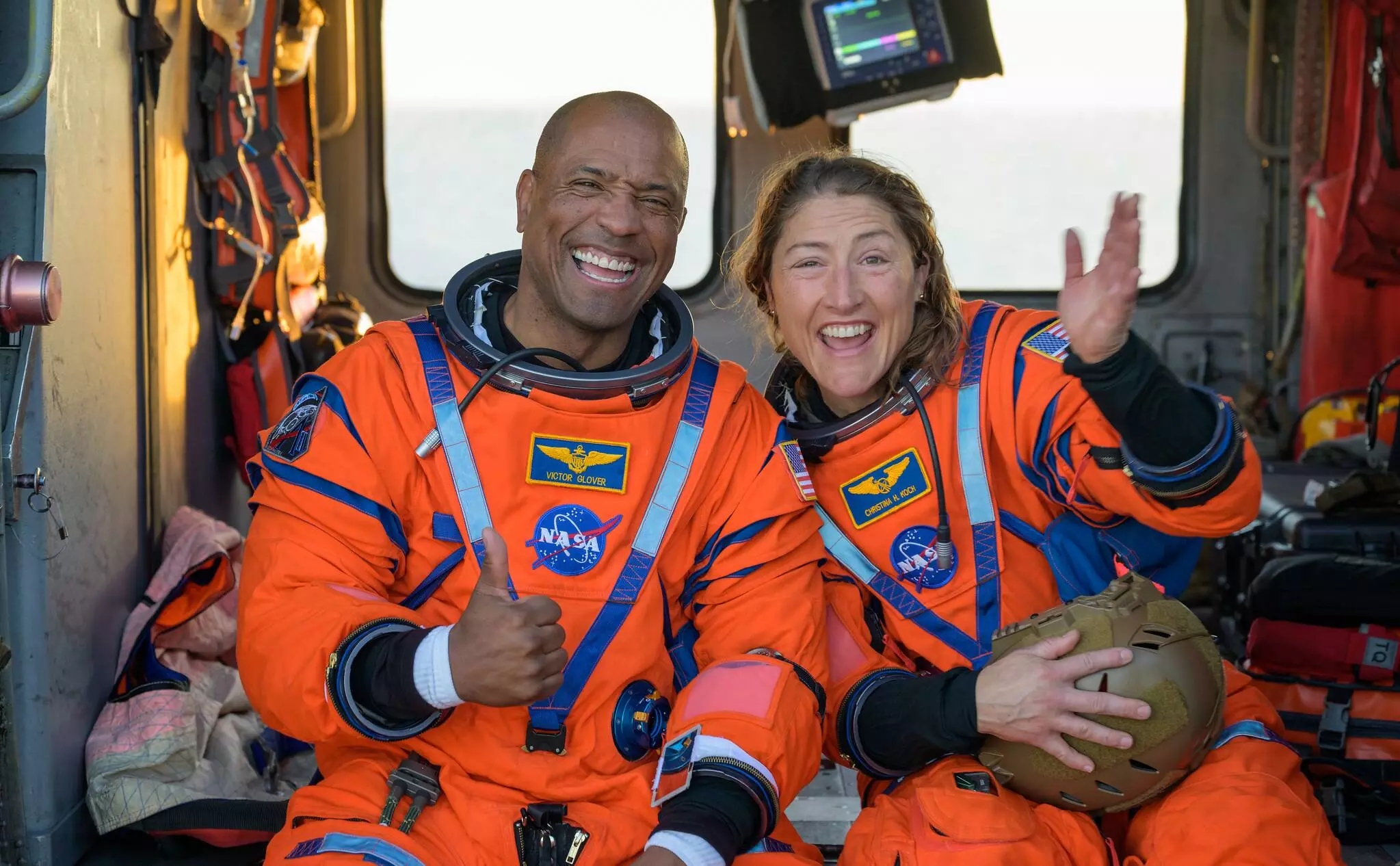
The Artemis II astronauts in jovial mood on the flight deck of USS John P. Murtha after splashdown. Photo: @NASAArtemis
From toilet glitch to Outlook error: 10 memorable moments of Artemis II mission
Artemis II mission ends with a successful splashdown in the Pacific Ocean. Here are 10 key moments, including glitches and milestones

The 10-day-long Artemis II mission ended with all four astronauts safely returning to Earth onboard the Orion spacecraft, making a perfect “splashdown” in the Pacific Ocean about 40 to 50 miles off the coast of San Diego on Friday (April 10). But the mission was not uneventful in any way.
Ranging from a malfunctioning toilet fan to a Microsoft Outlook glitch on an onboard computer, the mission had been a roller-coaster experience for both the crew members and ground control officials at NASA. Here are 10 memorable moments of the Artemis II mission:
1. Launch and mission start
Artemis II lifted off as part of NASA’s broader plan to return humans to the Moon. The agency described the mission as “a critical step forward” in preparing for future lunar landings.
Also Read: Artemis II astronauts return from moon after historic 10-day mission
Unlike earlier uncrewed tests, this mission placed astronauts onboard Orion to evaluate how systems perform with a crew during deep-space travel. The launch marked the beginning of a multi-day flight designed to test navigation, life-support systems, and communication beyond low Earth orbit under real mission conditions.
2. Moving away from Earth
After reaching space, the spacecraft began its journey away from Earth. The crew captured images showing the planet gradually becoming smaller in the distance. This phase confirmed that Orion was on the correct trajectory.
It also provided an early opportunity to monitor onboard systems in deep space. The visual change was steady rather than sudden, as Earth shifted from filling the view to appearing as a smaller object against space, marking the transition from Earth orbit to a longer outbound path.
3. Initial system checks
During the early part of the mission, astronauts carried out standard system checks. These included verifying navigation, communication, and environmental controls.
Also Read: Artemis II astronauts prepare for ‘fireball’ return as lunar mission nears splashdown
Some minor irregularities were observed, requiring coordination between the crew and mission control. These issues were resolved without affecting the mission timeline. Early checks are a critical part of any spaceflight, especially for missions beyond low Earth orbit, as they confirm that all systems are functioning correctly before the spacecraft travels farther from immediate support.
4. Waste system issue onboard
A problem developed in the spacecraft’s waste management system, specifically involving a toilet fan. The malfunction did not pose a safety risk but required attention from the crew, reported the Business Insider.
The issue was addressed and managed during the mission. Incidents like this highlight how even small onboard systems are important in a closed environment, where equipment must function reliably over several days without the possibility of quick replacement or repair from external support.
5. Software glitch during flight
At one point, an onboard computer experienced a glitch linked to Microsoft Outlook, briefly affecting scheduling functions.
The issue disrupted routine operations for a short period before being fixed. While not critical, it showed that software systems can still encounter familiar problems even in spaceflight conditions.
The crew and ground teams were able to resolve it quickly, ensuring that mission activities continued as planned without significant delays.
6. Communication blackout behind the Moon
As Orion travelled behind the Moon, communication with Earth was temporarily lost. NASA described this as “a planned communications blackout.”
This phase is expected in lunar missions because the Moon blocks direct signals. During this time, the spacecraft continued operating independently.
Once Orion moved back into range, communication was restored. The blackout is a standard part of such missions but remains an important test of onboard autonomy and system reliability.
7. Views of the lunar surface
After passing the far side of the Moon, Orion transmitted images showing detailed views of the lunar surface. The pictures highlighted craters, ridges, and variations in terrain.
Also Read: Artemis II photo essay: In the shadow of the Moon
These visuals confirmed the spacecraft’s proximity to the Moon and provided useful observational data. While similar images have been captured before, this mission marked a return to crewed observation of the Moon, adding operational and visual confirmation of the spacecraft’s performance near lunar distance.
8. Manual control by astronauts
Although most of the mission relied on automated systems, astronauts conducted periods of manual control. These tests were carried out to evaluate how the spacecraft responds to human input in deep space.
The exercises were completed successfully and provided additional data on handling and control. Maintaining the ability for astronauts to take control when needed remains an important part of mission design, especially for future operations that may require quick decisions.
The Artemis II astronauts on the flight deck of USS John P. Murtha after they were extracted from the Orion spacecraft. Photo: @NASAArtemis
9. Return trajectory adjustments
On the return journey to Earth, Orion performed a series of planned trajectory corrections. NASA stated these were “executed as planned,” ensuring the spacecraft remained on course for re-entry.
These adjustments are necessary to maintain accuracy over long distances. Even small deviations can affect the final approach, so continuous monitoring and correction are required to guide the spacecraft safely back to Earth.
Artemis II astronauts on the flight deck of USS John P. Murtha after they were extracted from the Orion spacecraft. Photo: @NASAArtemis
10. Re-entry and splashdown
The mission concluded with Orion re-entering Earth’s atmosphere and landing in the Pacific Ocean. Recovery teams were in place to retrieve the crew and spacecraft.
NASA called it “a successful conclusion to a mission that will inform future Artemis flights.” The splashdown marked the end of the mission and the start of analysis, as data collected during the flight will be used to support upcoming lunar missions.
Artemis II combined planned operations with minor technical issues, providing valuable data on how systems and crews perform during deep-space missions.